
Penny Dreadfuls, 1858 · page 17 of 400
The Young Duchess; or, Memoirs of a Lady of Quality — page 17: what you’re looking at
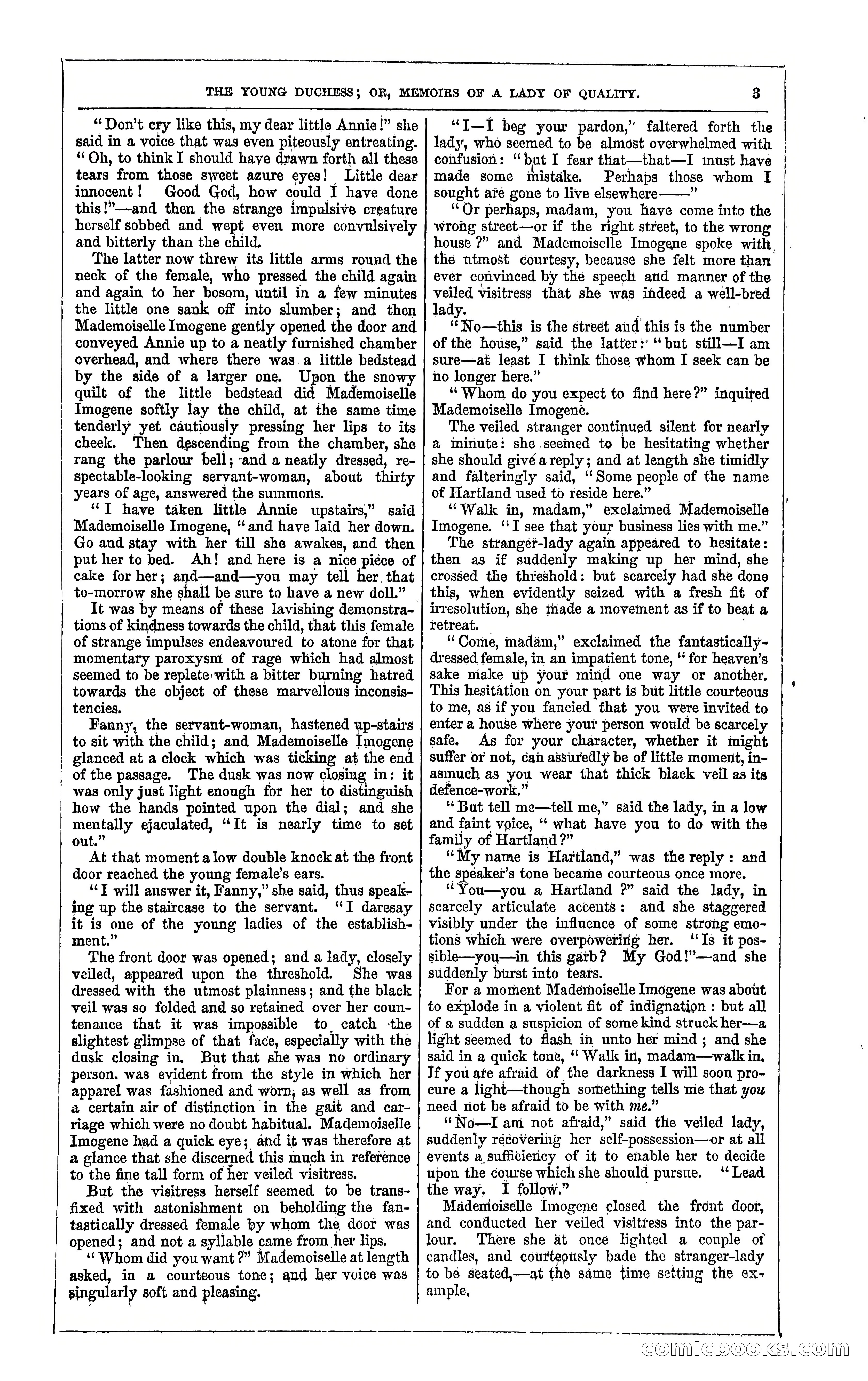
A restored page from Penny Dreadfuls, 1858. Page through the whole issue in the reader above.
📄 Transcribed text from this page (OCR, searchable)
Machine-transcribed from the original scan — historical spelling and the odd misread are preserved.
i a a a a eer 2 Pee me pint THE YOUNG DUCHESS; OR, MEMOIRS OF A LADY OF QUALITY. 3 “Don't ery like this, my dear little Annie!” she said in a voice that was even piteously entreating. “Oh, to think I should haye drawn forth all these tears from those sweet azure eyes! Little dear innocent! Good God, how could I have done this !”—and then the strange impulsive creature herself sobbed and wept even more convulsively and bitterly than the child, The latter now threw its little arms round the neck of the female, who pressed the child again and again to her bosom, until in a few minutes the little one sank off into slumber; and then Mademoiselle Imogene gently opened the door and conveyed Annie up to a neatly furnished chamber overhead, and where there was.a little bedstead by the side of a larger one. Upon the snowy quilt of the little bedstead did Mademoiselle Imogene softly lay the child, at the same time tenderly yet cautiously pressing her lips to its cheek. Then descending from the chamber, she rang the parlour bell; -and a neatly dressed, re- spectable-looking servant-woman, about thirty years of age, answered the summons. “T have taken little Annie upstairs,” said Mademoiselle Imogene, ‘and have laid her down. Go and stay with her till she awakes, and then put her to bed. Ah! and here is a nice piéce of cake for her; and—and—you may tell her, that to-morrow she shall be sure to have a new doll.” _ It was by means of these lavishing demonstra- tions of kindness towards the child, that this female of strange impulses endeavoured to atone for that momentary paroxysm of rage which had almost seemed to be replete with a bitter burning hatred towards the object of these marvellous inconsis- tencies. Fanny, the servant-woman, hastened up-stairs to sit with the child; and Mademoiselle Imogen glanced at a clock which was ticking at the en of the passage. The dusk was now closing in: it was only just light enough for her to distinguish how the hands pointed upon the dial; and she mentally ejaculated, ‘It is nearly time to set out.” At that moment alow double knock at the front door reached the young female’s ears. ‘J will answer it, Fanny,” she said, thus speak- ing up the staircase to the servant. ‘I daresa it is one of the young ladies of the establish- ment.” The front door was opened; and a lady, closely veiled, appeared upon the threshold. She was dressed with the utmost plainness; and the black veil was so folded and so retained over her coun- tenance that it was impossible to catch -the slightest glimpse of that face, especially with the dusk closing in. But that she was no ordinary person. was evident from the style in which her apparel was fashioned and worn, as well as from a certain air of distinction in the gait and car- riage which were no doubt habitual. Mademoiselle Imogene had a quick eye; and if was therefore at a glance that she discerned this much in reference to the fine tall form of her veiled visitress. But the visitress herself seemed to be trans- fixed with astonishment on beholding the fan- tastically dressed female by whom the door was opened; and not a syllable came from her lips, “ Whom did you want?” Mademoiselle at length asked, in a courteous tone; and her voice was singularly soft and pleasing. “I—I beg your pardon,” faltered forth the lady, who seemed to be almost overwhelmed with confusion: “but I fear that—that—I must have made some mistake. Perhaps those whom I sought are gone to live elsewhere——” “Or perhaps, madam, you have come into the LS cP yr wrong street—or if the right street, to the wrong | house ?” and Mademoiselle Imogene spoke with. the utmost courtesy, because she felt more than ever convinced by the speech and manner of the veiled visitress that she was indeed a well-bred lady. | “‘No—this is the street and this is the number of the house,” said the latter: “but still—I am sure—at least I think those whom I seek can be no longer here.” “Whom do you expect to find here?” inquired Mademoiselle Imogene. The veiled stranger continued silent for nearly a minute: she seemed to be hesitating whether she should givéareply; and at length she timidly and falteringly said, ‘‘Some people of the name of Hartland used to reside here.” “Walk in, madam,” exclaimed Mademoiselle Imogene. ‘I see that your business lies with me.” The stranger-lady again appeared to hesitate: then as if suddenly making up her mind, she crossed the threshold: but scarcely had she done this, when evidently seized with a fresh fit of irresolution, she iiade a movement as if to beat a fetreat. — “Come, madam,” exclaimed the fantastically- dressed female, in an impatient tone, “for heaven’s sake make up yout mind one way or another. This hesitation on your part is but little courteous to me, as if you fancied that you were invited to enter a house where your person would be scarcely safe. As for your character, whether it might suffer or not, can assuredly be of little moment, in- asmuch as you wear that thick black veil as its defence-work.” “But tell me—tell me,” said the lady, in a low and faint voice, “‘ what have you to do with the family of Hartland?” . “My name is Hartland,” was the reply: and the spéaker’s tone became courteous once more. “'You—you a Hartland ?” said the lady, in scarcely articulate accents: and she staggered visibly under the influence of some strong emo- tions which were overpowering her. ‘Is it pos- sible—you—in this gatb? My God!”—and she suddenly burst into tears. For a moment Mademoiselle Imogene was about to expldde in a violent fit of indignation : but all of a sudden a suspicion of some kind struck her—a light seemed to flash in unto her mind; and she said in a quick tone, ‘“ Walk in, madam—walk in. If you afe afraid of the darkness I will soon pro- eure a light—though something tells mie that you need riot be afraid to be with me.” “No—I ami not afraid,” said the veiled lady, suddenly récovering her self-possession—or at all events a sufficiency of it to enable her to decide upon the course which she should pursue. “ Lead the way. I follow.” Mademoiselle Imogene closed the front door, and conducted her veiled visittess into the par- lour. There she dt once lighted a couple of candles, and courteously bade the stranger-lady to be seated,—at the same time setting the ox~ ample, ~ Eomicbao ee ree SS Colin