
Penny Dreadfuls, 1858 · page 148 of 400
The Young Duchess; or, Memoirs of a Lady of Quality — page 148: what you’re looking at
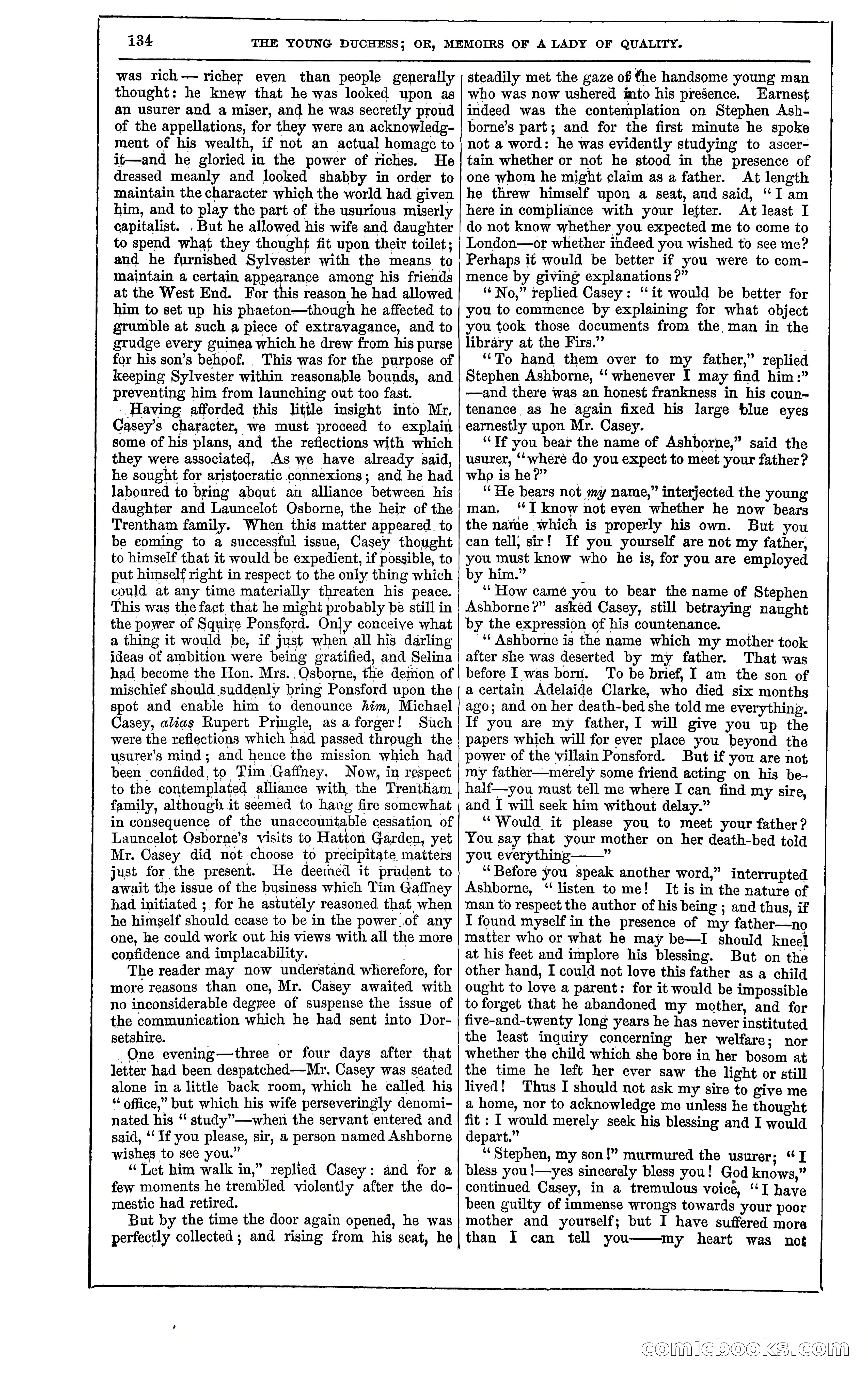
A restored page from Penny Dreadfuls, 1858. Page through the whole issue in the reader above.
📄 Transcribed text from this page (OCR, searchable)
Machine-transcribed from the original scan — historical spelling and the odd misread are preserved.
134 ——————— a rp THE YOUNG DUCHESS; OR, MEMOIRS OF A LADY OF QUALITY. was rich-— richer even than people generally thought: he knew that he was looked upon as an usurer and a miser, and he was secretly proud of the appellations, for they were an.acknowledg- ment of his wealth, if not an actual homage to it—and he gloried in the power of riches. He dressed meanly and looked shabby in order to maintain the character which the world had given him, and to play the part of the usurious miserly capitalist. . But he allowed his wife and daughter to spend what they thought fit upon their toilet; and he furnished Sylvester with the means to maintain a certain appearance among his friends at the West End. For this reason he had allowed him to set up his phaeton—though he affected to grumble at such a piece of extravagance, and to grudge every guinea which he drew from his purse for his son’s behoof. , This was for the purpose of keeping Sylvester within reasonable bounds, and preventing him from launching out too fast. - Having afforded this little insight into Mr, Casey’s character, we must proceed to explain some of his plans, and the reflections with which they were associated, As we have already said, he sought for aristocratic connexions; and he had laboured to bring about an alliance between his daughter and Launcelot Osborne, the heir of the Trentham family. When this matter appeared. to be coming to a successful issue, Casey thought to himself that it would be expedient, if possible, to put himself right in respect to the only thing which could at any time materially threaten his peace. This was the fact that he might probably be still in the power of Squire Ponsford. Only conceive what a thing it would be, if just when all his darling ideas of ambition were being gratified, and Selina had, become the Hon. Mrs. Osborne, the demon of mischief should suddenly bring Ponsford upon the spot and enable him to denounce him, Michael Casey, alias Rupert Pringle, as a forger! Such were the reflections which had passed through the usurer’s mind; and hence the mission which had been confided, to Tim Gaffney. Now, in respect to the contemplated alliance with, the Trentham family, although it seemed to hang fire somewhat in consequence of the unaccountable cessation of Launcelot Osborne’s visits to Hatton Garden, yet Mr. Casey did not choose to precipitate matters just for the present. He deemed it prudent to await the issue of the business which Tim Gaffney had initiated ;, for he astutely reasoned that when he himself should cease to be in the power of any one, he could work out his views with all the more confidence and implacability. | The reader may now understand wherefore, for more reasons than one, Mr. Casey awaited with no inconsiderable degree of suspense the issue of the communication which he had sent into Dor- setshire. . _ One evening—three or four days after that letter had been despatched—Mr. Casey was seated alone in a little back room, which he called his “ office,” but which his wife perseveringly denomi- nated his “‘ study”—when the servant entered and said, ‘If you please, sir, a person named Ashborne wishes to see you.” “Let him walk in,” replied Casey: and for a few moments he trembled violently after the do- mestic had retired. But by the time the door again opened, he was perfectly collected ; and rising from his seat, he steadily met the gaze of the handsome young man who was now ushered imto his presence. Earnest indeed was the contemplation on Stephen Ash- borne’s part; and for the first minute he spoke not a word: he was evidently studying to ascer- tain whether or not he stood in the presence of one whom he might claim as a father. At length he threw himself upon a seat, and said, ‘I am here in compliance with your letter. At least I do not know whether you expected me to come to London—or whether indeed you wished to see me? Perhaps it would be better if you were to com- mence by giving explanations ?” ‘“‘No,” replied Casey: “it would be better for you to commence by explaining for what object you took those documents from the, man in the library at the Firs.” “To hand them over to my father,” replied Stephen Ashborne, ‘‘ whenever I may find him :” —and there was an honest frankness in his coun- tenance, as he again fixed his large blue eyes earnestly upon Mr. Casey. “Tf you bear the name of Ashborne,” said the usurer, ‘‘where do you expect to meet your father? who is he?” “He bears not my name,” interjected the young man. ‘TI know not even whether he now bears the name which is properly his own. But you can tell, sir! If you yourself are not my father, you must know who he is, for you are employed by him.” ; ‘How camé you to bear the name of Stephen Ashborne?” asked Casey, still betraying naught by the expression of his countenance. “ Ashborne is the name which my mother took after she was deserted by my father. That was before I was born. To be brief, I am the son of a certain Adelaide Clarke, who died six months ago; and on her death-bed she told me everything. If you are my father, I will give you up the papers which will for ever place you beyond the power of the villain Ponsford. But if you are not my father—merely some friend acting on his be- half—you must tell me where I can find my sire, and I will seek him without delay.” ‘Would it please you to meet your father? You say that your mother on her death-bed told you everythin: ” ‘Before you speak another word,” interrupted Ashborne, “listen to me! It is in the nature of man to respect the author of his being ; and thus, if I found myself in the presence of my father—no matter who or what he may be—I should kneel at his feet and implore his blessing. But on the other hand, I could not love this father as a child ought to love a parent: for it would be impossible to forget that he abandoned my mother, and for five-and-twenty long years he has never instituted the least inquiry concerning her welfare; nor whether the child which she bore in her bosom at, the time he left her ever saw the light or still lived! Thus I should not ask my sire to give me a home, nor to acknowledge me unless he thought fit : I would merely seek his blessing and I would depart.” “Stephen, my son!” murmured the usurer; “I bless you !—yes sincerely bless you! God knows,” continued Casey, in a tremulous voice, “I have been guilty of immense wrongs towards your poor mother and yourself; but I have suffered more than I can tell you——my heart was not i a aaa aaa a ee NOO oO Colin Connic