
Penny Dreadfuls, 1858 · page 136 of 400
The Young Duchess; or, Memoirs of a Lady of Quality — page 136: what you’re looking at
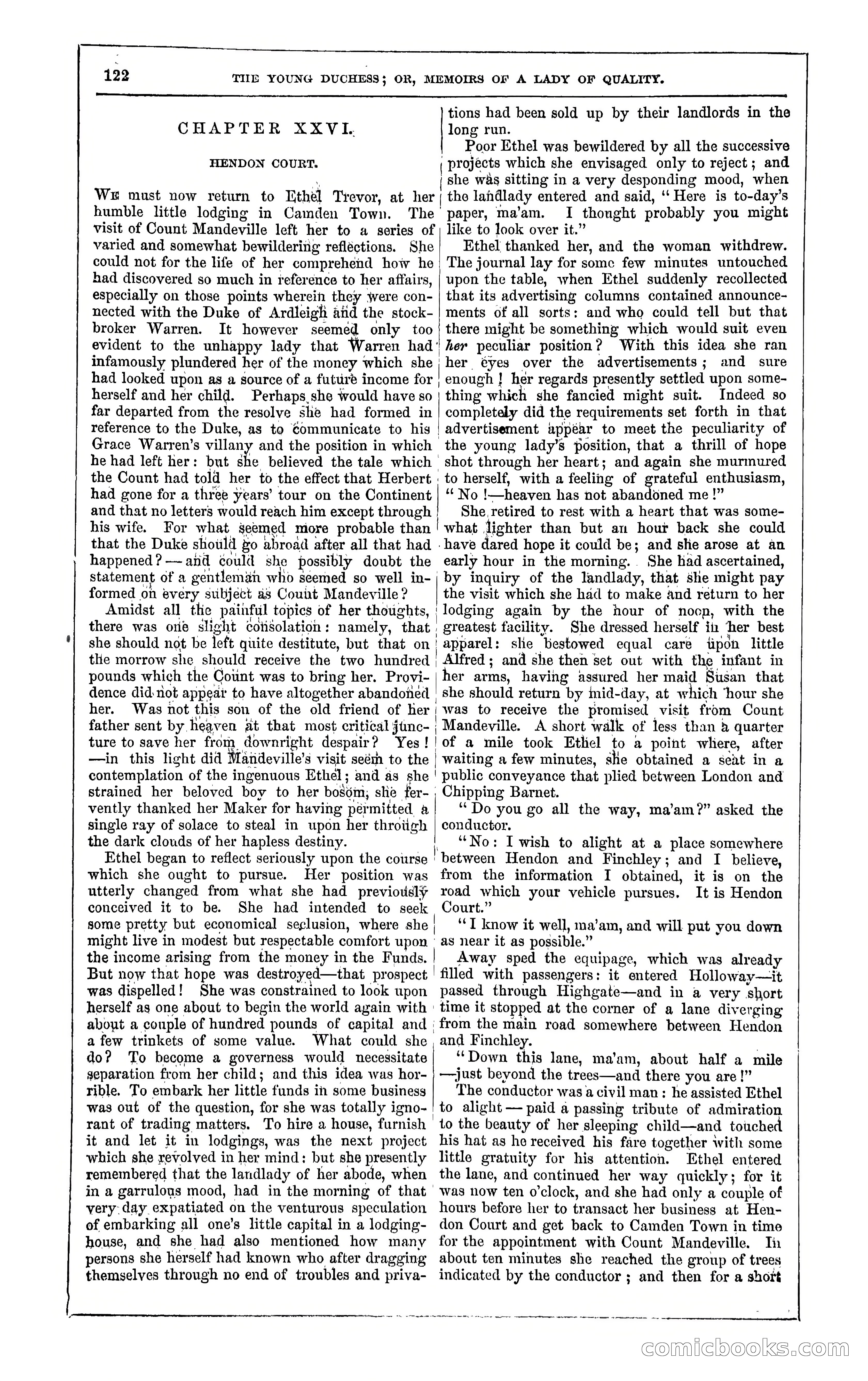
A restored page from Penny Dreadfuls, 1858. Page through the whole issue in the reader above.
📄 Transcribed text from this page (OCR, searchable)
Machine-transcribed from the original scan — historical spelling and the odd misread are preserved.
122 TIE YOUNG DUCHESS; OR, MEMOIRS OF A LADY OF QUALITY. CHAPTER XXYVI. HENDON COURT. Wer must now return to [thel Trevor, at her humble little lodging in Camden Town. The visit of Count Mandeville left her to a series of varied and somewhat bewildering refléctions. She could not for the life of her comprehend how he had discovered so much in reference to her affairs, especially on those points wherein they were con- nected with the Duke of Ardleigh aid the stock- broker Warren. It however seemed only too evident to the unhappy lady that Warren had: infamously plundered her of the money which she had looked upon as a source of a future income for herself and her child. Perhaps she would have so far departed from the resolve she had formed in reference to the Duke, as to Communicate to his Grace Warren’s any and the position in which he had left her: but she believed the tale which the Count had told her to the effect that Herbert had gone for a three years’ tour on the Continent and that no letters would reach him except through his wife. For what seemed miore probable than that the Duke should Zo abroad after all that had happened?—~and could she possibly doubt the statement of a gentleman who seemed so well in- formed on every subject as Count Mandeville? Amidst all thie painful topics of her thoughts, there was ore slight cotigolation: namely, that she should not be left quite destitute, but that on the morrow she should receive the two hundred pounds which the Count was to bring her. Provi- dence did not appear to have altogether abandotied | her. Was not this son of the old friend of her father sent by. heaven at that most critical junc- ture to save her from downright despair? Yes! —in this light did Mandeville’s visit seéth to the contemplation of the ingenuous Ethel; and as she strained her beloved boy to her bosom; she fer- vently thanked her Maker for having permitted a single ray of solace to steal in upon her throiig¢h the dark clouds of her hapless destiny. Ethel began to reflect seriously upon the course which she ought to pursue. Her position was utterly changed from what she had previously conceived it to be. She had intended to seek some pretty but economical seclusion, where she might live in modest but respectable comfort upon the income arising from the money in the Funds. But now that hope was destroyed—that prospect was dispelled! She was constrained to look upon herself as one about to begin the world again with about a couple of hundred pounds of capital and a few trinkets of some value. What could she do? To become a governess would necessitate separation from her child; and this idea was hor- rible. To embark her little funds in some business was out of the question, for she was totally igno- rant of trading matters. To hire a house, furnish it and let it in lodgings, was the next project which she revolved in her mind: but she presently remembered that the landlady of her abode, when in a garrulous mood, had in the morning of that very. day expatiated on the venturous speculation of embarking all one’s little capital in a lodging- house, and she had also mentioned how many persons she herself had known who after dragging themselves through no end of troubles and priva- tions had been sold up by their landlords in the long run. Poor Ethel was bewildered by all the successive | projects which she envisaged only to reject; and she was sitting in a very desponding mood, when | the landlady entered and said, ‘‘ Here is to-day’s “paper, ma’am. I thought probably you might like to look over it.” Ethel thanked her, and the woman withdrew. The journal lay for some few minutes untouched upon the table, when Ethel suddenly recollected that its advertising columns contained announce- ments of all sorts: and who could tell but that there might be something which would suit even her peculiar position? With this idea she ran her éyes over the advertisements; and sure enough ! her regards presently settled upon some- thing which she fancied might suit. Indeed so completely did the requirements set forth in that | advertisement appear to meet the peculiarity of the young lady’s position, that a thrill of hope shot through her heart; and again she murmured ‘to herself, with a feeling of gratelal enthusiasm, ‘“‘ No !—heaven has not abandoned me!” She retired to rest with a heart that was some- what Jighter than but au hour back she could -have dared hope it could be; and she arose at an early hour in the morning. She had ascertained, | by inquiry of the landlady, that she might pay the visit which she had to make and return to her ‘lodging again by the hour of nocp, with the | greatest facility. She dressed herself in her best ' apparel: she bestowed equal care iipon little Alfred ; and she then set out with the infant in er arms, having assured her maid Susan that she should return by mid-day, at which ‘hour she was to receive the promised visit from Count Mandeville. A short walk of less than & quarter |of a mile took Ethel to a point where, after waiting a few minutes, she obtained a seat in a ' public conveyance that plied between London and , Chipping Barnet. ‘Do you go all the way, ma’am?” asked the conductor. ‘‘No: I wish to alight at a place somewhere between Hendon and Finchley ; and I believe, from the information I obtained, it is on the road which your vehicle pursues. It is Hendon Court.” | ‘‘T know it well, ma’am, and will put you down ‘as near it as possible.” Away sped the equipage, which was already ‘filled with passengers: it entered Holloway—it passed through Highgate—and in a very short time it stopped at the corner of a lane diverging ‘from the main road somewhere between Hendon and Finchley. . ‘Down this lane, ma’am, about half a mile —just beyond the trees—and there you are !” The conductor was a civil man: he assisted Ethel to alight — paid a passing tribute of admiration to the beauty of her sleeping child—and touched his hat as he received his fare together with some little gratuity for his attention. Ethel entered the lane, and continued her way quickly; for it "was now ten o'clock, and she had only a couple of hours before her to transact her business at Hen- don Court and get back to Camden Town in time for the appointment with Count Mandeville. Th about ten minutes she reached the group of trees indicated by the conductor ; and then for a short ee rt re Ne ee —. o = — =. = COMO YN Wn) Colin