
Penny Dreadfuls, 1868 · page 8 of 400
Black Bess; or, The Knight of the Road — A Tale of the Good Old Times — page 8: what you’re looking at
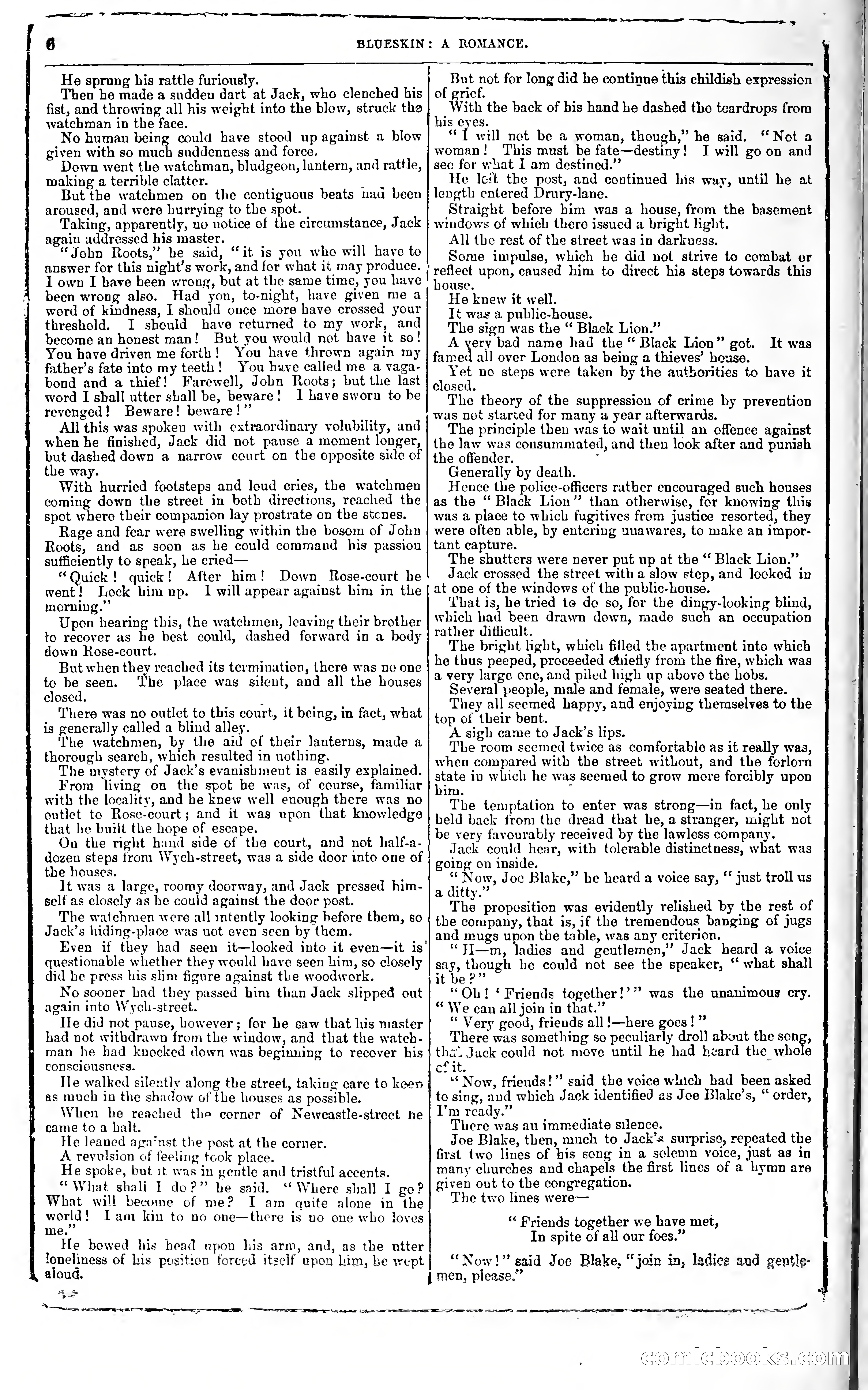
A restored page from Penny Dreadfuls, 1868. Page through the whole issue in the reader above.
📄 Transcribed text from this page (OCR, searchable)
Machine-transcribed from the original scan — historical spelling and the odd misread are preserved.
ee ee ee ee TE OG Re ee — Er a SY TD ey oa a 6 BLUESKIN He sprung his rattle furiously. Then he made a sudden dart at Jack, who clenched his fist, and throwing all his weight into the blow, struck the watchman in the face. No human being could have stood up against a blow given with so much suddenness and force. Down went the watchman, bludgeon, lantern, and rattle, making a terrible clatter. 7 But the watchmen on the contiguous beats naa been aroused, and were hurrying to the spot. Taking, apparently, uo notice of the circumstance, Jack again addressed his master. ‘ Jobn Roots,” be said, “it is you who will have to answer for this night’s work, and for what it may produce. 1 own I have been wrong, but at the same time, you have been wrong also. Had you, to-night, have given me a word of kindness, I should once more have crossed your threshold. I should have returned to my work, and become an honest man! But you would not bave it so! You have driven me forth! You have thrown again my father’s fate into my teeth! You have called me a vaga- bond and a thief! Farewell, Jobn Roots; but the last word I shall utter shall be, beware! I have sworn to be revenged! Beware! beware!” All this was spoken with extraordinary volubility, and when he finished, Jack did not pause a moment longer, but dashed down a narrow court on the opposite side of the way. With hurried footsteps and loud cries, the watchmen coming down the street in both directions, reached the spot where their companion lay prostrate on the stcnes. Rage and fear were swelling within the bosom of John Roots, and as soon as he could command his passion sufficiently to speak, he cried— “Quick! quick! After him! Down Rose-court he went! Lock himnp. I will appear against him in the morning.” Upon hearing this, the watchmen, leaving their brother to recover as he best could, dashed forward in a body down Rose-court. But when they reached its termination, there was no one to be seen. he place was silent, and all the houses closed. There was no outlet to this court, it being, in fact, what is generally called a blind alley. ‘I'he watchmen, by the aid of their lanterns, made a thorough search, which resulted in nothing. The mystery of Jack’s evanishment is easily explained. From living on the spot be was, of course, familiar with the locality, and he knew well enough there was no outlet to Rose-court; and it was upon that knowledge that he built the hope of escape. On the right hand side of the court, and not half-a. dozen steps from Wych-street, was a side door into one of the houses. It was a large, roomy doorway, and Jack pressed him- self as closely as he could against the door post. The watchmen were all »ntently looking before them, so Jack’s hiding-place was uot even seen by them. Even if they had seen it—looked into it even—it is’ questionable whether they would have seen him, so closely did he press his shm figure against the woodwork. No sooner had they passed him than Jack slipped out again into Wych-street. He did not pause, however; for be saw that his master had not withdrawn from the window, and that the watch- man he had knocked down was beginning to recover his consciousness. He walked silently along the street, taking care to keen as much in the shadow of the houses as possible. When he reached the corner of Newecastle-street he came to a halt. Tle leaned aca‘ust the post at the corner. A revulsion of feeling took place. He spoke, but it was in gentle and tristful accents. “What shali I do?” be said. ‘ Where shall I go? What will become of me? I am quite alone in the world | Iam kin to no one—there is po one who loves me, He bowed his head upon his arm, and, as the utter cogs ness of his position forced itself upon him, he wept aloud. ~ & >= Nmneerccme etter Di ca tT is a 8 tn ee 3 >: A ROMANCE. a eter , But not for long did he continue this childish expression Of prict. ith the back of his hand he dashed the teardrops from his cyes. “1 will not be a woman, though,” he said. “Not a I will go on and woman! This must be fate—destiny! see for what I am destined.”’ He cst the post, and continued his wuy, until he at length entered Drury-lane. Straight before him was a house, from the basement windows of which there issued a bright hght. All the rest of the street was in darkness. Some impulse, which he did not strive to combat or reflect upon, caused him to direct his steps towards this house. He knew it well. It was a public-house. The sign was the ‘* Black Lion.” A yery bad name had the “ Black Lion”’ got. famed all over London as being a thieves’ house. Yet no steps were taken by the authorities to have it closed. The theory of the suppression of crime by prevention was not started for many a year afterwards. The principle then was to wait until an offence against the law was cousummated, and then look after and punish the offender. " Generally by death. Hence the police-officers rather encouraged such houses as the “ Black Lion” than otherwise, for knowing this was a place to which fugitives from justice resorted, they were often able, by entcriug nuawares, to make an impor- tant capture. The shutters were never put up at the “ Black Lion.” Jack crossed the street with a slow step, and looked in at one of the windows of the public-house. That 1s, he tried te do so, for the dingy-looking blind, which had been drawn down, made such an occupation rather difficult. The bright hight, which filled the apartment into which he thus peeped, proceeded chiefly from the fire, which was a very large one, and piled high up above the hobs. Several people, male and female, were seated there. They all seemed happy, and enjoying themselves to the top of their bent. A sigh came to Jack’s lips. The room seemed twice as comfortable as it really was, when compared with the street without, and the forlorn yieg in which he was seemed to grow more forcibly upon im. The temptation to enter was strong—in fact, he only held back from the dread that he, a stranger, might not be very favourably received by the lawless company. Jack could hear, with tolerable distinctness, what was golng on inside. Now, Joe Blake,” he heard a voice say, “* just troll us a ditty.” The proposition was evidently relished by the rest of the company, that is, if the tremendous banging of jugs and mugs upon the table, was any criterion. “‘¥I—m, ladies and geutlemen,’ Jack heard a voice Sas though be could not see the speaker, “‘ what shall it be?” “Oh! * Friends together!’”? was the unanimous cry. * We can all join in that.” “ Very good, friends all !—here goes!” There was something so peculiarly droll about the song, tha. Jack could not move until he had heard the whole cf it. ‘‘ Now, friends!” said the voice wich bad been asked to sing, and which Jack identified as Joe Blake’s, “ order, I’m ready.” There was au immediate silence. Joe Blake, then, mnch to Jack’s surprise, repeated the first two lines of bis song in a solemn voice, just as in many churches and chapels the first lines of a hymn are given out to the congregation. The two lines were— It was ‘‘ Friends together we have met, In spite of all our foes.” “Now!” said Joe Blake, “join in, Iadies and gentle: j men, please.” Sy Ww See Se OF AEP LIE TRS Os ere EO DOO AUUC S (SO) =} |