
Penny Dreadfuls, 1868 · page 79 of 400
Black Bess; or, The Knight of the Road — A Tale of the Good Old Times — page 79: what you’re looking at
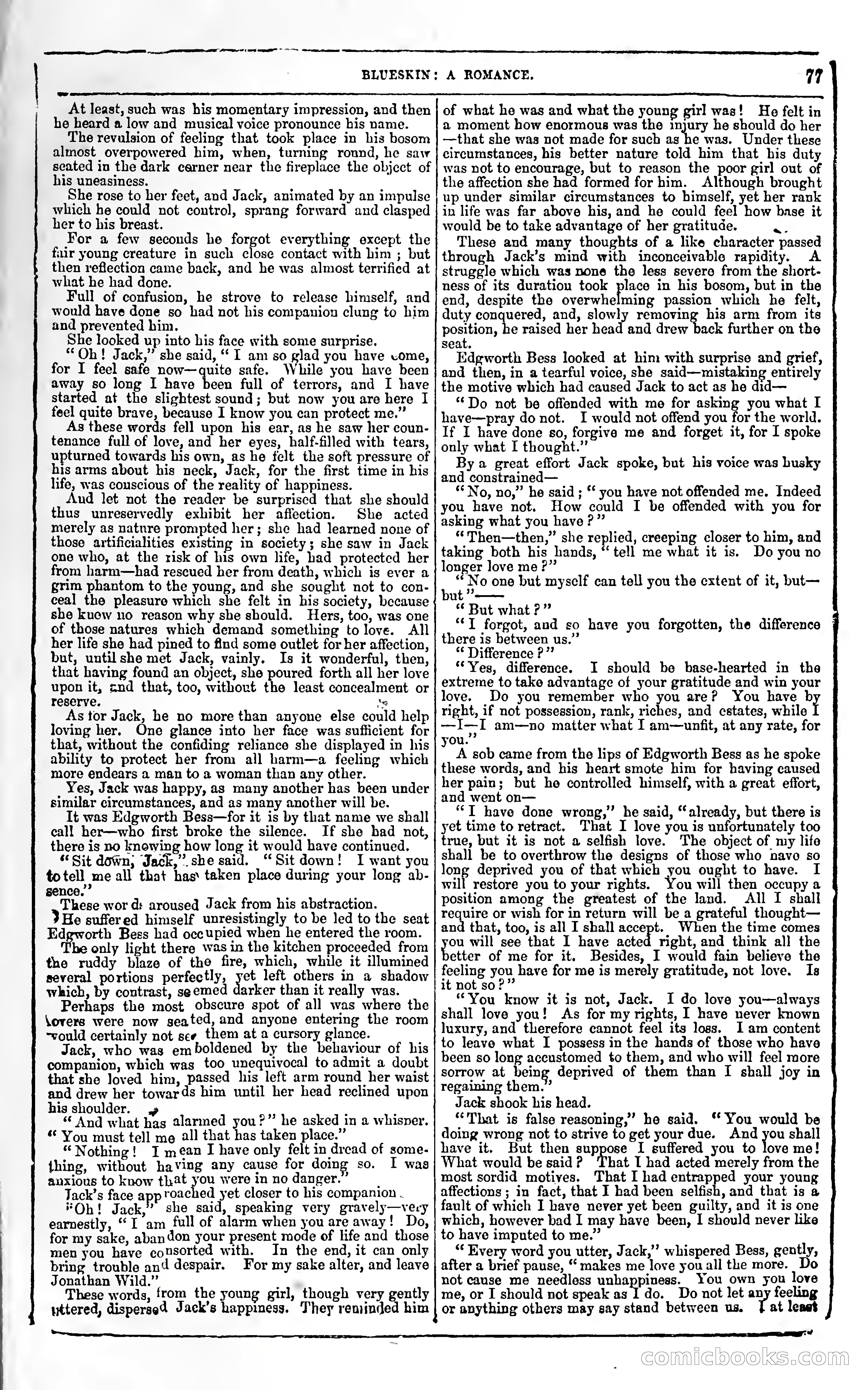
A restored page from Penny Dreadfuls, 1868. Page through the whole issue in the reader above.
📄 Transcribed text from this page (OCR, searchable)
Machine-transcribed from the original scan — historical spelling and the odd misread are preserved.
cE genera cece, yet POC AO | OE EN LO EA ETT AT TC CC TS TOD SCP SI A eg aS BLUESKIN: A ROMANCE, 77 at a a a a a a a At least, such was his momentary impression, and then he heard a low and musical voice pronounce his name. The revulsion of feeling that took place in his bosom almost overpowered him, when, turning round, he saw seated in the dark carner near the fireplace the object of his uneasiness. She rose to her feet, and Jack, animated by an impulse which he could not control, sprang forward and clasped her to his breast. For a few seconds he forgot everything except the fiir young creature in such close contact with him ; but then reflection came back, and he was almost terrified at what he had done. Full of confusion, he strove to release himself, and would have done so had not his companion clung to him and prevented bim. She looked up into his face with some surprise. “Oh! Jack,” she said, ‘“‘ I am so glad you have come, for I feel safe now—quite safe. While you have been away so long I have been full of terrors, and I have started at the slightest sound; but now you are here I feel quite brave, because I know you can protect me.” As these words fell upon his ear, as he saw her coun- tenance full of love, and her eyes, half-filled with tears, upturned towards his own, as he felt the soft pressure of his arms about his neck, Jack, for the first time in his life, was couscious of the reality of happiness. Aud let not the reader be surprised that she should thus unreservedly exhibit her affection. She acted merely as natnre prompted her; she had learned none of those artificialities existing in society; she saw in Jack one who, at the risk of his own life, had protected her from harm—had rescued her from death, which is ever a grim phantom to the young, and she sought not to con- ceal the pleasure which she felt in his society, because she kuew no reason why she should. Hers, too, was one of those natures which demand something to love. All her life she had pined to find some outlet for her affection, but, until she met Jack, vainly. Is it wonderful, then, that having found an object, she poured forth all her love upon it, and that, too, without the least concealment or reserve. As As tor Jack, he no more than anyone else could help loving her. One glance into her face was sufficient for that, without the confiding reliance she displayed in his ability to protect her from all harm—a feeling which more endears a man to a woman than any other. Yes, Jack was happy, as many another has been under similar circumstances, and as many another will be. It was Edgworth Bess—for it is by that name we shall call her—who first broke the silence. If she had not, there is no knowing how long it would have continued. ‘Sit down; Jack,” she said. “Sit down! I want you to tell me all that has\ taken place during your long ab- sence.” These wor ds: aroused Jack from his abstraction. He suffered himself uuresistingly to be led to the seat Edeworth Bess had oce upied when he entered the room. he only light there was in the kitchen proceeded from the ruddy blaze of the fire, which, while it illumined several portions perfectly, yet left others in a shadow which, by contrast, seemed darker than it really was. Perhaps the most obscure spot of all was where the \overs were now seated, and anyone entering the room “vould certainly not see them at a cursory glance. Jack, who was emboldened by the behaviour of his companion, which was too unequivocal to admit a doubt that she loved him, passed ls left arm round her waist and drew her towards him until her head reclined upon hig shoulder. . ; “ And what has alarmed you?” he asked in a whisner, ‘You must tell me all that has taken place.” “Nothing! I mean I have only felt in dread of some- thing, without having any cause for doing so. I was anxious to know that you were in no danger.” Jack’s face app roac ed yet closer to his companion . *Oh! Jack,” she said, speaking very gravely—very earnestly, “I am full of alarm when you are away! Do, for my sake, abandon your present mode of life and those men you have consorted with. In the end, it can only bring trouble and despair. For my sake alter, and leave 1 eR on, th irl, though tl se words, ‘rom e young gr, ough very gently uttered, dispersed Jack’s happiness! They renimded him of what he was and what the young girl was! He felt in a moment how enormous was the injury he should do her —that she was not made for such as he was. Under these circumstances, his better nature told him that his duty was not to encourage, but to reason the poor girl out of the affection she had formed for him. Although brought up under similar circumstances to himself, yet her rank in life was far above his, and he could feel how base it would be to take advantage of her gratitude. a These and many thoughts of a like character passed through Jack’s mind with inconceivable rapidity. A struggle which was none the less severe from the shiort- ness of its duration took place in his bosom, but in the end, despite the overwhelming passion which he felt, duty conquered, and, slowly removing his arm from its position, he raised her head and drew back further on the seat. Edgworth Bess looked at him with surprise and grief, and then, in a tearful voice, she said—mistaking entirely the motive which had caused Jack to act as he did— “Do not be offended with me for asking you what I have—pray do not. I would not offend you for the world. f I have done s0, forgive me and forget it, for I spoke only what I thought.” By a great effort Jack spoke, but his voice was husky and constrained— ‘* No, no,” he said; “‘ you have not offended me. Indeed you have not. How could I be offended with you for asking what you have ?”’ ‘¢Then—then,” she replied, creeping closer to him, and taking both his hands, * tell me what it is. Do you no longer love me ?”’ . ' N o one but mysclf can tell you the extent of it, but— u ** But what ?” ‘“*T forgot, and so have you forgotten, the difference | there is between us.” *¢ Difference ?” ‘S'Yes, difference. I should be base-hearted in the extreme to take advantage of your gratitude and win your love. Do you remember who you are? You have b night, if not possession, rank, riches, and estates, while i —I-I am—no matter what I am—unfit, at any rate, for you.” A sob came from the lips of Edgworth Bess as he spoke these words, and his heart smote him for having caused her pain; but he controlled himself, with a great effort, and went on— “I have done wrong,’ he said, “already, but there is yet time to retract. That I love you is unfortunately too true, but it is not a selfish love. The object of my life shall be to overthrow the designs of those who navo so long deprived you of that which you ought to have. I will restore you to your rights. You will then occupy a position among the greatest of the land. All I shall require or wish for in return will be a grateful thought— and that, too, is all I shall accept. When the time comes ou will see that I have acted right, and think all the etter of me for it. Besides, I would fain believe the feeling you have for me is merely gratitude, not love. Is it not so?” You know it is not, Jack. I do love you—always shall love you! As for my rights, I have never known luxury, and therefore cannot feel its loss. Iam content to leave what I possess in the hands of those who have been so long accustomed to them, and who will feel more sorrow at being deprived of them than I shall joy in regaining them.” Jack shook his head. ‘That is false reasoning,’ he said. ‘* You would be doing wrong not to strive to get your due. And you shall have it. But then suppose I suffered you to love me! What would be said? That I had acted merely from the most sordid motives. That I had entrapped your young affections ; in fact, that I had been selfish, and that is a fault of which I have never yet been guilty, and it is one which, however bad I may have been, I should never like to have imputed to me.” ‘Every word you utter, Jack,’’ whispered Bess, gently, after a brief pause, “ makes me love you all the more. Do not cause me needless unhappiness. You own you love me, or I should not speak asl do. Do not let any feeling or anything others may say stand between us. | at least (ee peg Sm yp i ERS «= un <SHIGO GOMIGIOO 5}