
Penny Dreadfuls, 1868 · page 65 of 400
Black Bess; or, The Knight of the Road — A Tale of the Good Old Times — page 65: what you’re looking at
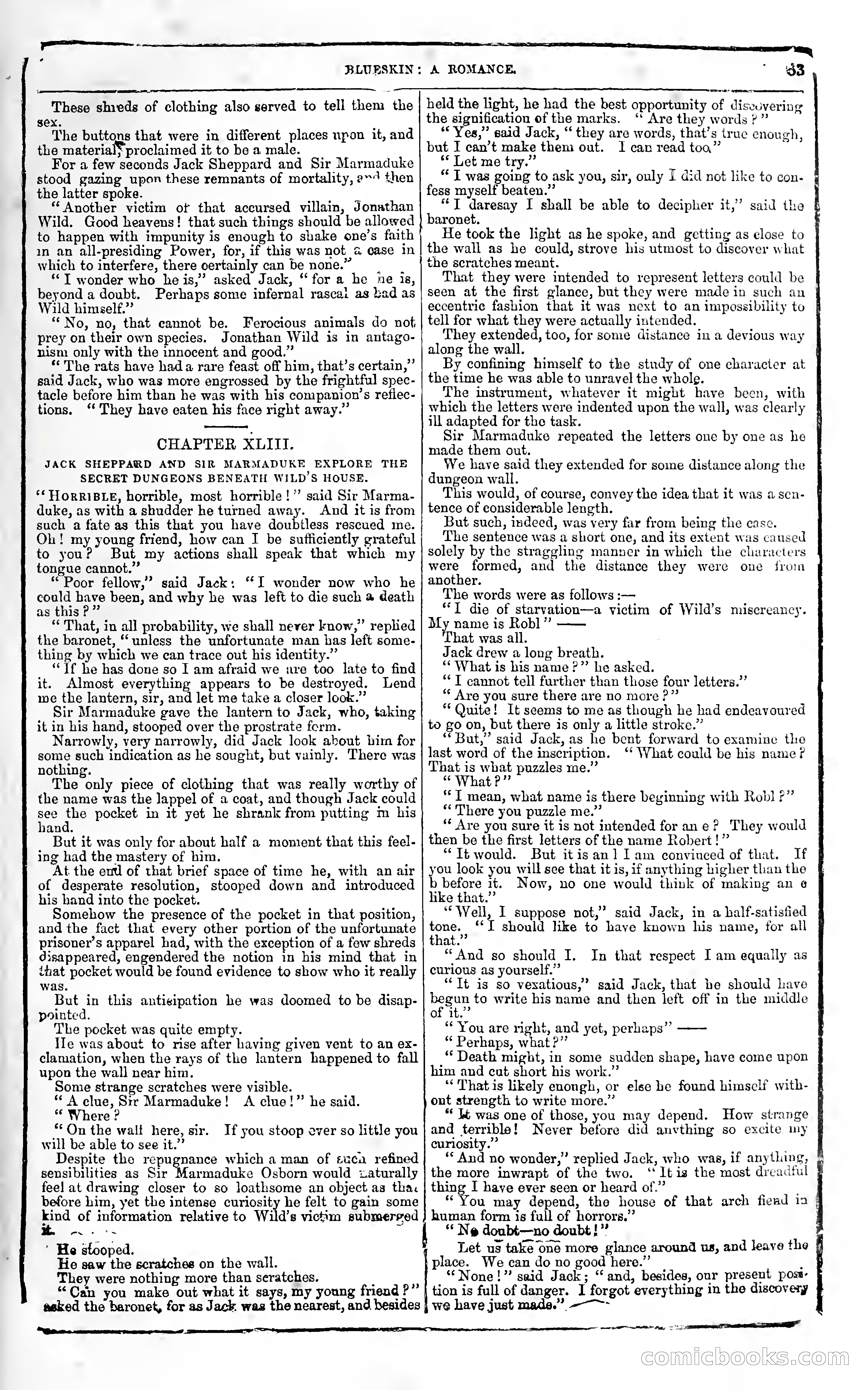
A restored page from Penny Dreadfuls, 1868. Page through the whole issue in the reader above.
📄 Transcribed text from this page (OCR, searchable)
Machine-transcribed from the original scan — historical spelling and the odd misread are preserved.
BLUESKIN : These sheds of clothing also served to tell them the Sex. The buttons that were in different places upon it, and the material® proclaimed it to be a male. For a few seconds Jack Sheppard and Sir Marmaduke stood gazing upon these remnants of mortality, a4 then the latter spoke. Another victim of that accursed villain, Jonathan Wild. Good heavens! that such things should be allowed to happen with impunity is enough to shake one’s faith in an all-presiding Power, for, if this was not & case in which to interfere, there certainly can be none.” ‘© T wonder who he is,”? asked Jack, “‘ for a he ne 1s, beyond a doubt. Perhaps some infernal rascai as bad as Wild himself.” ‘* No, no, that eannot be. Ferocious animals do not. prey on their own species. Jonathan Wild 1s in antago- nism only with the innocent and good.” “The rats have hada rare feast off him, that’s certain,” said Jack, who was more engrossed by the frightful spec- tacle before him than he was with his companion’s refiec- tions. ‘‘ They have eaten his face right away.” CHAPTER XLIII. JACK SHEPPARD AND SIR MARMADUKE EXPLORE THE SECRET DUNGEONS BENEATH WILD’S HOUSE. ** HORRIBLE, horrible, most horrible!” said Sir Marma- duke, as with a shudder he turned away. And itis from such a fate as this that you have doubtless rescued me. Oh! my young friend, how can I be sufficiently grateful to you? But my actions shall speak that which my tongue cannot.” “Poor fellow,’ said Jack: “JI wonder now who he cond pare been, and why he was left to die such a death as this P” That, in all probability, we shall never know,’ replied the baronet, “unless the unfortunate man has left some- thing by which we can trace out his identity.” “If he has done so I am afraid we ure too late to find it. Almost everything appears to be destroyed. Lend we the lantern, sir, and let me take a closer look.” Sir Marmaduke gave the lantern to Jack, who, taking it in his hand, stooped over the prostrate form. Narrowly, very narrowly, did Jack look about bim for some such indication as he sought, but vainly. There was nothing. The only piece of clothing that was really worthy of the name was the lappel of a coat, and though Jack could see a pocket in it yet he shrank from putting m his hand. But it was only for about half a moment that this feel- ing had the mastery of him. At. the ent of that brief space of time he, with an air of desperate resolution, stooped down and introduced his hand into the pocket. Somehow the presence of the pocket in that position, and the fact that every other portion of the unfortunate prisoner’s apparel had, with the exception of a few shreds disappeared, engendered the notion in his mind that in that pocket would be found evidence to show who it really was. But in this antierpation he was doomed to be disap- pointed. The pocket was quite empty. IIe was about to rise after having given vent to an ex- clamation, when the rays of the lantern happened to fall upon the wall near him. Some strange scratches were visible. ** A clue, Srr Marmaduke! A clue!” he said. “* Where ? ** On the walt here, sir. will be able to see it.” Despite the repugnance which a man of stuco refined sensibilities as Sir Marmaduke Osborn would cxaturally feel at drawing closer to so loathsome an object as thax before him, yet the intense curiosity he felt to gain some kind of information relative to Wild’s victtm submerred xt. ; ’ He stooped. He saw the scratches on the wall. They were nothing more than seratches. : “Can you make out what it says, my young friend P”’ asked the baronet, for as Jack. was the nearest, and besides If you stoop over so little you A ROMANCE, 33 held the light, he had the best opportunity of diseuvering the signification of the marks. ‘ Are they words ? ” Yes,” said Jack, “ they are words, that’s true enough, but I can’t make them out. I can read too,” ** Let me try.” * I was going to ask you, sir, ouly I did not hke to con- 3 fess myself beaten.” “*T daresay I shall be able to decipher it,’ said the baronet. He took the light as he spoke, and getting as elose to the wall as he could, strove his utmost to discover what the scratches meant. That they were intended to represent letters could be seen at the first glance, but they were madein such an eccentric fashion that it was next to an impossibility to tell for what they were actually intended. They extended, too, for some distance in a devious way along the wall. By confining himself to the study of one character at | the time he was able to unravel the whole. The instrument, whatever it might have been, with which the letters were indented upon the wall, was clearly ill adapted for the task. Sir Marmaduke repeated the letters one by one as he made them out. We have said they extended for some distance along the dungeon wall. This would, of course, convey the idea that it was a scn- tence of considerable length. But such, indeed, was very far from being the case. The sentence was a short one, and its extent was caused solely by the straggling manner in which the characters were formed, and the distance they were one from another. The words were as follows :— “I die of starvation—a victim of Wild’s miscreancy. name 1s Rob] ’?’ —— hat was all. Jack drew a long breath. ‘* What is his name ?”’ he asked. **T cannot tell further than those four letters.” ‘* Are you sure there are no more?” * Quite! It seems to me as though he had endeavoured to go on, but there is only a little stroke.” ‘** But,” said Jack, as he bent forward to examine the last word of the inscription. ‘*‘ What could be his name? That is what puzzles me.” What?” *T mean, what name is there beginning with Robl ?” ** There you puzzle me.” ** Are you sure it is not intended for ane? They would then be the first letters of the name Robert!” “It would. But itis an] Iam conviueed of that. If you look you will see that itis, if anything higher than the b before 1t. Now, no one would think of making an 6 hke that.” ‘Well, I suppose not,” said Jack, in a half-satisfied ee **Y should like to have known his name, for all that.” “And so should I. curious as yourself.” “It is so vexatious,’ said Jack, that he should have begun to write his name and then left off in the middle of it.” ** You are right, and yet, perhaps’? —— “ Perhaps, what?” ** Death might, in some sudden shape, have come upon him and cut short his work.” M In that respect I am equaily as ‘That is likely enough, or else he found himself with- § P) ont strength to write more.’ “* kt was one of those, you may depend. How strange § and terrible! curiosity.” ‘And no wonder,” replied Jack, who was, if anything, the more inwrapt of the two. thing I have ever seen or heard of.” Never before did anvthing so excite my “You may depend, the house of that arch fiead 12 | human form is full of horrors.” ‘* N@ doubt—no doubt!” Let us take one more glance around us, and leave the place. We can do no good here.”’ “‘None!” said Jack; ‘‘ and, besides, our present poss- tion is full of danger. I forgot everything in the discovery we have just made.” —~- ‘Tt is the most dreadful | aS 3S > a. be COIN GC DOOLKS (SO) 5}