
Penny Dreadfuls, 1868 · page 58 of 400
Black Bess; or, The Knight of the Road — A Tale of the Good Old Times — page 58: what you’re looking at
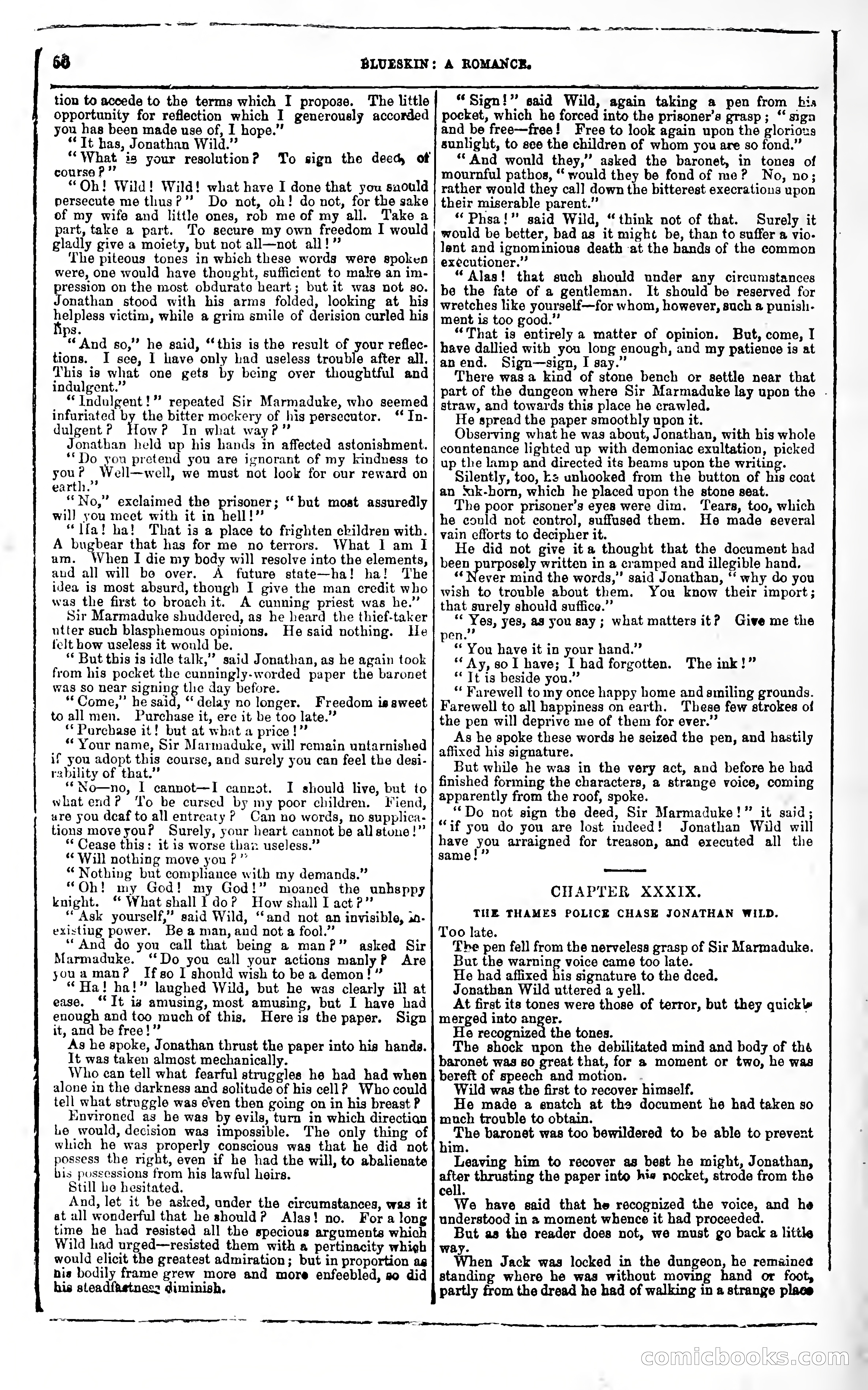
A restored page from Penny Dreadfuls, 1868. Page through the whole issue in the reader above.
📄 Transcribed text from this page (OCR, searchable)
Machine-transcribed from the original scan — historical spelling and the odd misread are preserved.
68 2 — eR ee ate Pe» Carinae © emamacmmewenss 5 «tian ee BLUESKIN: A ROMANCE, tion to accede to the terms which I propose. The little opportunity for reflection which I generously accorded you has been made use of, I hope.” “It has, Jonathan Wild.” “What is your resolution? To sign the decd of course P’’ “Oh! Wild! Wild! what have I done that you saould persecute me tlus?’’ Do not, oh! do not, for the sake of my wife and little ones, rob meof my all. Take a part, take a part. To secure my own freedom I would gladly give a moiety, but not all—not all!” The piteous tones in which these words were spoken were, one would have thought, sufficient to make an im- pression on the most obdurate heart; but it was not so. Jonathan stood with his arms folded, looking at his helpless victim, while a grim smile of derision curled his s. re And so,” he said, ‘‘this is the result of your reflec- tions. I see, I lave only had useless trouble after all. This is what one gets by being over thoughtful and indulgent.” *Indulgent!” repeated Sir Marmaduke, who seemed infuriated by the bitter mockery of his persecutor. ‘ In- dulgent? How?P In what way?” Jonathan held up his hands in affected astonishment. **Do you pretend you are ignorant of my kindness to you? Well—well, we must not look for our reward on earth.’ “No,” exclaimed the prisoner; “ but most assuredly will you meet with it in hell!”’ “Ifa! ha! That is a place to frighten children with. A bugbear that has for me no terrors. What 1] am I um. When I die my body will resolve into the elements, and all will bo over. A _ future state—ha! ha! ‘The idea is most absurd, though I give the man eredit who was the first to broach it. A cunning priest was he.” Sir Marmaduke shuddered, as he heard the thief-taker utter such blasphemous opinions. He said nothing. He felt how useless it would be. ** But this is idle talk,’’ said Jonathan, as he again took from his pocket the cunningly-worded paper the baronet was So near signing tlie day before. ‘**Come,” he sank “delay no longer. Freedom is sweet toall men. Purchase it, ere it be too late.” ‘** Purchase it! but at what a price !”’ “ Your name, Sir Marmaduke, will remain untarnished if you adopt this course, and surely you can feel the desi- rability of that.” **No—no, I cannot—I cannot. I should live, but to what end? To be cursed by my poor children. Fiend, ure you dcaf to all entreaty ? Can no words, no supplica- tions moveyou?P Surely, your heart cannot be all stone!” ** Cease this: it is worse thar useless.” ‘Will nothing move yon P”’ “Nothing but compliance with my demands.” “Oh! my God! my God!” moaned the unhsppy knight. “ What shall ldo? How shall I act?” “Ask yourself,” said Wild, ‘‘and not an invisible, an- existiug power. Beaman, and not a fool.” ‘“And do you call that being a manP” asked Sir Marmaduke. ‘Do you call your actions manly? Are youaman? Ifso 1 should wish to bea demon!” “Ha! ha!” laughed Wild, but he was clearly ill at ease. “It is amusing, most amusing, but I have had enough and too much of this, Here is the paper. Sign it, and be free!” As he spoke, Jonathan thrust the paper into his hands. It was taken almost mechanically. Who can tell what fearful struggles he had had when alone in the darkness and solitude of his cell? Who could tell what struggle was even then going on in his breast P Environed as he was by evils, turn in which directian Le would, decision was impossible. The only thing of which he was properly conscious was that he did not possess the right, even if he had the will, to abalienate bis possessions from his lawful heirs. Still he hesitated. And, let it be asked, under the circumstances, was it at ull wonderful that he should? Alas! no. Fora long time he had resisted all the specious arguments which Wild had urged—resisted them with a pertinacity which would elicit the greatest admiration; but in proportion as his bodily frame grew more and more enfeebled, ao did his steadfastnec: diminish. oa ~~ =. = “Sign!” said Wild, again taking a pen from bis pocket, which he forced into the prisoner’s grasp; “‘ sign and be free—free! Free to look again upon the gloriozs sunlight, to see the children of whom you are so fond.” *‘And would they,” asked the baronet, in tones of mournful pathos, ‘‘ would they be fond of me? No, no; rather would they cal] down the bitterest execrations upon their miserable parent.” ““Phsa!” said Wild, “think not of that. Surely it would be better, bad as it might be, than to suffer a vio- lent and ignominious death at the bands of the common executioner.” “Alas! that such should under any circumstances be the fate of a gentleman. It should be reserved for wretches like yourself—for whom, however, such a punisli- ment is too good.” “That is entirely a matter of opinion. But, come, I have dallied with you long enough, and my patience is at anend. Sign—sign, I say.” There was a kind of stone bench or settle near that part of the dungeon where Sir Marmaduke lay upon the . atraw, and towards this place he crawled. He spread the paper smoothly upon it. Observing what he was about, Jonathan, with his whole countenance lighted up with demoniac exultation, picked up the lamp and directed its beams upon the writing. Silently, too, ks unhooked from the button of his coat an “k-horn, which he placed upon the stone seat. The poor prisoner’s eyes were dim. ‘Tears, too, which he could not control, suffused them. He made eeveral vain efforts to decipher it. He did not give ita thought that the document had been purposely written in a cramped and illegible hand. ‘* Never mind the words,” said Jonathan, ‘‘ why do you wish to trouble about them. You know their import; that surely should suffice.” E Yes, yes, aS you say; what matters it? Give me the pen.’ * You have it in your hand.” ‘“Ay, 80 I have; I had forgotten. The ink!” * It is beside you.” ‘* Farewell to my once happy home and smiling grounds. Farewell to all happiness on earth. These few strokes of the pen will deprive me of them for ever.” As he spoke these words he seized the pen, and hastily affixed his signature. But while he was in the very act, and before he had finished forming the characters, a strange voice, coming apparently from the roof, spoke. “Do not sign the deed, Sir Marmaduke!” it said; “if you do you are lost indeed! Jonathan Wild will have you arraigned for treason, and executed all the same! CHAPTER XXXIX. THE THAMES POLICE CHASE JONATHAN WILD. Too late. The pen fell from the nerveless grasp of Sir Marmaduke. But the warning voice came too late. He had affixed hig signature to the deed. Jonathan Wild uttered a yell. At first its tones were those of terror, but they quick’ merged into anger. He recognized the tones. The shock upon the debilitated mind and body of thé baronet was so great that, for a moment or two, he was bereft of speech and motion. . Wild was the first to recover himaelf. He made a enatch at the document he had taken so much trouble to obtain. The baronet was too bewildered to be able to prevent him. Leaving him to recover as best he might, Jonathan, after thrusting the paper into hie nocket, strode from the cell. We have said that he recognized the voice, and he understood in a moment whence it had proceeded. _ But as the reader does not, we must go back a hitle way. When Jack was locked in the dungeon, he remained standing where he was without moving d or foot, partly from the dread he had of walking in a strange place Py TET ma COmiIcboooks (SO) =}