
Penny Dreadfuls, 1868 · page 311 of 400
Black Bess; or, The Knight of the Road — A Tale of the Good Old Times — page 311: what you’re looking at
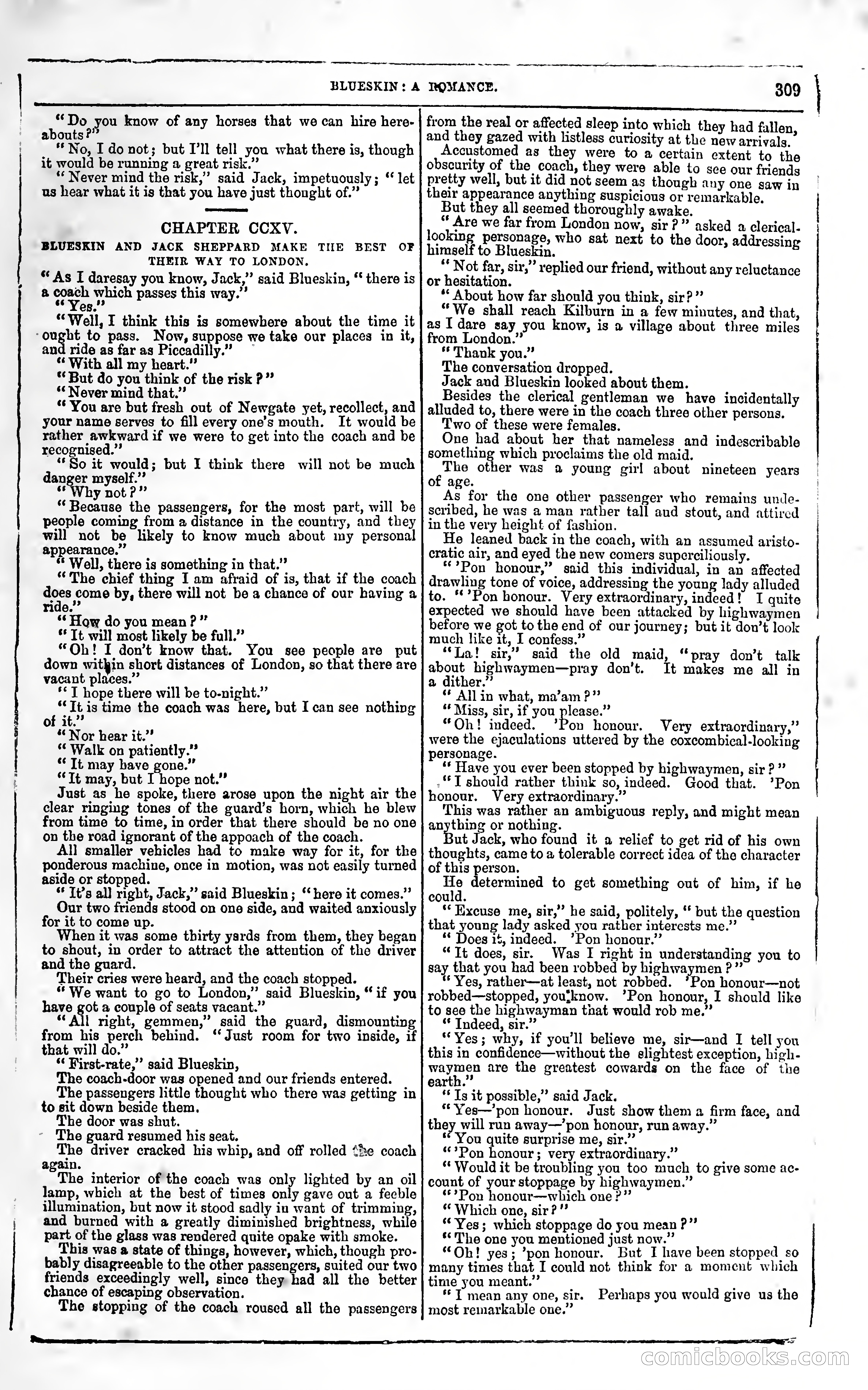
A restored page from Penny Dreadfuls, 1868. Page through the whole issue in the reader above.
📄 Transcribed text from this page (OCR, searchable)
Machine-transcribed from the original scan — historical spelling and the odd misread are preserved.
a ee A en nr Ng STEED Wy, TT a Ra ag ECE SE = Se mb BLUESKIN: A ROMANCE. “Do you know of any horses that we can hire here- abouts?’ "No, Ido not; but I'll tell you what there is, though it would be running a great risk.” “* Never mind the risk,” said Jack, impetuously; “ let us hear what it is that you have just thought of.” CHAPTER CCXV. AND JACK SHEPPARD MAKE TIIE BEST OF THEIR WAY TO LONDON. “ As I daresay you know, Jack,’’ said Blueskin, “ there is a coach which passes this way.’ 6¢ Yes,” “Well, I think this is somewhere about the time it BLUESKIN peuete to pass. Now, suppose we take our places in it, an ride as far as Piccadilly.” “With all my heart.” ** But do you think of the risk ?” ** Never mind that.” ** You are but fresh out of Newgate yet, recollect, and your name serves to fill every one’s mouth. It would be rather awkward if we were to get into the coach and be recognised.’ **So it would; but I think there will not be much danger myself.” Why not?” ** Because the passengers, for the most part, will be people coming from a distance in the country, and they will not be likely to know much about my personal appearance.” “ Well, there is something in that.” “The chief thing I am afraid of is, that if the coach eee ome by, there will not be a chance of our having a ride.” ** How do you mean?” ** Tt will most likely be full.” “Oh! I don’t know that. You see people are put down within short distances of London, so that there are vacant places.” **T hope there will be to-night.” 7: Tt is time the coach was here, but I can see nothing of it.’ “Nor hear it.” *¢ Walk on patiently.” ** It may have gone.” “It may, but I hope not.” Just as he spoke, there arose upon the night air the clear ringing tones of the guard’s horn, which he blew from time to time, in order that there should be no one on the road ignorant of the appoach of the coach. All smaller vehicles had to make way for it, for the ponderous machine, once in motion, was not easily turned aside or stopped. * It’s all right, Jack,” said Blueskin; ‘‘ here it comes.” Our two friends stood on one side, and waited anxiously for it to come up. When it was some thirty yards from them, they began to shout, in order to attract the attention of the driver and the guard. Their cries were heard, and the coach stopped. “We want to go to London,” said Blueskin, “if you have got a couple of seats vacant.” “All right, gemmen,” said the guard, dismounting from his perch behind. ‘‘ Just room for two inside, if that will do.” ‘ Wirst-rate,’ said Blueskin, The coach-door was opened and our friends entered. The passengers little thought who there was getting in to sit down beside them. The door was shut. ' The guard resumed his seat. The driver cracked his whip, and off rolled <he coach again. The interior of the coach was only lighted by an oil lamp, which at the best of times only gave out a feeble illumination, but now it stood sadly in want of trimming, and burned with a greatly diminished brightness, while part of the glass was rendered quite opake with smoke. This was a state of things, however, which, though pro- bably disagreeable to the other passengers, suited our two friends exceedingly well, since they had all the better chance of escaping observation. The stopping of the coach roused all the passengers See PS ee 309 from the real or affected sleep into which they had fall and they gazed with listless curiosity at the ney arrivals. Accustomed as they were to a certain extent to the obscurity of the coach, they were able to sce our friends pretty well, but it did not seem as though any one saw in their appearance anything suspicious or remarkable, But they all seemed thoroughly awake. Rice we far from pee now, sir?” aslted a clerical. ooxing personage, who sat next to the door himself to Blueskin, ree * Not far, sir,” replied our friend, without any reluctance or hesitation. ** About how far should you think, sir?” “We shall reach Kilburn in a few minutes, and that, as I dare say you know, is a village about three miles from London.” * Thank you.” The conversation dropped. Jack and Blueskin looked about them. Besides the clerical gentleman we have incidentally alluded to, there were in the coach three other persons. Two of these were females. One had about her that nameless and indescribable something which proclaims the old maid. The other was a young girl about nineteen years of age. As for the one other passenger who remains unde- scribed, he was a man rather tall aud stout, and attired in the very height of fashion. He leaned back in the coach, with an assumed aristo- cratic air, and eyed the new comers superciliously. “*?Pon honour,” said this individual, in an affected drawling tone of voice, addressing the young lady alluded to. “’Pon honour. Very extraordinary, indeed! I quite expected we should have been attacked by highwaymen before we got to the end of our journey; but it don’t look much like it, I confess.” ‘ua! sir,’ said the old maid, “pray don’t talk about highwaymen—pray don’t. It makes me all in a dither.” “ Allin what, ma’am ?” “* Miss, sir, if you please.” “Oh! indeed. ’Pon honour. Very extraordinary,” were the ejaculations uttered by the coxcombical-looking personage. “* Have you ever been stopped by highwaymen, sir? ” -*I should rather think so, indeed. Good that. ’Pon honour. Very extraordinary.” This was rather an ambiguous reply, and might mean anything or nothing. ut Jack, who found it a relief to get rid of his own thoughts, came to a tolerable correct idea of the character of this person. ae determined to get something out of him, if he could. ‘“‘ Excuse me, sir,” he said, politely, ‘* but the question that young lady asked you rather interests me.’’ “* Does 15, indeed. ’Pon honour.” “Tt does, sir. Was I right in understanding you to gay that you had been robbed by highwaymen ?”’ “Yes, rather—at least, not robbed. *Pon honour—not robbed—stopped, you;know. ’Pon honour, I should like to see the highwayman that would rob me.” ‘** Indeed, sir.” “Yes; why, if you'll believe me, sir—and I tell you this in confidenee—without the slightest exception, high- waymen are the greatest cowards on the face of the earth.” ** Ts it possible,” said Jack. ““Yes—’pon honour. Just show them a firm face, and they will run away—’pon honour, run away.” ** You quite surprise me, sir.” ***Pon honour; very extraordinary.” * Would it be troubling you too much to give some ac- count of your stoppage by highwaymen.” “*?Pon honour—which one?” * Which one, sir?” ‘Yes; which stoppage do you mean P” **'The one you mentioned just now.” Oh! yes; ’pon honour. But I have been stopped so many times that I could not think for a moment which time you meant.” ** 1 mean any one, sir. Perhaps you would give us the most remarkable one.” 0 8 ae SS ET RE Do ee SS GOMGIOO (SO) 5}