
Penny Dreadfuls, 1868 · page 246 of 400
Black Bess; or, The Knight of the Road — A Tale of the Good Old Times — page 246: what you’re looking at
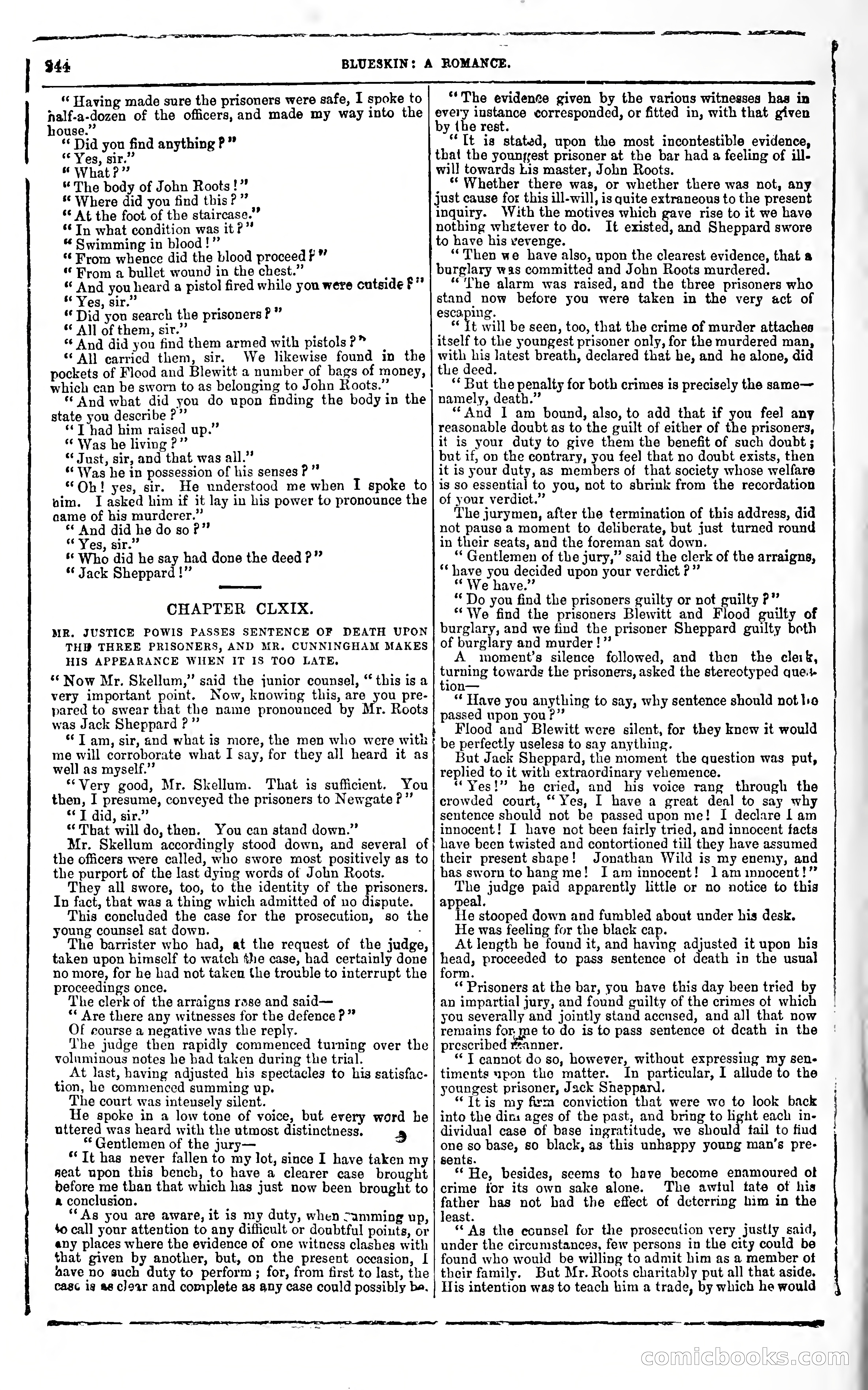
A restored page from Penny Dreadfuls, 1868. Page through the whole issue in the reader above.
📄 Transcribed text from this page (OCR, searchable)
Machine-transcribed from the original scan — historical spelling and the odd misread are preserved.
I IOI OO OE SF ITE EOI GILLIE IE 944 ‘ Having made sure the prisoners were safe, I spoke to nalf-a-dozen of the officers,and made my way into the house.” *‘ Did you find anything ?” ‘¢ Yes, sir.” “What?” “The body of John Roots!” Where did you find this?” ‘¢ At the foot of the staircase.” ‘¢ In what condition was it?’ “ Swimming in blood!” “From whence did the blood proceed F ”’ « Brom a bullet wound in the chest.” oo “ And you heard a pistol fired while yon were cutside FY ‘* Yes, sir.” ‘Did you search the prisoners P ” “ All of them, sit.” oo. And did you find them armed with pistols?” “All carricd them, sir. We likewise found in the pockets of Flood and Blewitt a number of bags of money, which ean be sworn to as belonging to John Roots.” ‘ And what did you do upon finding the body in the state you describe ?”’ ‘‘T had him raised up.” “© Was he living ?””’ “ Just, sir, and that was all.” ‘‘ Was he in possession of his senses P ” “Oh! yes, sir. He understood me when I spoke to vim. J asked him if it lay in his power to pronounce the aame of his murdcrer.” ** And did he do so?” * Yes, sir.” SS Who did he say had done the deed P” Jack Sheppard !” CHAPTER CLXIX. MR. JUSTICE POWIS PASSES SENTENCE OF DEATH UPON THR THREE PRISONERS, AND MR. CUNNINGHAM MAKES HIS APPEARANCE WIEN IT IS TOO LATE. ‘¢Now Mr. Skellum,” said the junior counsel, “ this is a very important point. Now, knowing this, are you pre- pared to swear that the name pronounced by Mr. Roots was Jack Sheppard ?” ‘TI am, sir, and what is more, the men who were with me will corroborate what I say, for they all heard it as well as myself.” “Very good, Mr. Skellum. That is sufficient. You then, I presume, conveyed the prisoners to Newgate?” ** JT did, sir.” “That will do, then. You can stand down.” Mr. Skellum accordingly stood down, and several of the officers were called, who swore most positively as to the purport of the last dying words of John Roots. They all swore, too, to the identity of the prisoners. In fact, that was a thing which admitted of uo dispute. This concluded the case for the prosecution, so the young counsel sat down. The barrister who had, at the request of the judge, taken upon himself to watch the case, had certainly done no more, for he had not taken Che trouble to interrupt the proceedings once. The clerk of the arraigns rase and said— ‘* Are there any witnesses for the defence?” Of course a negative was the reply. lhe judge then rapidly commenced turning over the voluminous notes he had taken during the trial. At last, having adjusted his spectacles to his satisfac- tion, he commenced summing up. The court was intensely silent. He spoke in a low tone of voice, but every word he uttered was heard with the utmost distinctness, 3 ** Gentlemen of the jury— ** It has never fallen to my lot, since I have taken my neat upon this bench, to have a clearer case brought before me than that which has just now been brought to a conclusion. ‘As you are aware, it is my duty, when -amming up, $0 call your attention to any difficult or doubtful poiuts, or any places where the evidence of one witness clashes with that given by another, but, on the present occasion, I aave no such duty to perform; for, from first to last, the case ig a8 cloar and complete as any case could possibly ba, eee BLUESKIN: A ROMANCE. i ‘*The evidente given by the various witnesses has in every instance corresponded, or fitted in, with that given by the rest. “Tt is stated, upon the most incontestible evidence, that the younsrest prisoner at the bar had a feeling of ill- will towards Lis master, John Roots. ‘* Whether there was, or whether there was not, any just cause for this ill-will, is quite extraneous to the present inquiry. With the motives which gave rise to it we have nothing whetever to do. It existed, and Sheppard swore to have his vevenge. “Then we have also, upon the clearest evidence, that a burglary was committed and John Roots murdered. “The alarm was raised, and the three prisoners who stand now before you were taken in the very act of escaping. ** It will be seen, too, that the crime of murder attaches itself to the youngest prisoner only, for the murdered man, with his latest breath, declared that he, and he alone, did the deed. ** But the penalty for both crimes is precisely the same— namely, death.” ‘And I am bound, also, to add that if you feel any reasonable doubt as to the guilt of either of the prisoners, it is your duty to give them the benefit of such doubt; but if, on the contrary, you feel that no doubt exists, then it is your duty, as members of that society whose welfare is so essential to you, not to shrink from the recordation of your verdict.” The jurymen, after the termination of this address, did not pause a moment to deliberate, but just turned round in their seats, and the foreman sat down. ‘* Gentlemen of the jury,” said the clerk of the arraigns, *‘ have you decided upon your verdict ?” ** We have.” “Do you find the prisoners guilty or not guilty ?” *‘ We find the prisoners Blewitt and Flood guilty of burglary, and we find the prisoner Sheppard guilty beth of burglary and murder!” A moment’s silence followed, and then the cler&, turning towards the prisoners, asked the stereotyped que.+ tion— “* Have you anything to say, why sentence should notte passed upon you ?” Flood and Blewitt were silent, for they knew it would be perfectly useless to say anything. But Jack Sheppard, the moment the question was put, replied to it with extraordinary vehemence. “Yes!” he cried, and his voice rang through the crowded court, *‘ Yes, I have a great deal to say why sentence should not be passed upon me! I declare | am innocent! I have not been fairly tried, and innocent facts have been twisted and contortioned tiil they have assumed their present shape! Jonathan Wild is my enemy, and has sworn to hang me! J am innocent! 1] am innocent!” The judge paid apparently little or no notice to this appeal. He stooped down and fumbled about under his desk. He was feeling for the black cap. At length he found it, and having adjusted it upon his head, proceeded to pass sentence of death in the usual form. ‘* Prisoners at the bar, you have this day been tried by an impartial jury, and found guilty of the crimes ot which you severally and jointly stand accnsed, and all that now remains for. me to do is to pass sentence ot dcath in the prescribed eanuer. “ T cannot do so, however, without expressing my sene timents upon the matter. In particular, I allude to the youngest prisoner, Jack Sneppanl. “Itis my firm conviction that were wo to look back into the dirs ages of the past, and bring to hght each in- dividual case of base ingratitude, we should fail to find one so base, so black, as this unhappy young man’s pre- sents. *‘ He, besides, seems to have become enamoured ot crime for its own sake alone. The awtul tate ot his father has not bad the effect of deterring bim in the least. “Ag the ecunsel for the prosecution very justly said, under the circumstances, few persons in the city could be found who would be willing to admit him as a member ot their family. But Mr. Roots charitably put all that aside. His intention was to teach him a trade, by which he would | 4 a | COIN Cc NOOlKKS CO >