
Penny Dreadfuls, 1868 · page 244 of 400
Black Bess; or, The Knight of the Road — A Tale of the Good Old Times — page 244: what you’re looking at
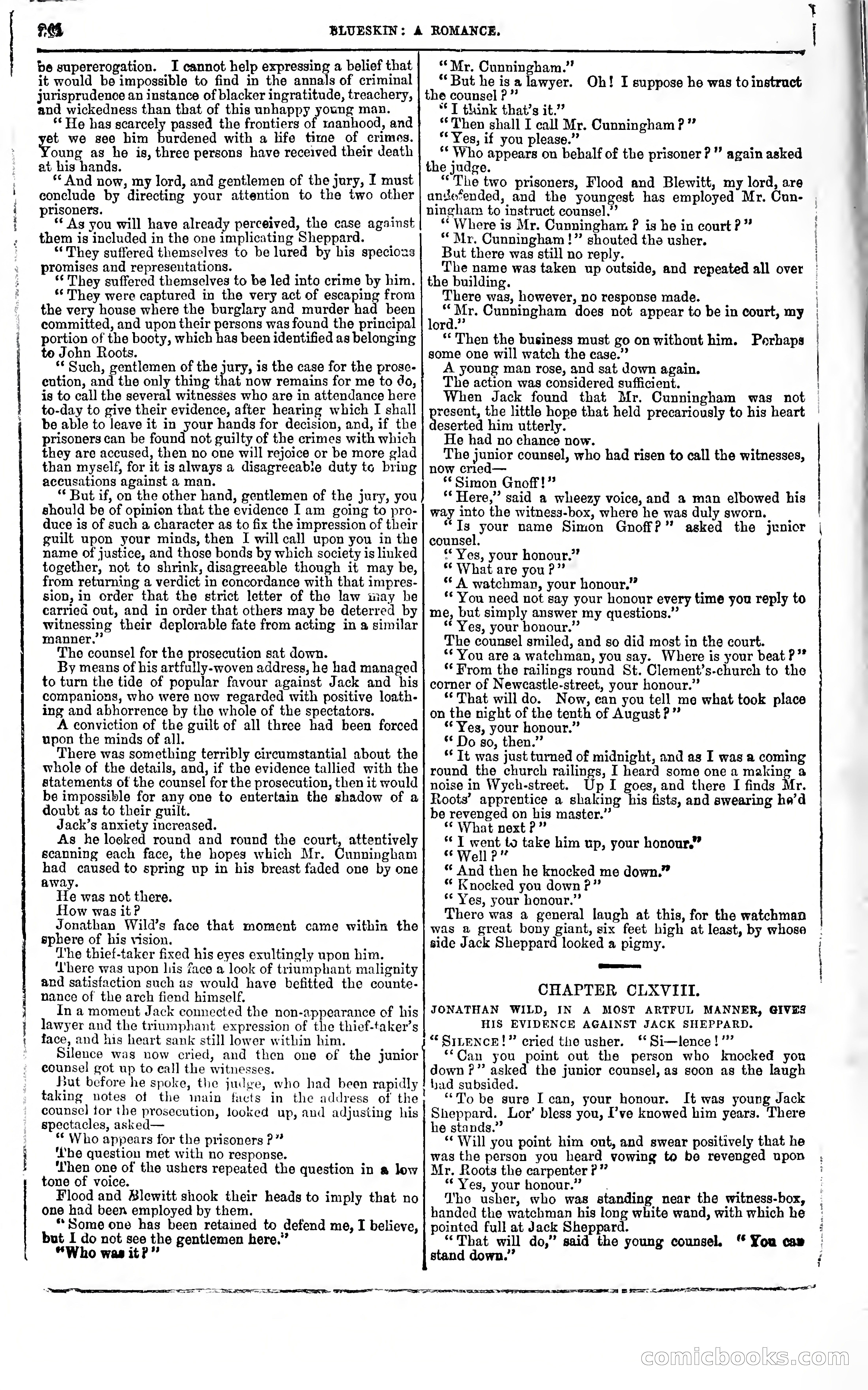
A restored page from Penny Dreadfuls, 1868. Page through the whole issue in the reader above.
📄 Transcribed text from this page (OCR, searchable)
Machine-transcribed from the original scan — historical spelling and the odd misread are preserved.
o%e erm Sf fag Ute -- HS yw — 74 be supererogation. I cannot help expressing a belief that it would be impossible to find in the annals of criminal BLUESKIN: & ROMANCE, eestor a “Mr. Cunningham.” “But he is a lawyer. Oh! I suppose he was to instruct jurisprudence an instance of blacker ingratitude, treachery, | the counsel ? ”’ and wickedness than that of this unhappy young man. ** He has scarcely passed the frontiers of raanhood, and et we see him burdened with a life time of crimos. oung as he is, three persons have received their death at his hands. ; ** And now, my lord, and gentlemen of the jury, I must conclude by directing your attention to the two other prisoners. . ; ** Ag you will have already perceived, the case against them is included in the one implicating Sheppard. “They suffered themselves to be lured by his speciozs promises and representations. ‘¢ They suffered themselves to be led into crime by him. ** They were captured in the very act of escaping from the very house where the burglary and murder had been committed, and upon their persons was found the principal portion of the booty, which has been identified as belonging te John Roots. ** Such, gentlemen of the jury, 1s the case for the prose- eution, and the only thing that now remains for me to do, is to call the several witnesses who are in attendance here to-day to give their evidence, after hearing which I shall be able to leave it in your hands for decision, and, if the prisoners can be found not guilty of the crimes with which they are accused, then no one will rejoice or be more glad than myself, for it is always a disagreeabie duty te bring accusations against a man. ** But if, on the other hand, gentlemen of the jury, you should be of opinion that the evidence [ am going to pro- duce is of such a character as to fix the impression of their guilt upon your minds, then I will call upon you in the name of justice, and those bonds by which society is linked together, not to shrink, disagreeable though it may be, from returning a verdict in concordance with that impres- sion, in order that the strict letter of the law iniay he carried out, and in order that others may be deterred by witnessing their deplorable fate from acting in a similar manner,” The counsel for the prosecution sat down. By means of his artfully-woven address, he had managed to turn the tide of popular favour against Jack and his companions, who were now regarded with positive loath- ing and abhorrence by the whole of the spectators. A conviction of the guilt of all three had been forced upon the minds of all. There was something terribly circumstantial about the whole of the details, and, if the evidence tallied with the statements of the counsel for the prosecution, then it would be impossible for any one to entertain the shadow of a doubt as to their guilt. Jack’s anxiety increased. As he looked round and round the court, attentively scanning each face, the hopes which Mr. Cunningham had caused to spring up in his breast faded one by one Away. Tle was not there. How was itP Jonathan Wild’s face that moment came within the sphere of his vision. ‘T'he thief-taker fixed his eyes exultingly upon him. here was upon his face a look of triumphant malignity and satisfaction such as would have befitted the counte- nance of the arch fiend himself. In a moment Jack connected the non-appearance of his lawyer and the triumphant expression of the thief-taker’s face, and his heart sank still lower within him. Silence was now cried, and then one of the junior counsel got up to eall the witnesses. But before he spoke, the judge, who had been rapidly taking notes of the inain facts in the address of the counsel for the prosecution, Jooked up, and adjusting his spectacles, asked— ** Who appears for the prisoners P” ‘he question met with no response. ‘I'hen one of the ushers repeated the question in a low tone of voice. Flood and Blewitt shook their heads to imply that no one had been employed by them. “Some one has been retained to defend me, I believe, but I do not see the gentlemen here.” “Who was it?” **T think that’s it.” ‘Then shall I call Mr. Cunningham ? ” ** Yes, if you please.” the ape appears on behalf of the prisoner?” again asked e judge. “The two prisoners, Flood and Blewitt, my lord, are anvefended, and the youngest has employed Mr. Cun- ningham to instruct counsel.’ ** Where is Mr. Cunningham P is he in court?” * Mr. Cunningham !” shouted the usher. But there was still no reply. The name was taken up outside, and repeated all over the building. There was, however, no response made. ee Cunningham does not appear to be in court, my ord. ** Then the business must go on without him. Perhaps some one will watch the cage.” A young man rose, and sat down again. The action was considered sufficient. When Jack found that Mr. Cunningham was not present, the little hope that held precariously to his heart deserted him utterly. He had no chance now. The junior counsel, who had risen to call the witnesses, now cried— **Simon Gnoff!” *‘ Here,” said a wheezy voice, and a man elbowed his way into the witness-box, where he was duly sworn. “Is your name Simon Gnoff?” asked the junior counsel. Yes, your honour.” ** What are you?” ** A watchman, your honour.” ** You need not say your honour every time you reply to me, but simply answer my questions.” *¢ Yes, your honour.” The counsel smiled, and so did most in the court. ** You are a watchman, you say. Where is your beat?” **¥rom the railings round St. Clement’s-church to the corner of Newcastle-street, your honour.” “That will do. Now, can you tell me what took place on the night of the tenth of August?” “Yes, your honour.” ** Do so, then.” ** It was just turned of midnight, and as I was a coming round the church railings, I heard some one a making a noise in Wych-street. Up I goes, and there I finds Mr. Roots’ apprentice a shaking his fists, and swearing he’d be revenged on his master.” ** What next?” ** T went to take him up, your honour,” Well?” “ And then he knocked me down.” * Knocked you down P” ** Yes, your honour.” There was a general laugh at this, for the watchman was a great bony giant, six feet high at least, by whose side Jack Sheppard looked a pigmy. CHAPTER CLXVIII. JONATHAN WILD, IN A MOST ARTFUL MANNER, GIVES HIS EVIDENCE AGAINST JACK SHEPPARD. “SILENCE!” eried the usher. ‘‘Si—lence!’” **Can you point out the person who knocked you down?” asked the junior counsel, as soon as the laugh bad subsided. “To be sure I can, your honour. It was young Jack Sheppard. Lor’ bless you, ?ve knowed him years. There he stands.” “Will you point him ont, and swear positively that he was the person you heard vowing to be revenged upon Mr. Roots the carpenter ?” ** Yes, your honour.” Tho usher, who was standing near the witness-box, handed the watchman his long white wand, with which he pointed full at Jack Sheppard. “That will do,” said the young counsel. rf 3 stand down.” 3 ge | BFE. REI OP RII CES POI PR EE Nis er FS Jw A, ~ oo eo ee —e SS rf 0 Nea ie BEA ces a Eo op ny te EO DOO SS 5} (SO)