
Penny Dreadfuls, 1868 · page 176 of 400
Black Bess; or, The Knight of the Road — A Tale of the Good Old Times — page 176: what you’re looking at
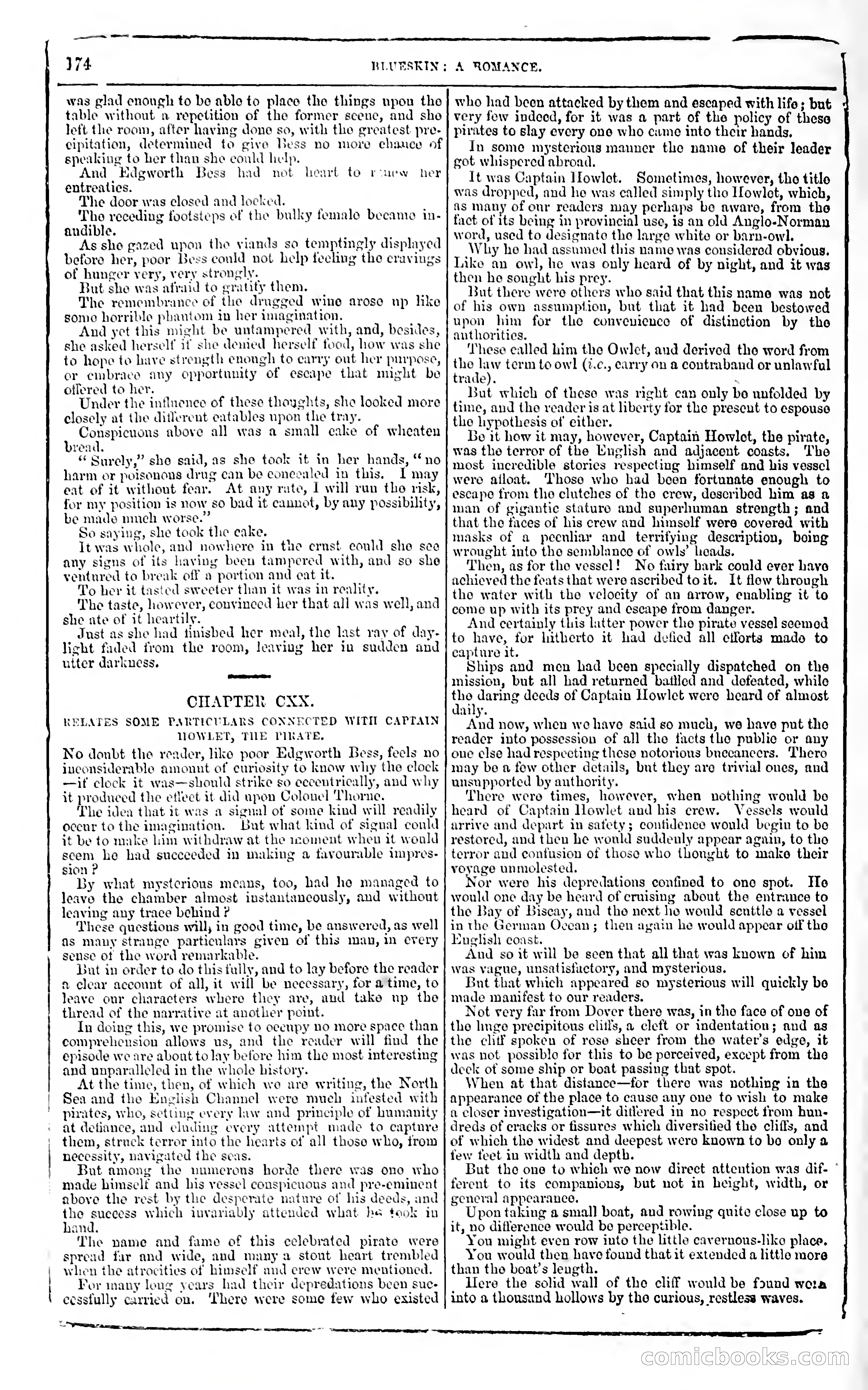
A restored page from Penny Dreadfuls, 1868. Page through the whole issue in the reader above.
📄 Transcribed text from this page (OCR, searchable)
Machine-transcribed from the original scan — historical spelling and the odd misread are preserved.
4 N \ cessfully carried on. —— ee 74 was glad enough to be able to place the things npou tho table without n repetition of the former scene, and she left the roam, after having done so, with the greatest pre- cipitation, determined to give Bess no more chance of speaking to her than she could help. And Kdgworth Bess had not heart to rouew her entreaties. The door was closed and locked. Tho receding footsteps of the bulky femalo beeamo in- audible. As she gazed upon the viands sa temptingly displayed before her, poor Bess could not help feeling the cravings of hunger very, very strongly. But she was afraid to gratity them. The remembrance of the drugged wine arose up like somo horrible phantom in her imagination. And yet this might be untampered with, and, besides, she asked herself if she demed herself food, how was she to hope to have strength enongh to carry out her purpose, or embrace any opportunity of escape that might be offered to her. Under the influence of these thayghts, she looked more closely at the different catables upon the tray. Conspicuons above all was a small eake of wheaten bread, “Surely,” she said, as she took it in her hands, “ no harm or poisonons drug can be concealed in this. 1 may eat of it without fear. At any rate, T will run the msk, for my position is now so bad it cannot, by any possibility, be made mneh worse.” So saying, she took the cake. It was whole, and nowhere in the ernst eonld she see any signs of its having been tampered with, and so she ventured to break off a portion and eat it. To her it tasted sweeter than it was in reality. The taste, however, convinecd her that all was well, and she ute of it heartily. Just as she had finisbed her meal, the last ray of day- licht faded from the room, leaving her in sudden and utter darkuess. Guninp.aeine CHAPTER CAN. RELATES SOME PARTICULARS CONNECTED WITIT CAPTAIN HOWLET, THE PIRATE, No donbt the reader, hike poor Edgworth Bess, feels no inveonsiderable amonnt of curiosity to know why the clock —if clock it was—should strike so cecentrically, and why it produced the etfeet it did upon Colauel Thorne. The idea that it was a signal of some kind will readily oceur to the imagination. But what kind of signal conld it be to make lim withdraw at the moment when it would scem he had succeeded in making a favourable impres- sion ? By what mystcrious means, too, had he managed to leave the chamber almost iustantancously, and without leaving any trace behind ? These questions will, in good time, be answered, as well as many strange partienlars given of this man, in every sense ot the word remarkable. But in order to do this fully, and to lay before the reader 2 elear aceonnt of all, it will be neeessary, for a time, to leave our characters where they are, aud take up the thread of the narrative at another point. In doing this, we promise to oceupy no more space than comprehension allows us, and the reader will find the episode we are about to lay before him the most interesting and unparalleled in the whole lnistory. At the time, then, of which wo ure writing, the North Sea and the Enghsh Channel were muel infested with pirates, who, setung every law and principle of humanity at defiance, aud eluding every attempt made to captnre them, struck terror into the hearts of all those who, trom necessity, navigated the seas. But among the numerous horde there was ono who made himself and Ins vessel conspicuous and pre-eminent above the rest by the desperate nature of Ins deeds, and the suecess which invariably attended what be took i hand. The name and fame of this eelebrated pirate were spread far and wide, and many a stout heart trembled when the atrocities of himself and crew were mentioned. Por inany Jong years had their depredations been sue- There were some few who existed ee — a — RBLUESKIN: A ROMANCE. SSS ST es aR who had been attacked by them and escaped with life; but very few indeed, for it was a part of the policy of these pirates to slay every one who came into their hands, In some mysterious manner the name of their leader got whispered abroad. It was Captain Howlet. Sometimes, however, tho title was dropped, and he was called simply tho Ifowlet, which, as many of onr readers may perhaps be aware, from the fact of its being in provincial use, is an old Anglo-Norman word, used to designate the large white or barn-owl. Why he had assumed this name was considered obvious. Inke an owl, he was only heard of by night, and it was then he songht his prey. But there were others who said that this name was not of his own assumption, but that it had been bestowed upon him for the convenienee of distinction by the authorities. These called him the Owlct, and derived the word from ian term toowl (2.c., carry on a contraband or unlawful rade). s But which of theso was right can only bo unfolded by tiine, and tho reader is at hberty for the present to espouse the hypothesis of either. Bo it how it may, however, Captain Howlot, the pirate, was the terror of the Enghsh and adjacent coasts. The most incredible stories respecting himself and his vessel were afloat. Those who had been fortunate enough to escape from the clutches of the crew, described him as a nan of gigantie stature and superhuman strength; and that the faces of his crew and himself were covered with masks of a peenhar and terrifying description, boing wrought into the semblance of owls’ heads. Then, as for the vessel! No fairy bark could ever have achieved the feats that were asenbed toit. It flow through the water with the velocity of an arrow, enabling it to come up with its prey and escape from danger. And certainly this latter power the pirate vessel seemed to have, for Intherto 1t lad deficd all etforts made to eapture it. Ships and men had been specially dispatched on the mission, but all had returned battled and defeated, while eee deeds of Captain Howlet were heard of almost aily. And now, when we have said so much, we have put the reader into possession of all the facts the publie or any one else had respecting these notorious buecaneers. Thero may be a few other details, but they are trivial ones, and unsupported by authority. There were times, however, when nothing would be heard of Captain Howlet and hs crew. Vessels would arrive and depart in safety; confidence would begin to be restored, and then he wonld suddenly appear agnin, to the terror aud confusion of those who thonght to make their voyage unmolested. Nor were his depredations confined to one spot. He would one day be heard of cruising about the entrance to the Bay of Biscay, and the next he would senttle a vessel in the German Ovean; then again he would appear off the Eughsh const. And so it will be seen that all that was known of hin was vague, unsatisfuctory, and mysterious. But that which appeared so mysterious will quickly be made manifest to our readers. Not very far from Dover there was, in the face of one of the lhnge precipitous clits, a cleft or undentation; and as the chif spoken of rose sheer from the water's edge, it was not possible for this to be perceived, except from the deek of some slip or boat passing that spot. When at that distance—for there was nothing in the appearance of the place to cause any one to wish to make a closer investigation—it ditlered im no respect from hun- dreds of cracks or fissures which diversitied the cliffs, and of which the widest and deepest were known to bo only a tew feet in width and depth. But the one to which we now direct attention was dif- * ferent to its companions, but not in height, width, or general appearance. Upon taking a small boat, and rowing quite close up to it, no difference would be perceptible. You might even row into the little cavernous-liko place. You would then have found thatit extended a httle more than the boat’s length. Here the solid wall of the cliff would be found wera into a thousand hollows by the curious, restless waves. SE A ee RSS RNC FH” a” = COMICHOOKS.CO 5}