
Penny Dreadfuls, 1868 · page 169 of 400
Black Bess; or, The Knight of the Road — A Tale of the Good Old Times — page 169: what you’re looking at
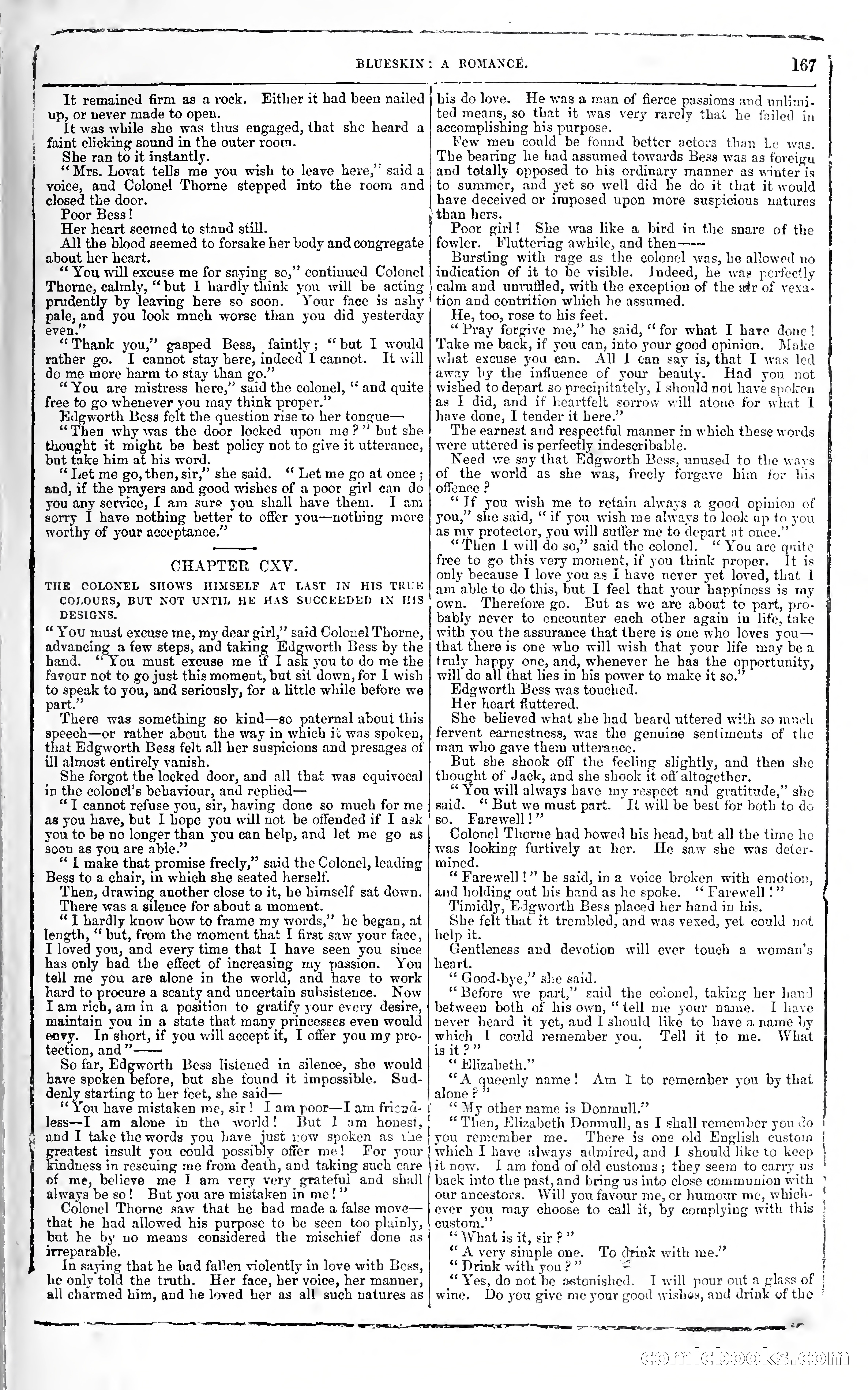
A restored page from Penny Dreadfuls, 1868. Page through the whole issue in the reader above.
📄 Transcribed text from this page (OCR, searchable)
Machine-transcribed from the original scan — historical spelling and the odd misread are preserved.
Pees * PTI RIT aE a TT ET TS — ae RC RI I 7 BLUESKIN: A ROMANCE, It remained firm as a rock. Either it had been nailed up, or never made to open. It was while she was thus engaged, that she heard a faint clicking sound in the outer room. She ran to it instantly. ‘“Mrs. Lovat tells me you wish to leave here,’ saida voice, and Colonel Thorne stepped into the room and closed the door. Poor Bess! Her heart seemed to stand still. All the blood seemed to forsake her body and congregate about her heart. “You will excuse me for saying so,” continued Colonel Thorne, calmly, “but I hardly think you will be acting prudently by leaving here so soon. Your face 1s ashy pale, and you look munch worse than you did yesterday even.” ‘Thank you,’ gasped Bess, faintly; “but I would rather go. I cannot stay here, indeed I cannot. It will do me more harm to stay than go.”’ “You are mistress here,” said the colonel, “ and quite free to go whenever you may think proper.” Edgworth Bess felt the question rise to her tongue— “Then why was the door locked upon me?” but she thought it might be hest policy not to give it utterance, but take him at his word. ** Let me go, then, sir,” she said. ‘‘ Let me go at once ; and, if the prayers and good wishes of a poor girl can do you any service, I am sure you shall have them. I am sorry I have nothing better to offer you—nothing more worthy of your acceptance.” Ene) CHAPTER CXY. THE COLONEL SHOWS HIMSELF AT LAST IN HIS TRUE COLOURS, BUT NOT UNTIL HE HAS SUCCEEDED IN EIS DESIGNS. * You must excuse me, my dear girl,” said Colonel Thorne, advancing a few steps, and taking Edgworth Bess by the hand. ‘* You must excuse me if I ask you to do me the favour not to go just this moment, but sit down, for I wish to speak to you, and seriously, for a little while before we part.’ There was something so kind—so paternal about this speech—or rather about the way in which 1% was spoken, that Edgworth Bess felt all her suspicions and presages of wl almost entirely vanish. She forgot the locked door, and all that was equivocal in the colonel’s behaviour, and repliied— “‘T cannot refuse you, sir, having done so much for me as you have, but I hope you will not be offended if I ask you to be no longer than you can help, and let me go as soon as you are able.” ‘* I make that promise freely,” said the Colonel, leading Bess to a chair, in which she seated herself. Then, drawing another close to it, he himself sat down. There was a silence for about a moment. © I hardly know how to frame my words,” he began, at length, “‘ but, from the moment that [ first saw your face, I loved you, and every time that 1 have seen you since has only had the effect of increasing my passion. You tell me you are alone in the world, and have to work hard to procure a scanty and uncertain subsistence. Now I am rich, amin a position to gratify your every desire, maintain you in a state that many princesses even would envy. In short, if you will accept it, I offer you my pro- tection, and” So far, Edgworth Bess listened in silence, she would have spoken before, but she found it impossible. Sud- denly starting to her feet, she said— ** You have mistaken me, sir! I am poor—I am fricaa- less—I am alone in the world! But I am honest, and I take the words you have just row spoken as vie; you remember me. - greatest insult you could possibly offer me! kindness in rescuing me from death, and taking such care |1t now. of me, believe me I am very very grateful and shall always be so! But you are mistaken in me!” Colonel Thorne saw that he had made a false move— that he had allowed his purpose to be seen too plainly, bat he by no means considered the mischief done as irreparable. In saying that he bad fallen violently in love with Bess, he only told the truth. Her face, her voice, her manner, all charmed him, and he loved her as all such natures as od his do love. He was aman of fierce passions and unlimi- ted means, so that it was very rarely that he failed in accomplishing his purpose. Few men could be found better actors than he was. The bearing he had assumed towards Bess was as foreigu and totally opposed to his ordinary manner as winter is to summer, and yet so well did he do it that it would have deceived or imposed upon more suspicious natures ‘than hers. Poor girl! She was like a bird in the snare of the fowler. Fluttering awhile, and then——— I > I SS a SS Si enh pnp npg Pr ee So PS Sy py > ret a i er OO eT OE EE ae . ee td La = me © — eG Tr Bursting with rage as the colonel was, he allowed no indication of it to be visible. Indeed, he was perfectly calm and unrufiled, with the exception of the air of vexa- tion and contrition which he assumed. He, too, rose to his feet. ‘Pray forgive me,” he said, *‘ for what I hare done! Take me back, if you can, into your good opinion. Make what excuse you can. All I can say is, that I was led away hy the influence of your beauty. Had you not wished to depart so precipitately, I should not have spoken as I did, and if heartfelt sorrow will atone for what I have done, I tender it here.” The earnest and respectful manner in which these words were uttered is perfectly indescribable. Need we say that Edgworth Bess, unused to the wavs of the world as she was, frecly forgave him for his offence ? “If you wish me to retain always a good opinion of you,” she said, “if you wish me always to look up to you as my protector, you will sutfer me to depart at once.” Then I will do so,” said the colonel. ‘‘ You are quite free to go this very moment, if you think proper. It is only because I love you as i have never yet loved, that | am able to do this, but I feel that your happiness is my own. Therefore go. But as we are about to part, pro- bably never to encounter each other again in life, take with you the assurance that there is one who loves you— that there is one who will wish that your life may bea truly happy one, and, whenever he has the opportunity, will do all that lies in his power to make it so.” Edgworth Bess was touched. Her heart fluttered. She believed what she had beard uttered with so much fervent earnestness, was the genuine sentiments of the man who gave them utterance. But she shook off the feeling slightly, and then she thought of Jack, and she shook it off altogether. ‘You will always have my respect and gratitude,” she said. ‘“‘ But we must part. It will be best for both to do so. Farewell!” Colonel Thorne had bowed his head, but all the time he was looking furtively at her. Mle saw she was deter- mined. ** Farewell!’’ he said, in a voice broken with emotion, and holding out his hand ashe spoke. ‘‘ Farewell!” Timidly, Elgworth Bess placed her hand in his. 7 pee felt that it trembled, and was vexed, yet could not elp it. Gentleness and devotion will ever touch a woman’s heart. ‘ Good-bye,” she said. “Before we part,” said the colonel, taking her land between both of his own, ‘tell me your name. I liave never heard it yet, aud I should like to have a name by which I could remember you. Tell it to me. What is it?” ** Elizabeth.” “cA queenly name! Am I to remember you by that alone ?” ‘* My other name is Donmull.” “Then, Elizabeth Donmull, as I shall remember you do There is one old English custoin For your | which I have always admired, and I should like to keep 4 \ I am fond of old customs; they seem to carry us back into the past, and bring us into close communion with °* our ancestors. Will you favour me, cr humour me, which- ever you may choose to call it, by complying with this | custom.”’ : * What is it, sir ?”’ “A very simple one. To drink with me.” “Drink with you?” o Yes, do not be astonished. TI will pour out a glass of |! wine. Do you give me your good wishes, and drink of the ‘ ae > 7 NOOKS EO CONMIC S 5}