
Penny Dreadfuls, 1868 · page 16 of 400
Black Bess; or, The Knight of the Road — A Tale of the Good Old Times — page 16: what you’re looking at
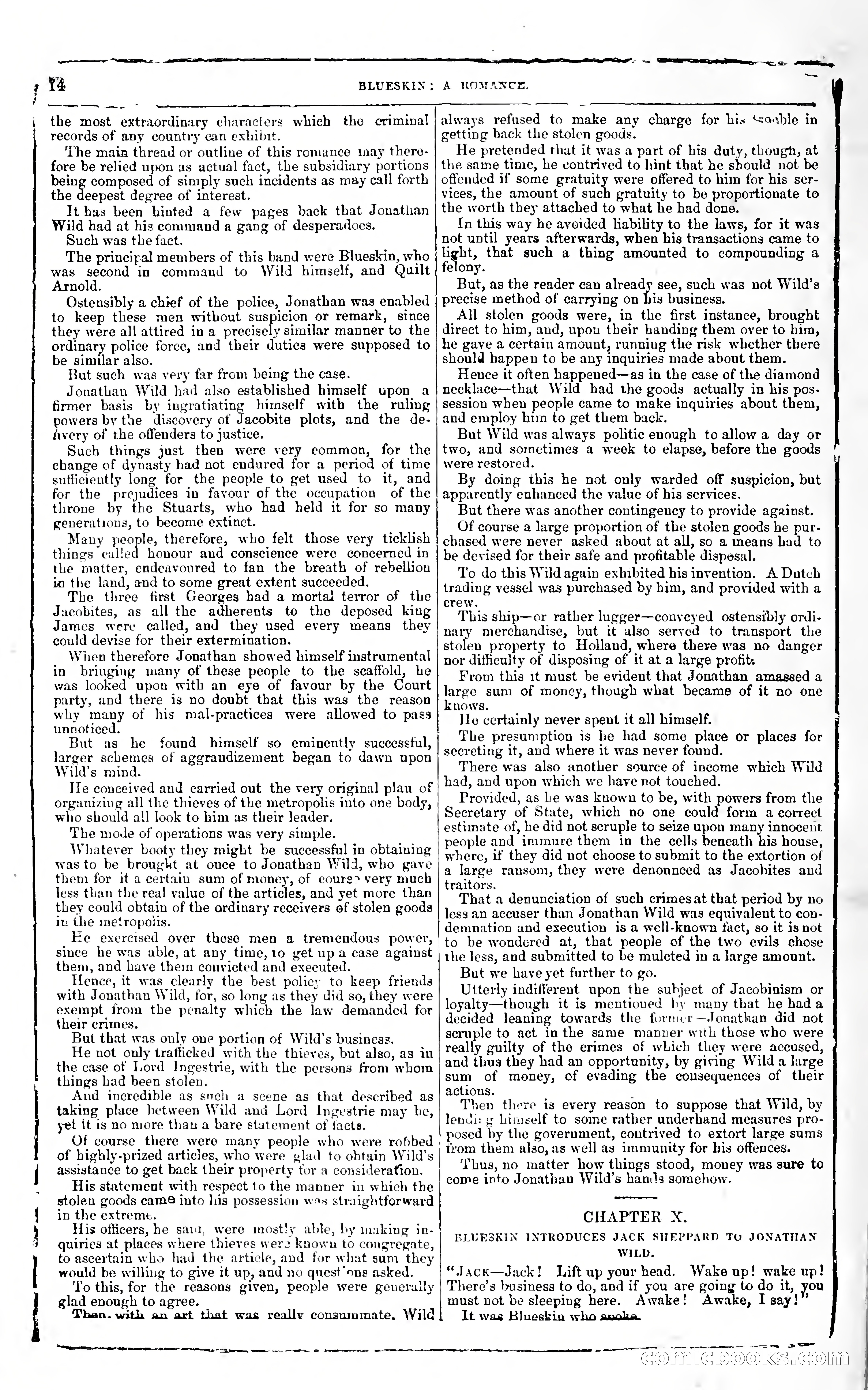
A restored page from Penny Dreadfuls, 1868. Page through the whole issue in the reader above.
📄 Transcribed text from this page (OCR, searchable)
Machine-transcribed from the original scan — historical spelling and the odd misread are preserved.
‘ ee Serres <2 ener, ¥4 the most extraordinary characters which the criminal records of any country can exhibit. The main thread or outline of this romance may there- fore be relied upon as actual fact, the subsidiary portions being composed of simply such incidents as may call forth the Nespest degree of interest. It has been hinted a few pages back that Jonathan Wild had at his command a gang of desperadoes. Such was the fact. The principal members of this band were Blueskin, who was second in command to Wild himself, and Quult Arnold. Ostensibly a chief of the police, Jonathan was enabled to keep these men without suspicion or remark, since they were all attired in a precisely similar manner to the ordinary police force, and their duties were supposed to be similar also. But such was very far from being the case. Jonathan Wild had also established himself upon a firmer basis by ingranaane himself with the ruling powers by the discovery of Jacobite plots, and the de- fivery of the offenders to justice. Such things just then were very common, for the change of dynasty had not endured for a period of time sufficiently long for the people to get used to it, and for the prejudices in favour of the occupation of the throne by the Stuarts, who had held it for so many generations, to become extinct. Many people, therefore, who felt those very ticklish things called honour and conscience were concerned in the matter, endeavoured to fan the breath of rebellion in the land, and to some great extent succeeded. The three first Georges had a mortal terror of tlie Jacobites, as all the adherents to the deposed king James were called, and they used every means they eould devise for their extermination. When therefore Jonathan showed himself instrumental in briuging many of these people to the scaffold, he was looked upon with an eye of favour by the Court party, and there is no doubt that this was the reason why many of his mal-practices were allowed to pass unnoticed. But as he found himself so eminently successful, larger schemes of aggrandizement began to dawn upon Wild's mind. fe conceived and carried out the very original plau of organizing all the thieves of the metropolis into one bods, who should all look to him as their leader. The mode of operations was very simple. Whatever booty they might be successful in obtaining was to be brought at ouce to Jonathan Wild, who gave them for it a certain sum of money, of courg> very much Jess than the real value of the articles, and yet more than they could obtain of the ordinary receivers of stolen goods in the metropolis. Fe exercised over these men a tremendous power, since he was able, at any time, to get up a case against them, and have them convicted and executed. Hence, it was clearly the best policy to keep friends with Jonathan Wild, for, so long as they did so, they were exempt from the penalty which the law demanded for their crimes. But that was ouly one portion of Wild’s business. He not only trathcked with the thieves, but also, as in the case of Lord Ingestrie, with the persons from whom things had been stolen. And incredible as such a scene as that described as taking place between Wild and Lord Ingestrie may be, yet it is no more than a bare statement of facts. Of course there were many people who were robbed of highly-prized articles, who were glad to obtain Wild’s assistance to get back their property tor a consideration. His statement with respect to the manner in which the stolen goods cam® into luis possession ws straightforward in the extreme. His officers, he saia, were mostly able, by making in- quiries at places where thieves were known to congregate, to ascertain who had the article, and for what sum they would be willing to give it up, and no quest ons asked. To this, for the reasons given, people were generally glad enough to agree. Then. with an art that was really consummate. Wild NN eNO OS EE Oe bpm, ewe te ee wet ne BLUESKIN: A Pt = eed ROMANCE. _ always refused to make any charge for his ‘<oxble in getting back the stolen goods. He pretended that it was a part of his duty, though, at the same time, he vontrived to hint that he should not be offended if some gratuity were offered to him for his ser- vices, the amount of such gratuity to be proportionate to the worth they attached to what he had done. In this way he avoided hability to the laws, for it was not until years afterwards, when his transactions came to hight, that such a thing amounted to compounding a felony. But, as the reader can already see, such was not Wild’s precise method of carrying on his business. All stolen goods were, in the first instance, brought direct to him, and, upon their handing them over to him, he gave a certain amount, running the risk whether there should happen to be any inquiries made about them. Hence it often happened—as in the case of the diamond necklace—that Wild had the goods actually in his pos- session when people came to make inquiries about them, and employ him to get them back. But Wild was always politic enough toallowa day or two, and sometimes a week to elapse, before the goods were restored. By doing this be not only warded off suspicion, but apparently enhanced the value of his services. But there was another contingency to provide against. Of course a large proportion of the stolen goods he pur- chased were never asked about at all, so a means had to be devised for their safe and profitable dispesal. To do this Wild again exhibited his invention. A Dutch trading vessel was purchased by him, and provided with a crew. This ship—or rather lugger—conveyed ostensibly ordi- nary merchandise, but itt also served to transport the stolen property to Holland, where there was no danger nor difficulty of disposing of it at a large profit. From this it must be evident that Jonathan amassed a large sum of money, though what became of it no one knows. He certainly never spent it all himself. The presumption is he had some place or places for secreting it, and where it was never found. There was also another source of income which Wild had, and upon which we have not touched. Provided, as he was known to be, with powers from the Secretary of State, which no one could form a correct estimate of, he did not scruple to seize upon many innocent people and immure them in the cells beneath his house, where, if they did not choose to submit to the extortion of a large ransom, they were denounced as Jacobites aud traitors. That a denunciation of such crimesat that period by no less an accuser than Jonathan Wild was equivalent to con- demnation and execution is a well-known fact, so it is not to be wondered at, that people of the two evils chose the less, and submitted to be mulcted in a large amount. But we have yet further to go. Utterly indifferent upon the subject of Jacobinism or loyalty—though it is mentioned by many that he hada decided leaning towards the former —Jonathan did not scruple to act in the same manver with those who were really guilty of the erimes of which they were accused, and thus they had an opportunity, by giving Wild a large sum of money, of evading the consequences of their actions. ; Then there is every reason to suppose that Wild, by lendi: e linmself to some rather underhand measures pro- posed by the government, contrived to extort large sums trom them also, as well as immunity for his offences. Thus, no matter how things stood, money was sure to come into Jonathan Wild’s hans somehow. CHAPTER X. INTRODUCES JACK SHEPPARD To JONATHAN WILD. “Jack—Jack! Lift up your head. Wake up! wake up! There’s business to do, and if you are going to do it, you must not be sleeping here. Awake! Awake, I say!” It was Blueskin who anoka. BLUESKIN ~~, | t=” ANIClOOOL EG SS} o(CO) =