
Penny Dreadfuls, 1868 · page 119 of 400
Black Bess; or, The Knight of the Road — A Tale of the Good Old Times — page 119: what you’re looking at
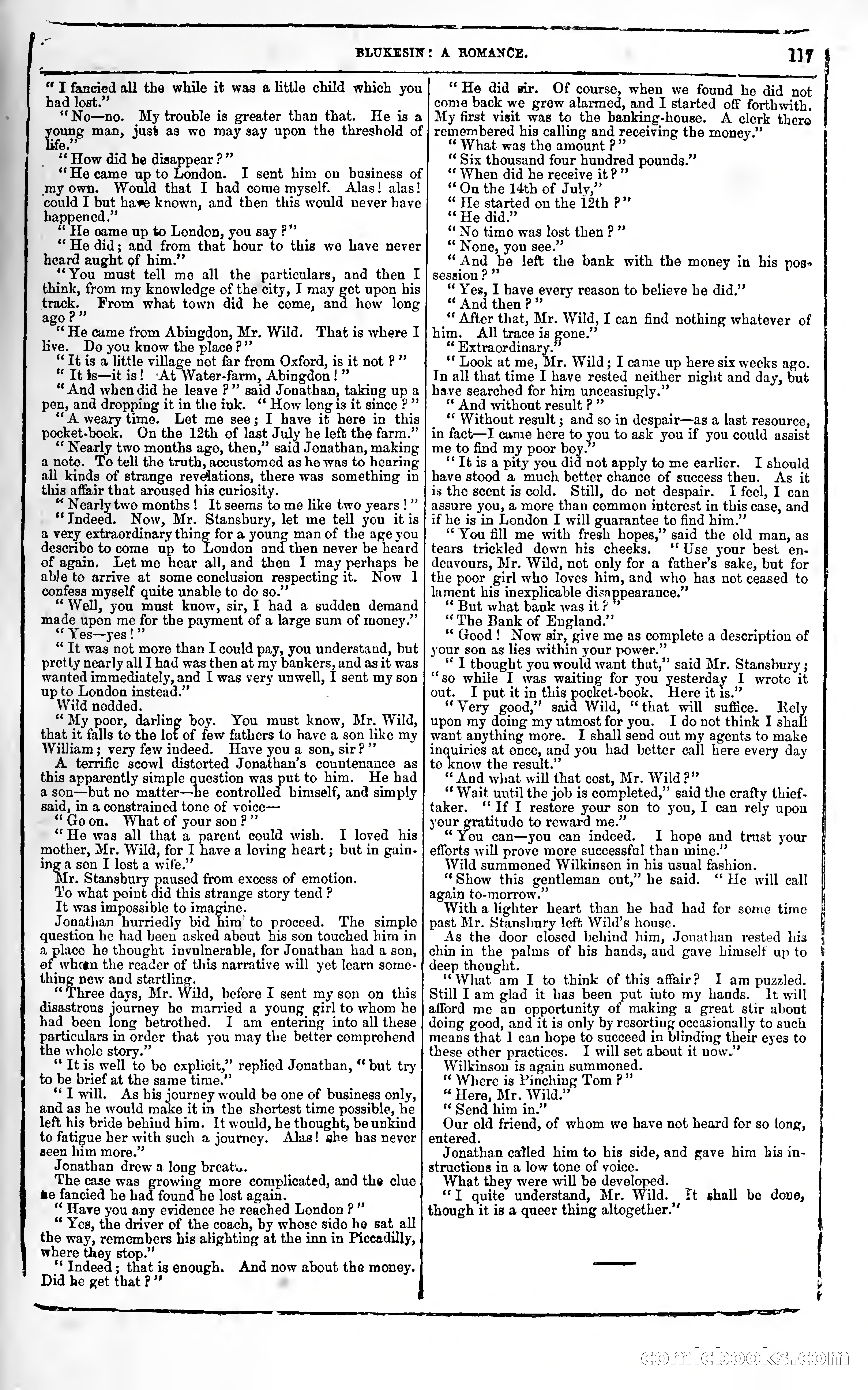
A restored page from Penny Dreadfuls, 1868. Page through the whole issue in the reader above.
📄 Transcribed text from this page (OCR, searchable)
Machine-transcribed from the original scan — historical spelling and the odd misread are preserved.
ow e BLUKESIN: A ROMANCE. a I fancied all the while it was a httle child which you had lost.” “No—no. My trouble is greater than that. He isa young man, juss as we may say upon the threshold of re) D>) ‘* How did he disappear ?”’ *“He came upto London. I sent him on business of my own. Would that I had come myself. Alas! alas! could I but have known, and then this would never have happened.” ‘“* He oame up to London, you say ?” “He did; and from that hour to this we have never heard aught of him.”’ “You must tell me all the particulars, and then I think, from my knowledge of the city, I may get upon his igs From what town did he come, and how long ago ‘He came from Abingdon, Mr. Wild. That is where I hve. Do you know the place ?” “It is a little village not far from Oxford, is it not ? ” “ It is—it is! -At Water-farm, Abingdon! ” ‘* And when did he leave ?” said Jonathan, taking up a pen, and dropping it in the ink. ‘‘ How long is it since ? ” ‘‘A weary time. Let me see; I have it here in this pocket-book. On the 12th of last July he left the farm.” ** Nearly two months ago, then,” said Jonathan, making a note. To tell the truth, accustomed as he was to hearing all kinds of strange revelations, there was something in this affair that aroused his curiosity. “Nearly two months! It seems to me lke two years!” ‘Indeed. Now, Mr. Stansbury, let me tell you it is a very extraordinary thing for a young man of the age you describe to come up to ieondon and then never be heard of again. Let me hear all, and then I may perhaps be able to arrive at some conclusion respecting it. Now 1 confess myself quite unable to do so.” ‘Well, you must know, sir, I had a sudden demand made upon me for the payment of a large sum of money.”’ ““Yes—yes!” “It was not more than I could pay, you understand, but pretty nearly all I had was then at my bankers, and as it was wanted immediately, and I was very unwell, I sent my son up to London instead.” . Wild nodded. “My poor, darling boy. You must know, Mr. Wild, that it falls to the lot of few fathers to have a son hke my William; very few indeed. Have you a son, sir?”’ A terrific scowl distorted Jonathan’s countenance as this apparently simple question was put to him. He had ason—but no matter—he controlled himself, and simply said, in a constrained tone of voice— “Goon. What of your son?” ‘He was all that a parent could wish. I loved his mother, Mr. Wild, for I have a loving heart; but in gain- ing a son I lost a wife.” {r. Stansbury paused from excess of emotion. To what point did this strange story tend ? It was impossible to imagine. Jonathan hurriedly bid him to proceed. The simple question he had been asked about his son touched him in a place he thought invulnerable, for Jonathan had a son, ef whcen the reader of this narrative will yet learn some- thing new and startling. “Three days, Mr. Wild, before I sent my son on this disastrous journey he married a young girl to whom he had been tong betrothed. I am entering into all these particulars in order that you may the better comprehend the whole story.” ““ It is well to be explicit,” replied Jonathan, “ but try to be brief at the same time.” “Twill. As his journey would be one of business only, and as he would make it in the shortest time possible, he left his bride behind him. It would, he thought, be unkind to fatigue her with such a journey. Alas! she has never seen him more.” Jonathan drew a long breatu. The case was growing more complicated, and the clue be fancied he had found he lost again. ‘* Have you any evidence he reached London ?” * Yes, the driver of the coach, by whose side he sat all the way, remembers his alighting at the inn in Piccadilly, where they stop.” “Indeed ; that is enough. And now about the money. Did he get that ?” Ei pyre 117 “He did sir. Of course, when we found he did not come back we grew alarmed, and I started off forthwith, My first visit was to the banking-house. A clerk there remembered his calling and receiving the money.” “ What was the amount ?” ‘Six thousand four hundred pounds.” ** When did he receive it P”’ **On the 14th of July,” “* He started on the 12th P”’ ‘* He did.” “No time was lost then ? ” “* None, you see.” “And he left the bank with the money in his pogo session ? ”’ “Yes, I have every reason to believe he did.” *¢ And then ? ” “* After that, Mr. Wild, I can find nothing whatever of him. All trace is gone.” ‘* Extraordinary.’ ‘* Look at me, Mr. Wild; I came up here six weeks ago. In all that time I have rested neither night and day, but have searched for him unceasingly.”’ ‘** And without result ? ” ‘** Without result; and so in despair—as a last resource, in fact—I came here to you to ask you if you could assist me to find my poor boy.” ‘* Tt is a pity you did not apply to me earlier. I should have stood a much better chance of success then. As it is the scent is cold. Still, do not despair. I feel, I can assure you, a more than common interest in this case, and if he is in London I will guarantee to find him.” ‘* You fill me with fresh hopes,” said the old man, as tears trickled down his cheeks. ‘‘ Use your best en- deavours, Mr. Wild, not only for a father’s sake, but for the poor girl who loves him, and who has not ceased to lament his inexplicable disappearance.” ‘€ But what bank was it ¥ ” “The Bank of England.” “Good! Now sir, give me as complete a description of your son as hes within your power.” “I thought you would want that,” said Mr. Stansbury ; “so while I was waiting for you yesterday I wrote it out. I put it in this pocket-book. Here it is.” “Very good,” said Wild, “that will suffice. Rely upon my doing my utmost for you. I donot think I shall want anything more. I shall send out my agents to make rik kn at once, and you had better call here every day to know the result.” ** And what will that cost, Mr. Wild ?” “Wait until the job is completed,” said the crafty thief- taker. ‘“‘If I restore your son to you, I can rely upon your gratitude to reward me.” ‘¢ You can—you can indeed. I hope and trust your efforts will prove more successful than mine.” Wild summoned Wilkinson in his usual fashion. ‘““Show this gentleman out,” he said. ‘“‘ He will call again to-morrow.” With a lighter heart than he had had for some time past Mr. Stansbury left Wild’s house. As the door closed behind him, Jonathan rested hits chin in the palms of his hands, and gave himself up to deep thought. “What am I to think of this affair? I am puzzled. Still Iam glad it has been put into my hands. It will afford me an opportunity of making a great stir about doing good, and it is only by resorting occasionally to such means that 1] can hope to succeed in blinding their eyes to these other practices. I will set about it now.” Wilkinson is again summoned. ‘Where is Pinching Tom ?” “ Here, Mr. Wild.” *€ Send him in.” Our old friend, of whom we have not heard for so long, entered. Jonathan catled him to his side, and gave him his in- structions in a low tone of voice. What they were will be developed. ‘*T quite understand, Mr. Wild. though it is a queer thing altogether.” et shall be done, Sr eo eeneremnenggeremeeseer pepe werner eee nes ce rent panne pepper gO GST ETI ae i COmiIcboooks (SO) 5}