
Penny Dreadfuls, 1868 · page 109 of 400
Black Bess; or, The Knight of the Road — A Tale of the Good Old Times — page 109: what you’re looking at
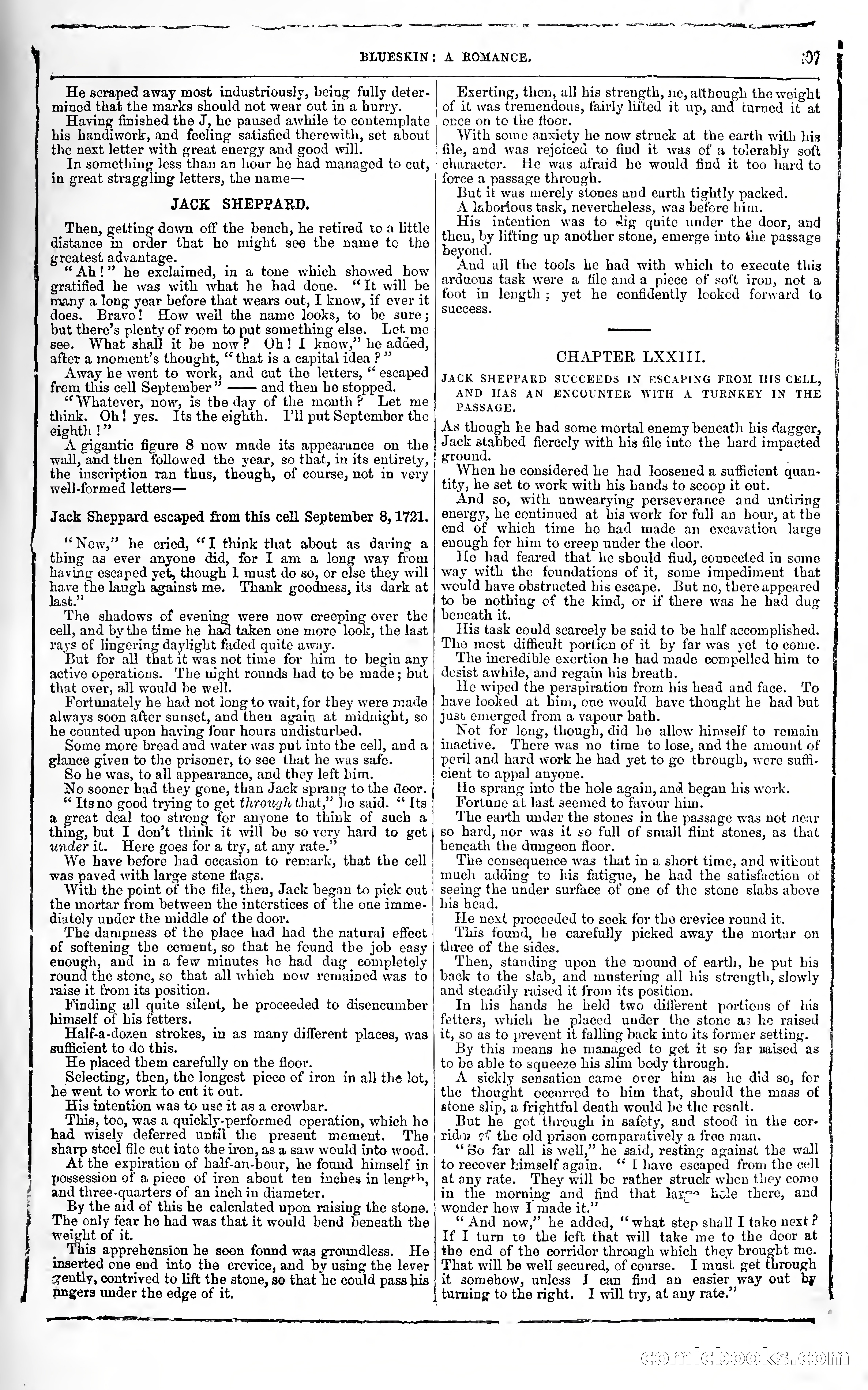
A restored page from Penny Dreadfuls, 1868. Page through the whole issue in the reader above.
📄 Transcribed text from this page (OCR, searchable)
Machine-transcribed from the original scan — historical spelling and the odd misread are preserved.
Beene, 39a FS, lh RR tt Pt ants OPE Rg seen gate > ens ge ~ ere Oe eit TE ae 8 smell BLUESKIN: A ROMANCE. —— = —eaiiecen wer Pe Wate oe ay ee ES aR eee SE seer 7 rr RR ER RS Ng He scraped away most industriously, being fully deter- mined that the marks should not wear out in a hurry. Having finished the J, he paused awhile to contemplate | his handiwork, and feeling satisfied therewith, set about the next letter with great energy and good will. In something less than an hour he had managed to cut, in great straggling letters, the name— JACK SHEPPARD. Then, getting down off the bench, he retired to a httle distance in order that he might see the name to the greatest advantage. “Ah!” he exclaimed, in a tone which showed how gratified he was with what he had done. “It will be many a long year before that wears out, I know, if ever it does. Bravo! How weil the name looks, to be sure; but there’s plenty of room to put something else. Let me see. What shall it be now? Oh! I know,” he adaed, after a moment’s thought, “‘ that is a capital idea P ” Away be went to work, and cut the letters, ‘‘ escaped from this cell September ” and then he stopped. ‘Whatever, now, is the day of the month? Let me think. Oh! yes. Itsthe eighth. Vl put September the eighth !” A gigantic figure 8 now made its appearance on the wall, and then followed the year, so that, 1n its entirety, the inscription ran thus, though, of course, not in very well-formed letters— Jack Sheppard escaped from this cell September 8, 1721. ‘* Now,” he cried, “I think that about as daring a thing as ever anyone did, for I am a long way from having escaped yet, though I must do se, or alee they will ie the laugh against me. Thank goodness, ils dark at ast. The shadows of evening were now creeping over the cell, and by the time he had taken one more look, the last rays of lingering daylight faded quite away. But for all that it was not time for him to begin any active operations. The night rounds had to be made; but that over, all would be well. Fortunately he had not long to wait, for they were made always soon after sunset, and then again at midnight, so he counted upon having four hours undisturbed. Some more bread and water was put into the cell, and a | glance given to the prisoner, to see that he was safe. So he was, to all appearance, and they left him. No sooner had they gone, than Jack sprang to the door. *‘ Its no good trying to get through that,” he said. ‘* Its a great deal too strong for anyone to think of such a thing, but I don’t think it will be so very hard to get under it. Here goes for a try, at any rate.” We have before had occasion to remark, that the cell | ‘much adding to his fatigue, he had the satisfaction of was paved with large stone flags. With the point of the file, then, Jack began to pick out the mortar from between the interstices of the one imme- diately under the middle of the door. The dampness ot the place had had the natural effect of softening the cement, so that he found the job easy enough, and in a few minutes he had dug completely round the stone, so that all which now remained was to raise it from its position. Finding all quite silent, he proceeded to disencumber himself of his fetters. Half-a-dozen strokes, in as many different places, was sufficient to do this. He placed them carefully on the floor. Selecting, then, the longest piece of iron in all the lot, he went to work to cut it out. His intention was to use it as a crowbar. This, too, was a quickly-performed operation, which he had wisely deferred until the present moment. The sharp steel file cut into the iron, as a saw would into wood. At the expiration of half-an-hour, he found himself in possession of a piece of iron about ten inches in length, and three-quarters of an inch in diameter. By the aid of this he calenlated upon raising the stone. The only fear he had was that it would bend beneath the weight of it. _ This apprehension he soon found was groundless. He inserted one end into the crevice, and by using the lever gently, contrived to lift the stone, so that he could pass his nngers under the edge of it. en, Oe _- a turning to the right. Exerting, then, all his strength, ne, although the weight of it was tremendous, fairly lifted it up, and turned it at once on to the floor. With some anxiety he now struck at the earth with his file, and was rejoiced to find it was of a tolerably soft character. He was afraid he would find it too hard to force a passage through. But it was merely stones and earth tightly packed. A laborious task, nevertheless, was before him. His intention was to sig quite under the door, and oer by lifting up another stone, emerge into the passage eyond. ‘And all the tools he had with which to execute this arduous task were a file anda piece of soft iron, not a foot in length; yet he confidently lookcd forward to success. CEE CHAPTER UXXITI. JACK SHEPPARD SUCCEEDS IN ESCAPING FROM HIS CELL, AND HAS AN ENCOUNTER WITH A TURNKEY IN THE PASSAGE, As though he had some mortal enemy beneath his dagger, Jack aoe fiercely with his file into the hard impacted ground. When he considered he had loosened a sufficient quan- tity, he set to work with his hands to scoop it out. And so, with unwearying perseverance and untiring energy, he continued at his work for full an hour, at the end of which time he had made an excavation large enough for him te creep under the door. He had feared that he should fiud, connected in some way with the foundations of it, some impediment that would have obstructed his escape. But no, there appeared to be nothing of the kind, or if there was he had dug beneath it. His task could scarcely be said to be half accomplished. The most difficult porticn of it by far was yet to come. The incredible exertion he had made compelled him to desist awhile, and regain his breath. He wiped the perspiration from his head and face. To have looked at him, one would have thonght he had but just emerged from a vapour bath. Not for long, though, did he allow himself to remain inactive. There was no time to lose, and the amount of peril and hard work he had yet to go through, were sufli- cient to appal anyone. He sprang into the hole again, and began his work. Fortune at last seemed to favour him. The earth under the stones in the passage was not near so hard, nor was it so full of small flint stones, as that beneath the dungeon floor. The consequence was that in a short time, and without seeing the under surface of one of the stone slabs above his head. He next proceeded to seek for the crevice round it. This found, he carefully picked away the mortar on three of the sides. Then, standing upon the mound of earth, he put his back to the slab, and mustering all his strength, slowly and steadily raised it from its position. In his hands he held two different portions of his fetters, which he placed under the stone as he raised it, so as to prevent it falling back into its former setting. By this means he managed to get it so far naised as to be able to squeeze his slim body through. A sickly sensation came over him as he did so, for the thought occurred to him that, should the mass of stone slip, a frightful death would be the result. But he got through in safety, and stood in the cor- ridiw ¢f the old prison comparatively a free man. ‘So far all is well,” he said, restmg against the wall to recover Limself again. ‘‘ I have escaped from the cell at any rate. They will be rather struck when they come in the morning and find that larce hele there, and wonder how I made it.” ‘And now,” he added, ‘‘ what step shall I take next P If I turn to the left that will take me to the door at the end of the corridor through which they brought me. That will be well secured, of course. I must get through it somehow, unless I ean find an easier way out by I will try, at any rate.” RE Es LL ce IG SS @ (S) GOMILGIOO anu