
Penny Dreadfuls, 1895 · page 340 of 394
Belle Rose: A Romance of the Cloak and Sword — page 340: what you’re looking at
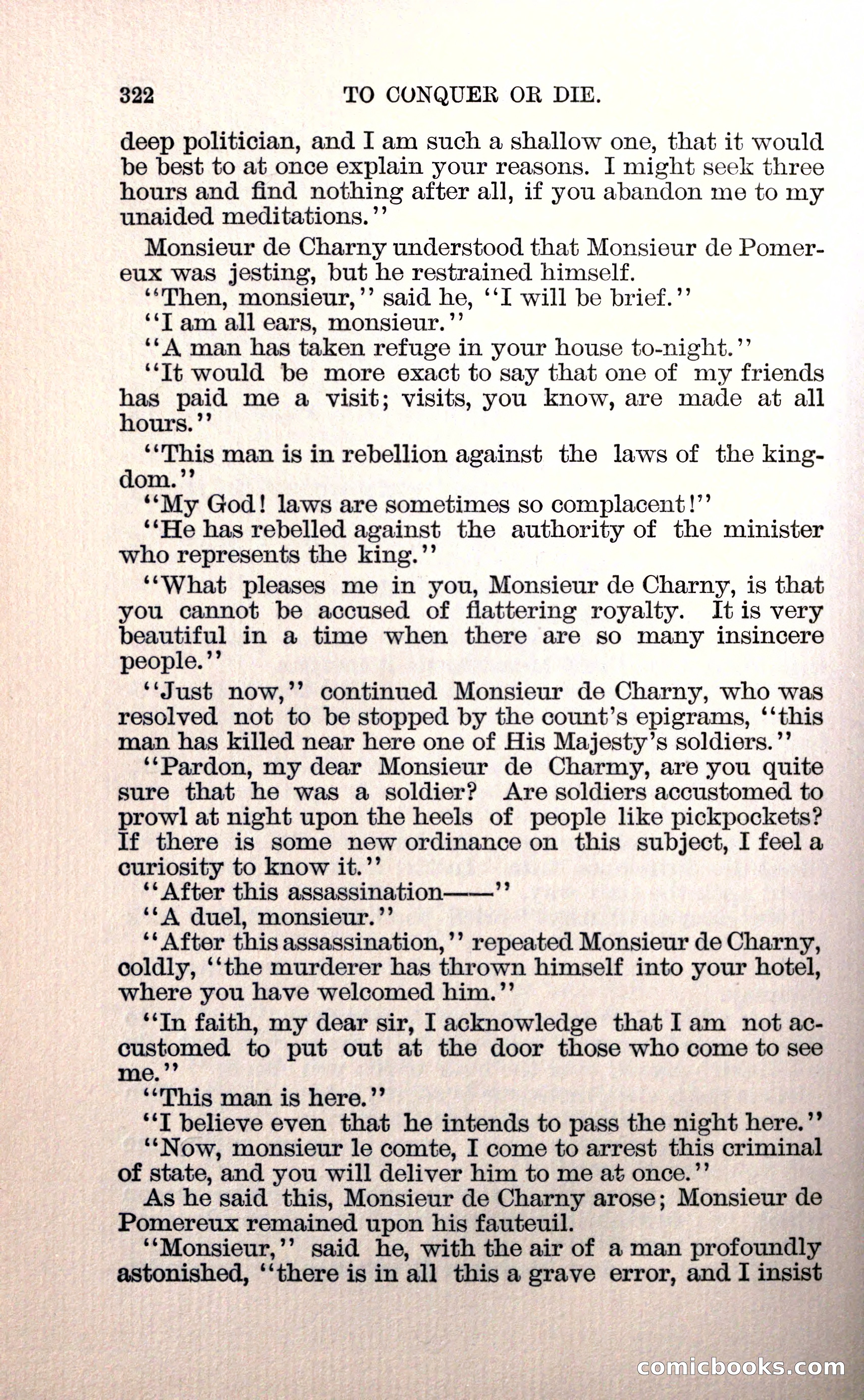
A restored page from Penny Dreadfuls, 1895. Page through the whole issue in the reader above.
📄 Transcribed text from this page (OCR, searchable)
Machine-transcribed from the original scan — historical spelling and the odd misread are preserved.
322 TO CONQUER OR DIE. deep politician, and I am such a shallow one, that it would be best to at once explain your reasons. I might seek three hours and find nothing after all, if you abandon me to my unaided meditations. ’’ Monsieur de Charny understood that Monsieur de Pomer- eux was jesting, but he restrained himself. ‘“‘Then, monsieur,’’ said he, ‘‘I will be brief.’’ ‘‘T am all ears, monsieur.”’ ‘*A man has taken refuge in your house to-night.’’ ‘It would be more exact to say that one of my friends has paid me a visit; visits, you know, are made at all hours. ‘This man is in rebellion against the laws of the king- dom.’’ ‘‘My God! laws are sometimes so complacent!”’ ‘*He has rebelled against the authority of the minister who represents the king.”’ ‘‘What pleases me in you, Monsieur de Charny, is that you cannot be accused of flattering royalty. It is very beautiful in a time when there are so many insincere people.’’ ‘‘Just now,’’ continued Monsieur de Charny, who was resolved not to be stopped by the count’s epigrams, ‘‘this man has killed near here one of His Majesty’s soldiers. ’’ ‘*Pardon, my dear Monsieur de Charmy, are you quite sure that he was a soldier? Are soldiers accustomed to prowl at night upon the heels of people like pickpockets? If there is some new ordinance on this subject, I feela curiosity to know it.”’ ‘‘After this assassination——’’ ‘‘A duel, monsieur.’’ ‘* After this assassination,’’ repeated Monsieur de Charny, coldly, ‘‘the murderer has thrown himself into your hotel, where you have welcomed him.”’ ‘*In faith, my dear sir, I acknowledge that Iam not ac- customed to put out at the door those who come to see me. ’’ ‘This man is here.”’ ‘“‘T believe even that he intends to pass the night here.”’ ‘‘Now, monsieur le comte, I come to arrest this criminal of state, and you will deliver him to me at once.’’ As he said this, Monsieur de Charny arose; Monsieur de Pomereux remained upon his fauteuil. ‘*Monsieur,’’ said he, with the air of a man profoundly astonished, ‘‘there is in all this a grave error, and I insist (E(@) =} iGbooks