
Penny Dreadfuls, 1895 · page 140 of 394
Belle Rose: A Romance of the Cloak and Sword — page 140: what you’re looking at
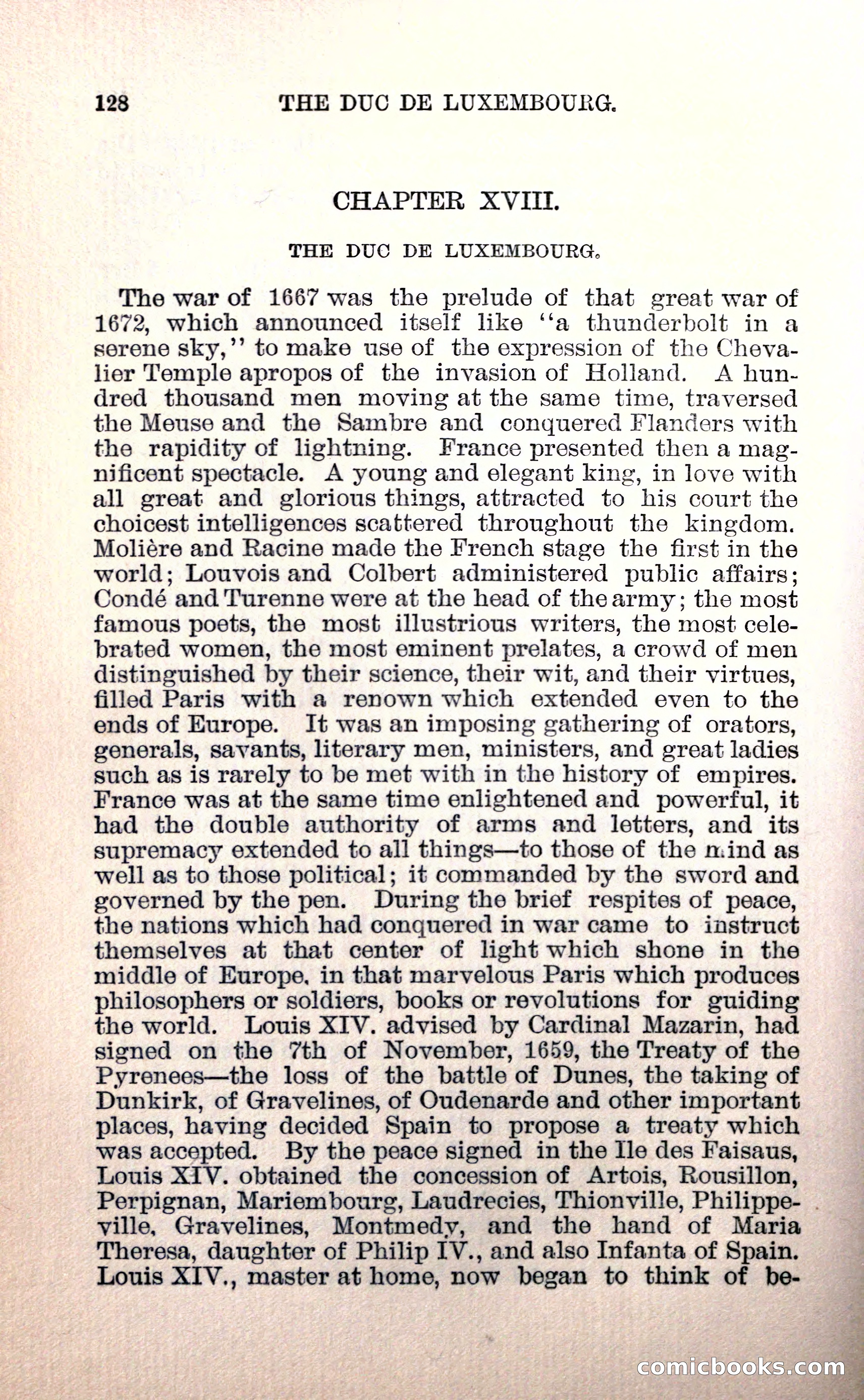
A restored page from Penny Dreadfuls, 1895. Page through the whole issue in the reader above.
📄 Transcribed text from this page (OCR, searchable)
Machine-transcribed from the original scan — historical spelling and the odd misread are preserved.
128 THE DUC DE LUXEMBOURG. CHAPTER XVIII. THE DUC DE LUXEMBOURG. The war of 1667 was the prelude of that great war of 1672, which announced itself like ‘‘a thunderbolt in a serene sky,’’ to make use of the expression of the Cheva- lier Temple apropos of the invasion of Holland. A hun- dred thousand men moving at the same time, traversed the Meuse and the Sambre and conquered Flanders with the rapidity of lightning. France presented then a mag- nificent spectacle. A young and elegant king, in love with all great and glorious things, attracted to his court the choicest intelligences scattered throughout the kingdom. Moliére and Racine made the French stage the first in the world; Louvois and Colbert administered public affairs; Condé and Turenne were at the head of the army; the most famous poets, the most illustrious writers, the most cele- brated women, the most eminent prelates, a crowd of men distinguished by their science, their wit, and their virtues, filled Paris with a renown which extended even to the ends of Europe. It was an imposing gathering of orators, generals, savants, literary men, ministers, and great ladies such as is rarely to be met with in the history of empires. France was at the same time enlightened and powerful, it had the double authority of arms and letters, and its supremacy extended to all things—to those of the mind as well as to those political; it commanded by the sword and governed by the pen. During the brief respites of peace, the nations which had conquered in war came to instruct themselves at that center of light which shone in the middle of Europe, in that marvelous Paris which produces philosophers or soldiers, books or revolutions for guiding the world. Louis XIV. advised by Cardinal Mazarin, had signed on the 7th of November, 1659, the Treaty of the Pyrenees—the loss of the battle of Dunes, the taking of Dunkirk, of Gravelines, of Oudenarde and other important places, having decided Spain to propose a treaty which was accepted. By the peace signed in the Ile des Faisaus, Louis XIV. obtained the concession of Artois, Rousillon, Perpignan, Mariembourg, Laudrecies, Thionville, Philippe- . ville, Gravelines, Montmedy, and the hand of Maria Theresa, daughter of Philip 1V., and also Infanta of Spain. Louis XIV., master at home, now began to think of be- Eomicbooks.com |