
Penny Dreadfuls, 1895 · page 354 of 391
Belle-Rose — page 354: what you’re looking at
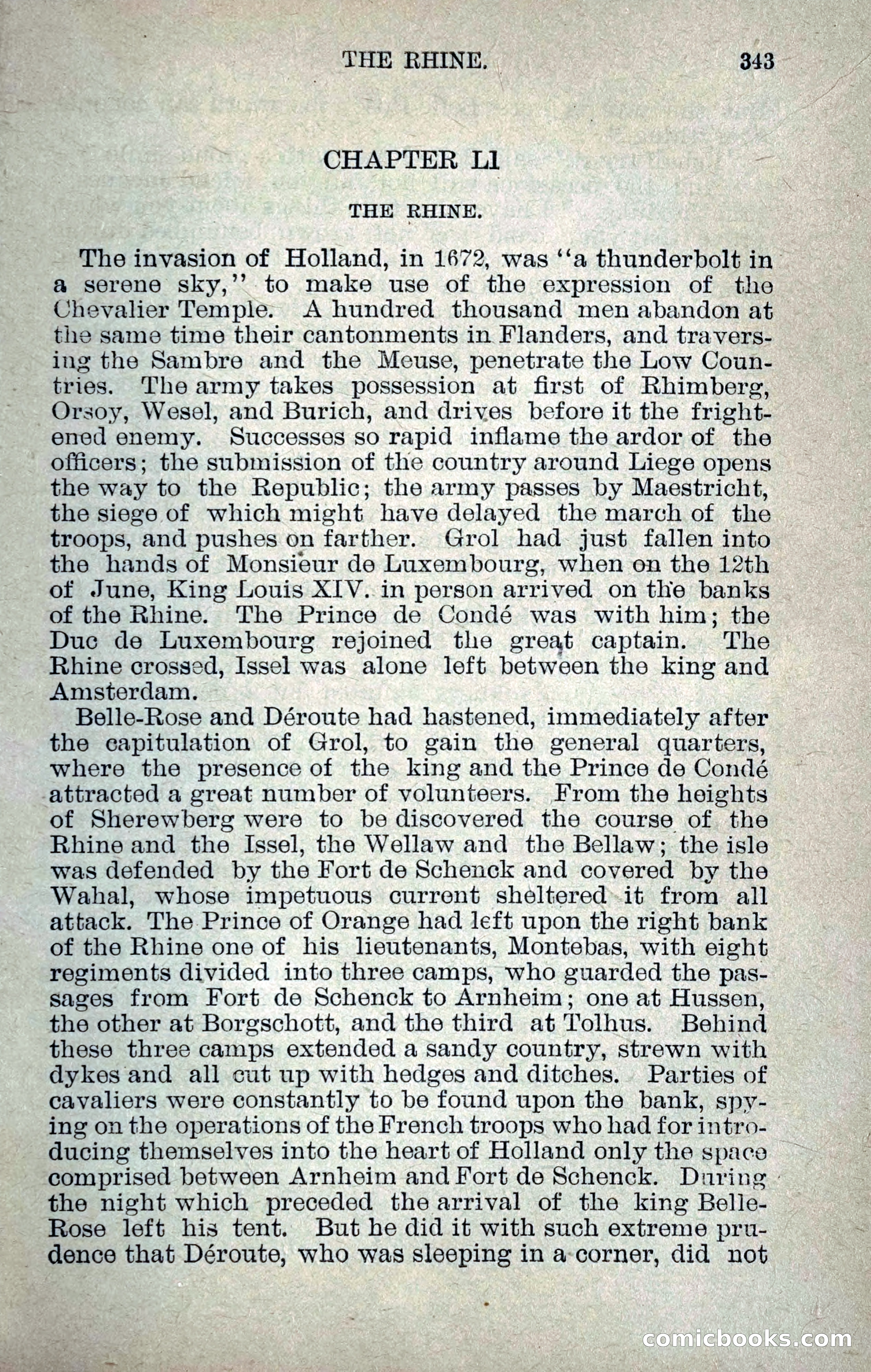
A restored page from Penny Dreadfuls, 1895. Page through the whole issue in the reader above.
📄 Transcribed text from this page (OCR, searchable)
Machine-transcribed from the original scan — historical spelling and the odd misread are preserved.
THE RHINE, | 343 CHAPTER Ll THE RHINE. The invasion of Holland, in 1672, was ‘‘a thunderbolt in a serene sky,’’ to make use of the expression of the Chevalier Temple. A hundred thousand men abandon at the same time their cantonments in Flanders, and travers- ing the Sambre and the Meuse, penetrate the Low Coun- tries. The army takes possession at first of Rhimberg, Orsoy, Wesel, and Burich, and drives before it the fright- ened enemy. Successes so rapid inflame the ardor of the officers; the submission of the country around Liege opens the way to the Republic; the army passes by Maestricht, the siege of which might have delayed the march of the troops, and pushes on farther. Grol had- just fallen into the hands of Monsieur de Luxembourg, when on the 12th of June, King Louis XIV. in person arrived on the banks of the Rhine. The Prince de Condé was with him; the Duc de Luxembourg rejoined the great captain. The Rhine crossed, Issel was alone left between the king and Amsterdam. Belle-Rose and Déroute had hastened, immediately after the eapitulation of Grol, to gain the general quarters, where the presence of the king and the Prince de Condé attracted a great number of volunteers. From the heights of Sherewberg were to be discovered the course of the Rhine and the Issel, the Wellaw and the Bellaw; the isle was defended by the Fort de Schenck and covered by the Wahal, whose impetuous current shelteredit from all attack. The Prince of Orange had left upon the right bank of the Rhine one of his lieutenants, Montebas, with eight regiments divided into three camps, who guarded the pas- sages from Fort de Schenck to Arnheim; one at Hussen, the other at Borgschott, and the third at Tolhus. Behind these three camps extended a sandy country, strewn with dykes and all cut up with hedges and ditches. Parties of cavaliers were constantly to be found upon the bank, spy- ing on the operations of the French troops who had for intro- ducing themselves into the heart of Holland only the space comprised between Arnheim and Fort de Schenck. During» the night which preceded thearrival of the king Belle- Rose left his tent. But he did it with such extreme pru- dence that Déroute, who was sleeping in a-corner, did not (E(0) Gomicboo .S