
Penny Dreadfuls, 1877 · page 15 of 16
Beadle's Half Dime Library — page 15: what you’re looking at
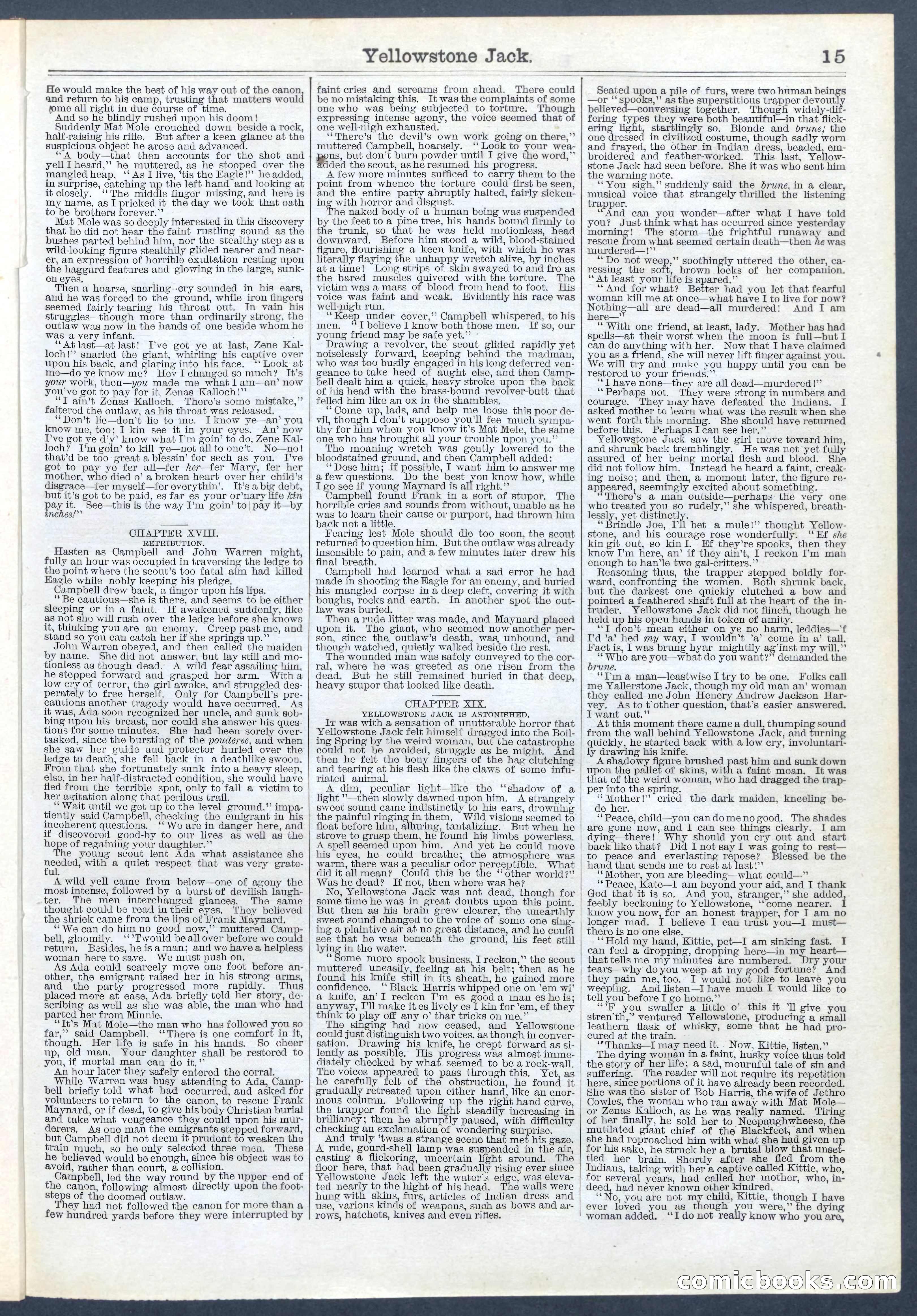
A restored page from Penny Dreadfuls, 1877. Page through the whole issue in the reader above.
📄 Transcribed text from this page (OCR, searchable)
Machine-transcribed from the original scan — historical spelling and the odd misread are preserved.
Yellowstone Jack. 15 He would make the best of his way out of the canon and return to his camp, trusting that matters would tome all right in due course of time, And so he blindly rushed upon his doom! Suddenly Mat Mole crouched down beside a rock, half-raising his rifle, But after a keen eae at the suspicious object he arose and advanced. “A body—that then accounts for the shot and yell I heard,’ he muttered, as he stooped over the mangled heap. ‘' As I live, “tis the Eagle!” he adde in surprise, catching up the left hand and looking a it closely. ‘‘The middle finger missing, and here is my name, as I pricked it the day we took that oath to be brothers forever.” : : Mat Mole was so deeply interested in this discovery that he did not hear the faint rustling sound as the bushes parted behind him, nor the stealthy step as a wild-looking figure stealthily glided nearer and near- er, an expression of horrible exultation resting upon the haggard features and glowing in the large, sunk- en eyes, Then a hoarse, snarling--cry sounded in his ears, and he was forced to the ground, while iron fingers seemed fairly tearing his throat out. In vain his struggles—though more than ordinarily strong, the outlaw was now in the hands of one beside whom he was avery infant. : “At last—at last! I’ve got ye at last, Zene Kal- loch!” snarled the giant, whirling his captive over upon his back, and glaring into face. *‘ Look at me—do ye know me? HevI changed so much? It’s your work, then—you made me what I am—an’ now you've got to pay for it, Zenas Kalloch!” “T ain't Zenas Kalloch, There's some mistake,” faltered the outlaw, as his throat was released. “Don’t lie—don't lie to me, I know ye—an’ you know me, too; I kin see it in your eyes. An’ now Dve got ye d’y’ know what I'm goin’ to do, Zene Kal- loch? I'm goin’ to ldll ye—not allto one’t. No—nol that’d be too great a blessin’ for sech as you. I’ve got to pay ye fer all—fer her—fer i fer her mother, who died o’ a broken heart over her child's disgrace—fer myself—fer everythin’. It's a big debt, but it’s got to be paid, es far es your or’nary life kin ~ eo See—this is the way I'm goin’ to! pay it—by ches. CHAPTER XVII. RETRIBUTION. Hasten as Oampbell and John Warren might, fully an hour was occupied in traversing the ledge to the ges! where the scout’s too fatal aim had killed Eagle while nobly keeping his pledge. Campbell drew back, a finger upon his lips, ‘Be cautious—she is there, and seems to be either sleeping or in a faint. If awakened suddenly, like as not she will rush over the ledge before she knows it, thinking youare an enemy. Oreep past me, and stand so you can catch her if she springs up.” John Warren obeyed, and then called the maiden by name, She did not answer, but lay still and mo- tionless as though dead. A wild fear ps, a he stepped forward and grasped her arm. ith a low cry of terror, the et awoke, and struggled des- perately to free herself. Only for Camp éll's pre- cautions another tragedy would have occurred. As it was, Ada soon recognized her uncle, and sunk sob- bing upon his breast, nor could she answer his ques- tions for some minutes. She had been sorely over- tasked, since the bursting of the youderee, and when she saw her guide and protector hurled over the ledge to death, she fell back in a deathlike swoon. From that she fortunately sunk into a heavy sleep, else, in her half-distracted condition, she would have fled from the terrible spot, only to fall a victim to her agitation along that pag ote trail. _“ Wait until we get up to the level ground,” impa- tiently said ae checking the emigrant in hi incoherent questions, ‘‘We are in danger here, and if discovered good-by to our lives as well as the hope of regaining your daughter.”’ he young scout lent Ada what assistance she ge with a quiet respect that was very grate- A wild yell came from below—one of agony the most intense, followed by a burst of devilish laugh- ter. The men interchanged glances. The same thought could be read in their eyes, They believed the shriek came from the lips of Frank Maynard, ‘We can do him no good now,’ muttered Camp- bell, gloomily. ‘‘’Twould be all over before we could return, Basides, he isaman; and we havea helpless woman here to save, We must push on. As Ada could scarcely move one foot before an- other, the emigrant raised her in his strong arms, and the party progressed more rapidly. Thus placed more at ease, Ada briefly told her story, de- scribing as well as she was able, the man who had parted her from Minnie. ‘“‘Tt’s Mat Mole—the man who has followed you so far,” said Campbell. ‘There is one comfort in it, though. Her life is safe in his hands, So cheer up, old man. Your daughter shall be restored to you, if mortal man can do it,” An hour later they safely entered the corral. While Warren was busy attending to Ada, Camp- bell briefly told what had Segertad, and asked for volunteers to return to the canon, to rescue Frank Maynard, or if dead, to give his body Christian burial and take what vengeance they could upon his mur- derers, As one man the emigrants stepped forward, but Campbell did not deem it prudent to weaken the train much, so he only selected three men. These he believed would be enough, since his object was to avoid, rather than court, a collision. Campbell, led the way round by the upper end of the canon, follo almost directly upon the foot- steps of the doomed outlaw. ey had not followed the canon for more than a few hundred yards before they were interrupted by faint cries and screams from ahead, There could be no hig: this. It was the complaints of some one who was being subjected to torture. Though expressing intense agony, the voice seemed that of one well-nigh exhausted. ‘‘There’s the devil’s own work going on there,” muttered Campbell, hoarsely. ‘‘ Look to your wea- pons, but don't burn powder until I give the word,” Wiaca the scout, ashe resumed his progress. A few more minutes sufficed to carry them to the point from whence the torture could first be seen, and the entire party abruptly halted, fairly sicken- ing with horror and ust. e naked body of a human being was suspended by the feet to a om tree, his hands bound firmly to the trunk, so that he was held motionless, head downward, Before him stood a, wild, blood-stained figure, flourishing a keen knife, with which he was literally flaying the enlapEy wretch alive, by inches at a time! Long strips of skin swayed to and fro as the bared muscles quivered with the torture. The victim was a mass of blood from head to foot, His voice was faint and weak, Evidently his race was well-nigh run, uA eep under cover,’? Campbell whispered, to his men. I believe I know both those men, If so, our young friend may be safe yet.” ° Drawing a revolver, the scout ing rapidly yet noiselessly forward, keeping behind the madman, who was too busily engaged in his long deferred ven- geance to take heed of aught else, and then Camp- bell dealt him a quick, heavy stroke upon the bac of his head with the brass-bound revolver-butt that felled him like an ox in the shambles, ““Come up, lads, and help me loose this poor de- vil, though I don’t suppose you'll fee much sympa- thy for him when poe know it’s Mat Mole, the same one who has brought all your trouble upon you.” The moaning wretch was gently lowered to the bloodstained ground, and then Campbell added: ‘*Dose him; if possible, I want to answer me a few questions. Do the best you know how, while I go see {= Ma dis right.” Campbell found Frank in a sort of stupor, The horrible cries and sounds from without, unable as he was to learn their cause or purport, had thrown him back not a little. Fearing lest Mole should die too goon, the scout returned to question him, But the outlaw was tnd insensible to pain, and a few minutes later drew final breath, Campbell had learned what a sad error he had made in shooting the Wagle for an enemy, and buried his mangled corpse in a deep cleft, covering it with boughs, rocks and earth. In another spot the out- law was buried. Then a rude litter was made, and Maynard placed upon it. The giant, who seemed now another per- son, since the outlaw’s death, wag unbound, and though watched, quietly walked beside the rest. The wounded man was safely conveyed to the cor- ral, where he was greeted as one en from the dead, But he still remained buried in that deep, heavy stupor that looked like death, CHAPTER XIX, YELLOWSTONE JACK IS ASTONISHED. It was with a sensation of unutterable horror that Yellowstone Jack felt himself dragged into the Boil- ing Spring by the weird woman, but the catastrophe could not be avoided, struggle as he might. nd then he felt the poe 4 fingers of the hag clutching and tearing at his flesh like the claws of some infu- riated animal. : A dim, peculiar light—like the ‘“‘shadow of a light *—then slowly dawned upon him. A strangely sweet sound came indistinctly to his ears, drowning the painful rin inthem, Wild visions seemed to float before him, alluring, tantalizing. But when he strove to grasp them, he found his bs powerless, A spell seemed upon him. And yet he could move his eyes, he could breathe; the atmosphere was warm, there was a peculiar odor ae sure What did it allmean? Could this be the ‘other world?” ‘Was he dead? If not, then where was he? No, Yellowstone Jack was not dead, though for some time he was in great doubts upon this point. But then as his brain grew clearer, the unearthly sweet sound changed to the voice of some one sing- ing a plaintive air at no great distance, and he could see that he was beneath the ground, his feet still ying in the water. “Some more spook business, I reckon,” the scout muttered uneasily, feeling at ‘his belt; then as he found his knife still in its sheath, he gained more confidence, ‘Black Harris whipped one on ‘em wi’ a knife, C4 it mies = ace ee 4 man acts is; anyway, ll make ites liv es or’em, ef they Stor to play off any o’ thar tricks on me.” The fe oon: Meee now ceased, and Yellowstone could just distinguish two voices, as though in conver- sation, Drawing his knife, ho crept forward as si- lently as possible. His progress was almost imme- diately checked by what. seemed to be a rock-wall, The voices appeared to pass through this. Yet, as he carefully felt of the obstruction, he found it gradually retreated upon either hand, like an enor- mous column, song | up the right hand curve, the trapper found the gh steadily increasing in brilliancy; then he abruptly paused, with difficulty checking an exclamation of wondering surprise. And truly *twas a strange scene that met his gaze. A rude, gourd-shell lamp was suspended in the air, casting a tare uncertain light around. The floor here, that had been gradually rising ever since Yellowstone Jack left the water's edge, was eleva- ted nearly to the hight of his head. The walls were hung with skins, furs, articles of Indian dress and use, various kinds of weapons, such as bows and ar- rows, hatchets, knives and even rifles, Seated ng a pile of furs, were two human beings —or ‘“spooks,’’ as the superstitious trapper oe believed—conversing together. Though widely-dit- fering types they were both beautiful—in that flick- Fea, t, ape eit so. Blonde and brune; the one dressed in civilized costume, though sadly worn and frayed, the other in Indian dress, beaded, em- broidered and feather-worked, This last, Yellow- stone Jack had seen before. She it was who sent him the warning note, : “You sigh,’’ suddenly said the drvne,in a clear, musical voice that strangely thrilled the listening ba ag . d can you wonder—after what I have told you? Just think what has occurred since yesterday morning! The storm—the frightful runaway and rescue from what seemed certain death—then he was tmurdered—!” “Do not weep,’ soothingly uttered the other, ca- ressing the soft, brown locks of her companion. “At least your life is spared.” “And for what? Better had you let that fearful woman kill me at once—what have I to live for now? Nothing—all are dead—all murdered! And I am here—’ “With one friend, at least, lady. Mother has had spells—at their worst when the moon is full—but I can do anything with her. Now that I have claimed ou as a friend, she will never lift finger against you. e will try and make you happy until you can be restored to your friends.” ““Thave none—they are all dead—murdered!” “Perhaps not. ‘They were strong in numbers and courage. They inay have defeated the Indians, I asked mother to learn what was the result when she went forth this morning. She should have returned before this. Perhaps I can see her.” Yellowstone Jack saw the girl move toward him, and shrunk back tremblingly. He was not yet fully assured of her a rag flesh and blood. She did not follow him. ead he heard a faint, creak- ing noise; and then, a moment later, the figure re- appeared, seemingly excited about something, “There’s a man outside—perhaps the very one who treated you so rudely,” she whispered, breath- lessly, yet eS “Brindle Joe, I'll bet a mule!” thought Yellow- stone, and his courage rose wonderfully. ‘Ef she kin git out, so kinL Ef they’re spooks, then they know I'm here, an’ if they ain’t, I reckon I'm man enough to han’le two gal-critters.”’ Reasoning thus, the trapper stepped boldly for- ward, confronting the women. Both shrunk back but the darkest one oars clutched a bow and ointed a feathered shaft at the heart of the in- der. Yellowstone Jack did not flinch, though he held up his open hands in token of amity. ‘““T don’t mean either on ye no harm, leddies—'f I'd ’a’ hed my way, I wouldn’t ’a’ come in a’ tall, Fact is, [was brung hyar mightily aginst my will.’ ‘ ‘Who are you—what do you want?”’ demanded the TUNE. “Tm a man—leastwise I try to be one. Folks call me Yallerstone Jack, though my old man an’ woman they called me John Henery Andrew Jackson Har- vey. As to t’other question, that’s easier answered. I want out.” At this moment there camea el thumping sound from the wall behind Yellowstone Jack, and turnin quickly, he started back with a low cry, involuntari- ly drawing his knife. A shadowy Sao brushed past him and sunk down upon the pallet of skins, with a faint moan, It was that of the weird woman, who had dragged the trap- per into the spring. ‘Mother! cried the dark maiden, kneeling be- de her. ‘‘ Peace, child—you candomenogood. The shades are gone now, and I can see things clearly. I am dying—there! Why should you cry out and start back like that? Did I not say I was going to rest— to peace and everlasting repose? lessed be the hand that sends me to rest at last!’ ‘* Mother, you are bleeding—what could—” “Peace, Kate—I am beyond your aid, and I thank God that it is so. And you, stranger,’ she added feebly beckoning to Yellowstone, ‘‘come nearer. i know you now, for an honest trapper, for I am no longer mad, T believe I can trust you—I must— there is no one else. ‘““Hold my hand, Kittie, pet—I am sinking fast. I can feel a dropping, dropping here—in my heart— that tells me my utes are numbered. Dry your tears—why doyou weep at my good fortune? And they pain me, too. I would not like to leave you weeping. And listen—I have much I would like to tell you before I go home.” : “"F you swaller a little o’ this it Il give you stren'th,” ventured Yellowstone, producing a small leathern flask of whisky, some that he had pro- cured at the train. ; ‘“'Thanks—I may need it. Now, Kittie, listen.” The yeas woman in a faint, husky voice thus told the story of her life; a sad, mournful tale of sin and suffering. The reader will not require its repetition here, since portions of it have already been recorded. She was the sister of Bob Harris, the wife of Jethro Cowles, the woman who ran away with Mat Mole— or Zenas Kalloch, as he was really named. of her finally, he sold her to _Neepaughwheese, the mutilated giant chief of the Blackfeet, and when she had reproached him with what she had given u for his sake, he struck her a brutal blow that unse fled her brain. Shortly after she fled from the Indians, taking with her’a captive called Kittie, who, for several years, had called her mother, who, in- deed, had never known other kindred, “No, you are not zh child, Kittie, though I have ever loved you as though you were,” the dying woman added. ‘Ido not really know who you are, oO Comichboo S oO co