
Penny Dreadfuls, 1897 · page 28 of 52
Army and Navy Weekly — page 28: what you’re looking at
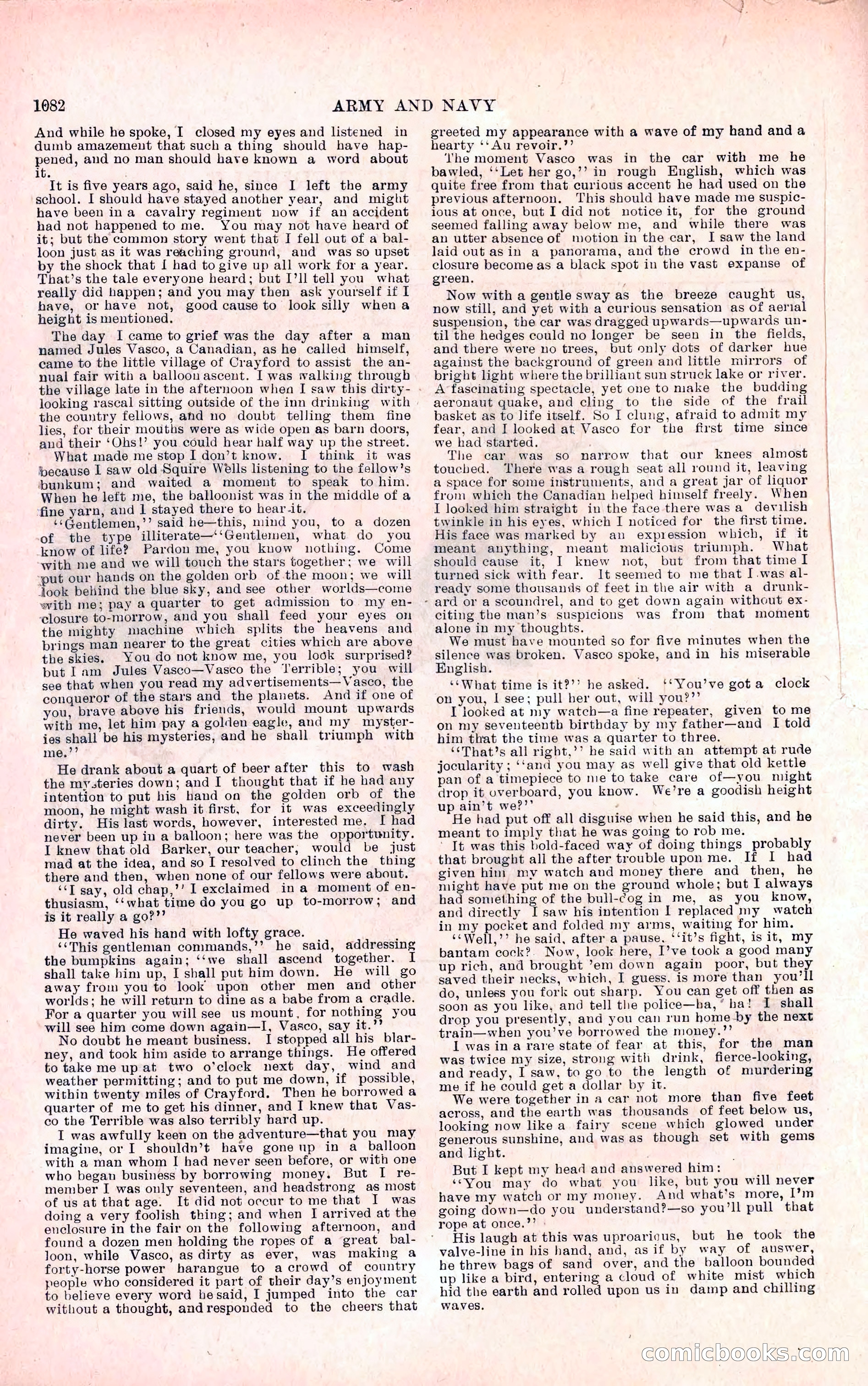
A restored page from Penny Dreadfuls, 1897. Page through the whole issue in the reader above.
📄 Transcribed text from this page (OCR, searchable)
Machine-transcribed from the original scan — historical spelling and the odd misread are preserved.
1082 And while he spoke, I closed my eyes and listened in dumb amazement that such a thing should have hap- poner and no man should have known a word about it. It is five years ago, said he, since I left the army school. I should have stayed another year, and might have been ina cavalry regiment now if an accident had not happened to me. You may not have heard of it; but the common story went that I fell out of a bal- loon just as it was reaching ground, and was so upset by the shock that I had to give up all work for a year. That’s the tale everyone heard; but I’ll tell you what really did happen; and you may then ask yourself if I have, or have not, good cause to look silly whena height is mentioned. The day I came to grief was the day after a man named Jules Vasco, a Canadian, as he called himself, came to the little village of Crayford to assist the an- nual fair with a balloon ascent. I was walking through the village late in the afternoon whea I saw this dirty- . looking rascal sitting outside of the inn drinking with the country fellows, ahd no doubt telling them fine lies, for their mouths were as wide open as barn doors, and their ‘Ohs!’ you could hear half way up the street. What made me stop I don’t know. I think it was \Decause L saw old Squire Wells listening to the fellow’s bunkum; and waited a moment to speak to him. When he left me, the balloonist was in the middle of a fine yarn, and 1 stayed there to hear -it. ‘¢Gentlemen,’’ said he—this, mind you, to a dozen of the type illiterate—‘‘Gentlemen, what do you know of life? Pardon me, you know nothing. Come with me and we will touch the stars together; we will yput our hands on the golden orb of the moon; we will ‘look belind the blue sky, and see other worlds—come wvith me; pay a quarter to get admission to my en- ¢losure to-morrow, and you shall feed your eyes on the mighty machine which splits the heavens and brings man nearer to the great cities which are above the skies. You do not know me, you lodk surprised? but Lam Jules Vasco—Vasco the Terrible; you will see that when you read my advertisements— Vasco, the conqueror of the stars and the planets. And if one of you, brave above his friends, would mount upwards with me, let him pay a golden eagle, and my myster- ies shall be his mysteries, and he shall triumph with me,’’ He drank about a quart of beer after this to wash the mysteries down; and I thought that if he had any intention to put his hand on the golden orb of the moon, he might wash it first, for it was exceedingly dirty. His last words, however, interested me. I had never been up in a balloon; here was the opportunity. I knew that old Barker, our teacher, would be just mad at the idea, and so [ resolved to clinch the thing there and then, when none of our fellows were about. ‘‘T say, old chap,’’ I exclaimed in a moment of en- thusiasm, ‘‘what time do you go up to-morrow; and is it really a go?”’ He waved his hand with lofty grace. ‘‘This gentleman commands,’’ he said, addressing the bumpkins again; ‘‘we shall ascend together. I shall take him up, I shall put him down. He will go away from you to look upon other men and other worlds; he will return to dine as a babe from a cradle. For a quarter you will see us mount, for nothing you will see him come down again—I, Vasco, say it.”’ No doubt he meant business. I stopped all his blar- ney, and took him aside to arrange things. He offered to take me up at two o'clock next day, wind and weather permitting; and to put me down, if possible, within twenty miles of Crayford. Then he borrowed a quarter of me to get his dinner, and I knew that Vas- co the Terrible was also terribly hard up. I was awfully keen on the adventure—that you may imagine, or I shouldn’t have gone up in a balloon with a man whom I had never seen before, or with one who began business by borrowing money. But I re- member I was only seventeen, and headstrong as most of us at that age. It did not occur to me that I was doing a very foolish thing; and when I arrived at the enclosure in the fair on the following afternoon, and found a dozen men holding the ropes of a great bal- loon, while Vasco, as dirty as ever, was making a forty-horse power harangue to acrowd of country people who considered it part of their day’s enjoyment to believe every word besaid, I jumped into the car without a thought, andresponded to the cheers that ARMY AND NAVY greeted my appearance with a wave of my hand and a hearty ‘‘ Au revoir.”’ ‘he moment Vasco was in the car with me he bawled, ‘‘Let her go,’? in rough English, which was quite free from that curious accent he had used on the previous afternoon. This should have made me suspic- ious at once, but I did not noticeit, for the ground seemed falling away below me, and while there was an utter absence of motion in the car, I saw the land laid out asin a panorama, and the crowd in the en- closure become as a black spot in the vast expanse of green. Now with a gentle sway as the breeze caught us, now still, and yet with a curious sensation as of aerial suspension, the car was dragged upwards—upwards un- til the hedges could no longer be seen in the fields, and there were no trees, but only dots of darker hue against the background of green and little mirrors of bright light where the brilliant sun struck lake or river. A fascinating spectacle, yet one to make the budding aeronaut quake, and cling to the side of the frail basket as to life itself. So I clung, afraid to admit my fear, and I looked at Vasco for the first time since we had started. The car was so narrow that our knees almost touched. There was a rough seat all round it, leaving a space for some instruments, and a great jar of liquor from which the Canadian helped himself freely. When I looked him straight in the face there wasa_ devilish twinkle in his eyes, which I noticed for the first time. His face was marked by an expression which, if it meant anything, meant malicious triumph. What should cause it, I knew not, but from that time I turned sick with fear. It seemed to me that I.was al- ready some thousands of feet in the air with a drunk- - ard or a scoundrel, and to get down again without ex- citing the man’s suspicions was from that moment alone in my thoughts. We must have mounted so for five minutes when the silence was broken. Vasco spoke, and in his miserable English. ‘What time is it?’?’ he asked. ‘‘You’ve gota clock on you, | see; pull her out, will you?”’ I looked at my watch—a fine repeater, given to me on my seventeenth birthday by my father—and I told him that the time was a quarter to three. ‘‘That’s all right,’’ he said with an attempt at rude jocularity ; ‘‘and you may as well give that old kettle pan of a timepiece to me to take care of—you might drop it overboard, you know. We’re a goodish height up ain’t we?”’ He had put off all disguise when he said this, and he meant to imply that he was going to rob me. ' It was this bold-faced way of doing things probably that brought all the after trouble upon me. If I had given hint my watch and money there and then, he might have put me on the ground whole; but I always had something of the bull-cog in me, as you know, and directly I saw his intention I replaced my watch in my pocket and folded my arms, waiting for him. ‘¢Well,’’ he said, after a pause, ‘‘it’s fight, is it, my bantam cock?. Now, look here, I’ve took a good many up rich, and brought ’em down again poor, but they saved their necks, which, I guess. is more than you’ll do, unless you fork out sharp. You can get off then as soon as you like, and tell the police—ba, “ha! I shall drop you presently, and you can run home by the next train—when you’ve borrowed the money.”’ I was in a rare state of fear at this, for the man was twice my size, strong with drink, fierce-looking, and ready, I saw, to go to the length of murdering me if he could get a dollar by it. We were together in a car not more than five feet across, and the earth was thousands of feet below us, looking now like a fairy scene which glowed under generous sunshine, and was as though set with gems and light. But I kept my head and answered him: ‘“You may do what you like, but you will never have my watch or my money. And what's more, I’m going down—do you understand?—so you'll pull that rope at once.”? » His laugh at this was uproaricus, but he took the valve-line in his hand, and, asif by way of auswer, he threw bags of sand over, and the balloon bounded up like a bird, entering a cloud of white mist which hid the earth and rolled upon us in damp and chilling waves. SS (© COMmM|lClOO