
Penny Dreadfuls, 1867 · page 98 of 196
The Skeleton Crew; Or, Wildfire Ned — page 98: what you’re looking at
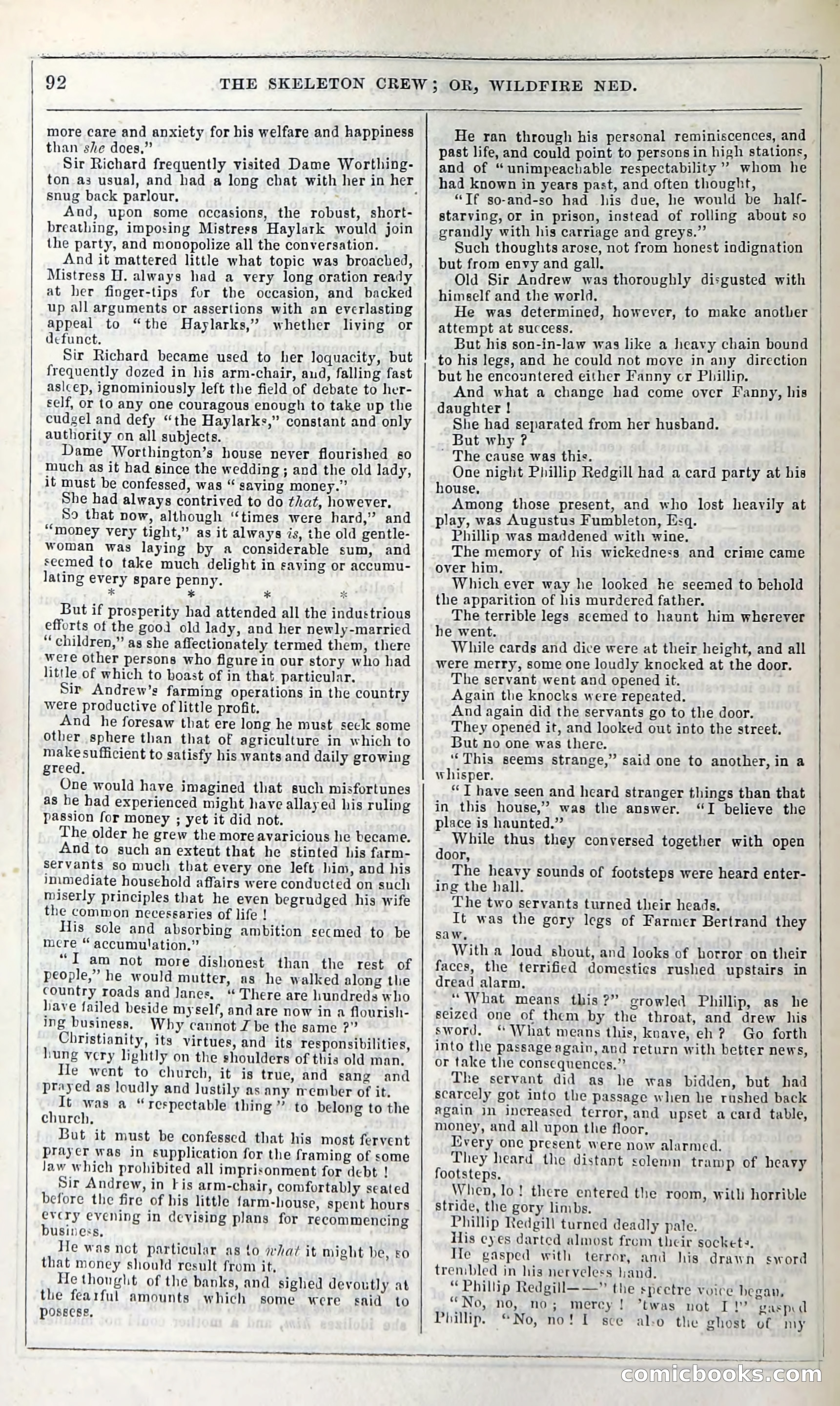
A restored page from Penny Dreadfuls, 1867. Page through the whole issue in the reader above.
📄 Transcribed text from this page (OCR, searchable)
Machine-transcribed from the original scan — historical spelling and the odd misread are preserved.
92 THE SKELETON CREW; OR, WILDFIRE NED. more care and anxiety for his welfare and happiness than she does,” Sir Richard frequently visited Dame Worthing- ton a3 usual, and had a long chat with her in her snug back parlour, And, upon some occasions, the robust, short- breathing, imposing Mistress Haylark would join the party, and monopolize all the conversation. And it mattered little what topic was broached, Mistress H. always had a very long oration ready at her finger-tips fur the occasion, and backed up all arguments or assertions with an everlasting appeal to “the MHaylarks,’? whether liying or defunct. Sir Richard became used to her loquacity, but frequently dozed in his arm-chair, aud, falling fast aslcep, ignominiously left the field of debate to her- self, or to any one couragous enough to take up the cudgel and defy “the Haylarks,” constant and only authority on all subjects. Dame Worthington’s house never flourished so much as it had since the wedding; and the old lady, it must be confessed, was “ saving money.” She had always contrived to do that, however, So that now, although “times were hard,” and “money very tight,” as it always is, the old gentle- woman was laying by a considerable sum, and seemed to take much delight in saving or accumu- lating every spare penny. But if prosperity had attended all the industrious efforts of the good old lady, and her newly-married “children,” as she affectionately termed them, there were other persons who figure in our story who had little of which to boast of in that particular. Sir Andrew’s farming operations in the country were productive of little profit. And he foresaw that ere long he must seck some other sphere than that of agriculture in which to ae to satisfy his wants and daily growing greed. One would have imagined that such misfortunes as he had experienced might have allay ed his ruling passion for money ; yet it did not. The older he grew the more avaricious he became. And to such an extent that he stinted his farm- servants so much tbat every one left him, and his Immediate household affairs were conducted on such miserly principles that he even begrudged his wife the common necessaries of life ! His sole and absorbing ambition secmed to be mere “ accumulation.” “I am not more dishonest than the rest of people,” he would mutter, as he walked along the country roads and Janes. “ There are hundreds who liave failed beside myself, andare now in a flourish- ing business. Why cannot Tbe the same ?” Christianity, its virtues, and its responsibilities, hung very lightly on the shoulders of this old man. Ile went to church, it is true, and sang and prayed as loudly and lustily as any member of it. It was a “respectable thing” to belong to the church, But it must be confessed that his most fervent prayer was in supplication for the framing of some Jaw which prohibited all imprisonment for debt ! Sir Andrew, in tis arm-chair, comfortably seated before the fire of his little farm-house, spent hours evcry evening in devising plans for recommencing business, He was net particular as to what it might be, so that money should result from it, Me thought of the banks, and sighed devoutly at the fearful amounts which some were said to possess. He ran through his personal reminiscences, and past life, and could point to persons in high stations, and of “unimpeachable respectability’ whom he had known in years past, and often thought, “Tf so-and-so had his due, he would be half- starving, or in prison, instead of rolling about so grandly with his carriage and greys.” Such thoughts arose, not from honest indignation but from envy and gall. Old Sir Andrew was thoroughly disgusted with himself and the world. He was determined, however, to make another attempt at success. But his son-in-law was like a heavy chain bound to his legs, and he could not move in any direction but he encountered either Fanny or Phillip. And what a change had come over Fanny, his daughter ! She had separated from her husband. But why ? - The cause was this. One night Phillip Redgill had a card party at his house, Among those present, and who lost heavily at play, was Augustus Fumbleton, Esq. Phillip was maddened with wine. The memory of his wickedness and crime came over him, Which ever way he looked he seemed to behold the apparition of his murdered father. The terrible legs scemed to haunt him wherever he went. While cards and dice were at their height, and all were merry, some one loudly knocked at the door. The servant went and opened it. | Again the knocks were repeated. And again did the servants go to the door. They opened it, and looked out into the street. But no one was there. ‘‘This seems strange,” said one to another, in a whisper. ““T have seen and heard stranger things than that in this house,’ was the answer. “I believe the place is haunted.” : While thus they conversed together with open oor, The heavy sounds of footsteps were heard enter- ing the hall. The two servants turned their heads. It was the gory legs of Farmer Bertrand they saw, With a loud shout, and looks of horror on their faces, the terrified domestics rushed upstairs in dread alarm. “What means this?” growled Phillip, as he seized one of them by the throat, and drew his sword. ‘ What means this, knave, eh? Go forth into the passage again, and return with better news, or take the consequences.” The servant did as he was bidden, but had scarcely got into the passage when he rushed back again jn increased terror, and upset acard table, money, and all upon the floor, Iuvery one present were now alarmed. They heard the distant solemn tramp of heavy footsteps. When, lo! there entered the room, with horrible stride, the gory limbs. Phillip Redgill turned deadly pale. ilis cyes darted almost from their sockets. Ife gasped with terror, and his drawn sword trembled in his nerveless hand, “Phillip Redgill——” the spectre voice began, “No, no, no; mercy! ’twas not I!” gaspud Phillip. “No, no! I sce also the ghost of my ee (E(0) michboo KH (E(0) am ti ——