
Penny Dreadfuls, 1867 · page 76 of 196
The Skeleton Crew; Or, Wildfire Ned — page 76: what you’re looking at
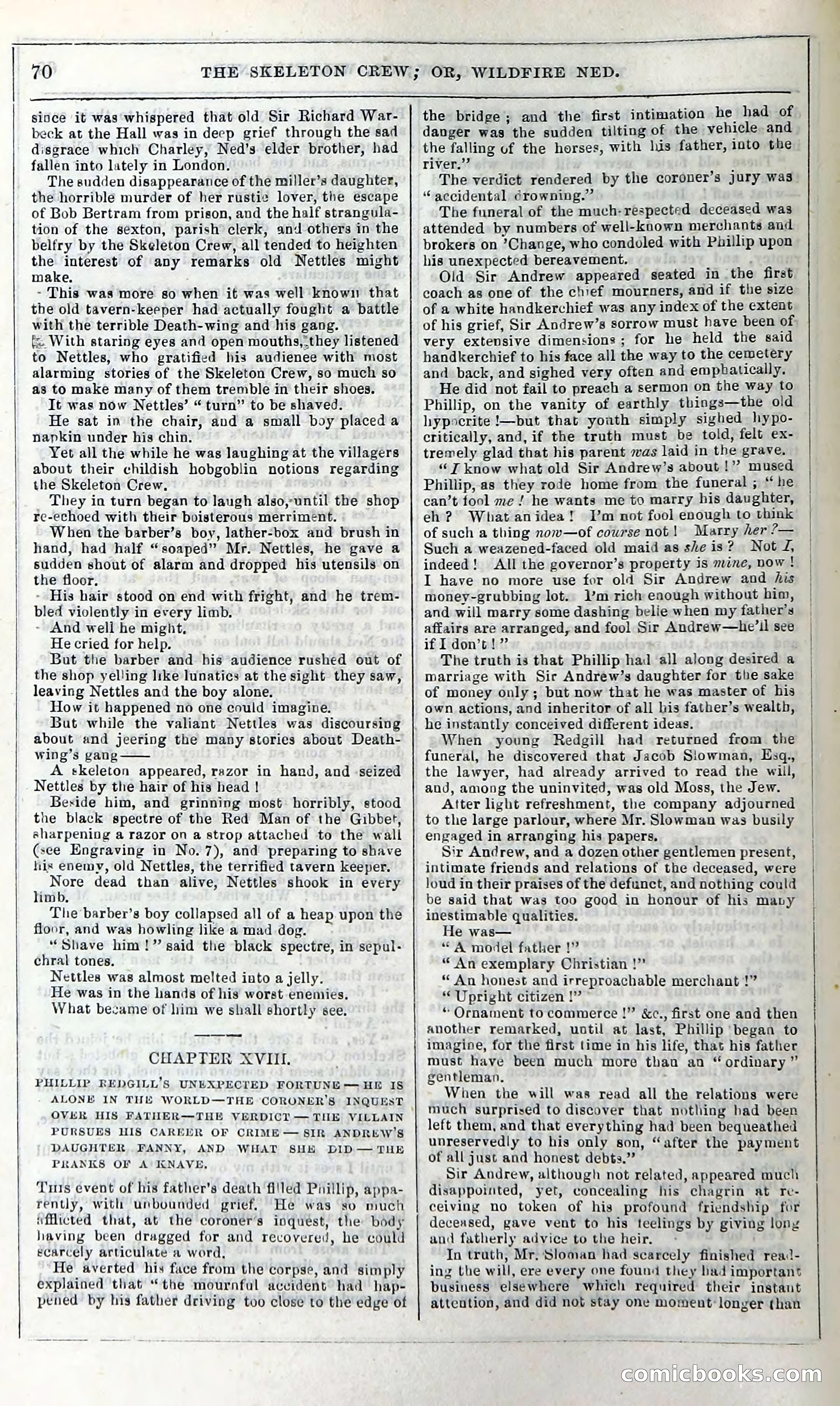
A restored page from Penny Dreadfuls, 1867. Page through the whole issue in the reader above.
📄 Transcribed text from this page (OCR, searchable)
Machine-transcribed from the original scan — historical spelling and the odd misread are preserved.
ee ney Penn ee 70 THE SKELETON CREW; OR, WILDFIRE NED. ae eee aaa eee __ nnn since it was whispered that old Sir Richard War- beck at the Hall was in deep grief through the sad disgrace which Charley, Ned’s elder brother, had fallen into lately in London. The sudden disappearance of the miller’s daughter, the horrible murder of her rustic lover, the escape of Bob Bertram from prison, and the half strangula- tion of the sexton, parish clerk, and others in the belfry by the Skeleton Crew, all tended to heighten the interest of any remarks old Nettles might make, - This was more so when it was well known that the old tavern-keeper had actually fought a battle with the terrible Death-wing and his gang. f With staring eyes and open mouths,_they listened to Nettles, who gratified his audienee with most alarming stories of the Skeleton Crew, so much so as to make many of them tremble in their shoes. It was now Nettles’ “turn” to be shaved. He sat in the chair, and a small boy placed a napkin under his chin. Yet all the while he was laughing at the villagers about their childish hobgoblin notions regarding the Skeleton Crew. They in turn began to laugh also,-until the shop re-echoed with their boisterous merriment. When the barber’s boy, lather-box and brush in hand, had half “soaped” Mr. Nettles, he gave a sudden shout of alarm and dropped his utensils on the floor. - His hair stood on end with fright, and he trem- bled violently in every limb. - And weli he might, He cried for help. But the barber and his audience rushed out of the shop yelling like lunatics at the sight they saw, leaving Nettles and the boy alone. How it happened no one could imagine. But while the valiant Nettles was discoursing about and jeering the many stories about Death- wing’s gang A skeleton appeared, razor in hand, and seized Nettles by the hair of his head ! Beside him, and grinning most horribly, stood the black spectre of the Red Man of the Gibbet, sharpening a razor on a strop attached to the wall (see Engraving in No.7), and preparing to shave his enemy, old Nettles, the terrified tavern keeper. Nore dead than alive, Nettles shook in every imb, The barber’s boy collapsed all of a heap upon the floor, and was howling like a mad dog. “Shave him!” said the black spectre, in sepul- chral tones. Nettles was almost melted into a jelly. He was in the hands of his worst enemies. What became of him we shall shortly see. CHAPTER XVIII. PHILLIP REDGILL’S UNEXPECTED FORTUNE —HE IS ALONE IN THE WORLD—THE CORONER’S INQUEST OVER HIS FATHER—THE VERDICT — THE VILLAIN PURSUES HIS CAREER OF CRIME — SIR ANDREW'S DAUGHTER FANNY, AND WHAT SHE DID— THE PRANKS OF A KNAVE, Tins event of his father’s death filled Phillip, appa- rently, with unbounded grief, He was so much sfflicted that, at the coroner’s inquest, the body having been dragged for and recovered, he could gcarcely articulate a word, He averted his face from the corpse, and simply explained that “the mournful accident had hap- pened by his father driving too close to the edge of the bridge; and the’ first intimation he had of danger was the sudden tilting of the vehicle and the falling uf the horses, with his father, into the river.” : The verdict rendered by the coroner’s jury was “accidental drowning.” The funeral of the much-respected deceased was attended by numbers of well-known merchants and brokers on ’Change, who condoled with Phillip upon his unexpected bereavement. Old Sir Andrew appeared seated in the first coach as one of the chief mourners, and if the size of a white handkerchief was any index of the extent of his grief, Sir Andrew’s sorrow must have been of. very extensive dimensions ; for he held the said handkerchief to his face all the way to the cemetery and back, and sighed very often and emphatically. He did not fail to preach a sermon on the way to Phillip, on the vanity of earthly things—the old hypocrite !—but that youth simply sighed hypo- © critically, and, if the truth must be told, felt ex- tremely glad that his parent was laid in the grave. “T know what old Sir Andrew’s about !”? mused Phillip, as they rode home from the funeral ; “he can’t fool me! he wants me to marry his daughter, eh? What anidea! I’m not fool enough to think of such a thing now—of course not! Marry her ?— Such a weazened-faced old maid as she is? Not J, indeed! All the governor’s property is mine, now ! I have no more use for old Sir Andrew and his money-grubbing lot.. Vm rich enough without him, and will marry some dashing belie when my father’s affairs are arranged, and fool Sir Andrew—he’il see if I don’t!” The truth is that Phillip had all along desired a marriage with Sir Andrew’s daughter for the sake of money only ; but now that he was master of his own actions, and inheritor of all his father’s wealth, _ he instantly conceived different ideas. When young Redgill had returned from the funeral, he discovered that Jacob Slowman, Esq., the lawyer, had already arrived to read the wiil, and, among the uninvited, was old Moss, the Jew. Atter light refreshment, the company adjourned to the large parlour, where Mr. Slowman was busily engaged in arranging his papers. Sir Andrew, and a dozen other gentlemen present, intimate friends and relations of the deceased, were loud in their praises of the defunct, and nothing could be said that was too good in honour of his many inestimable qualities. He was— ‘“A model father !” “An exemplary Christian !” * An honest and irreproachable merchant !” “Upright citizen !” * Ornament to commerce !” &c., first one and then another remarked, until at last, Phillip began to imagine, for the first time in his life, that his father must have been much more than an “ ordinary ” gentleman. When the will was read all the relations were much surprised to discover that nothing had been left them, and that everything had been bequeathed unreservedly to his only son, “after the payment of all just and honest debts.” Sir Andrew, although not related, appeared much disappointed, yet, concealing his chagrin at re- ceiving no token of his profound friendship for deceased, gave vent to his teelings by giving long and fatherly advice to the heir. - In truth, Mr. Sloman had scarcely finished read- ing the will, ere every one found they bad important business elsewhere which required their instant attention, and did not stay one moment lonver (han michboo (E(0) S) (C(O)