
Penny Dreadfuls, 1867 · page 72 of 196
The Skeleton Crew; Or, Wildfire Ned — page 72: what you’re looking at
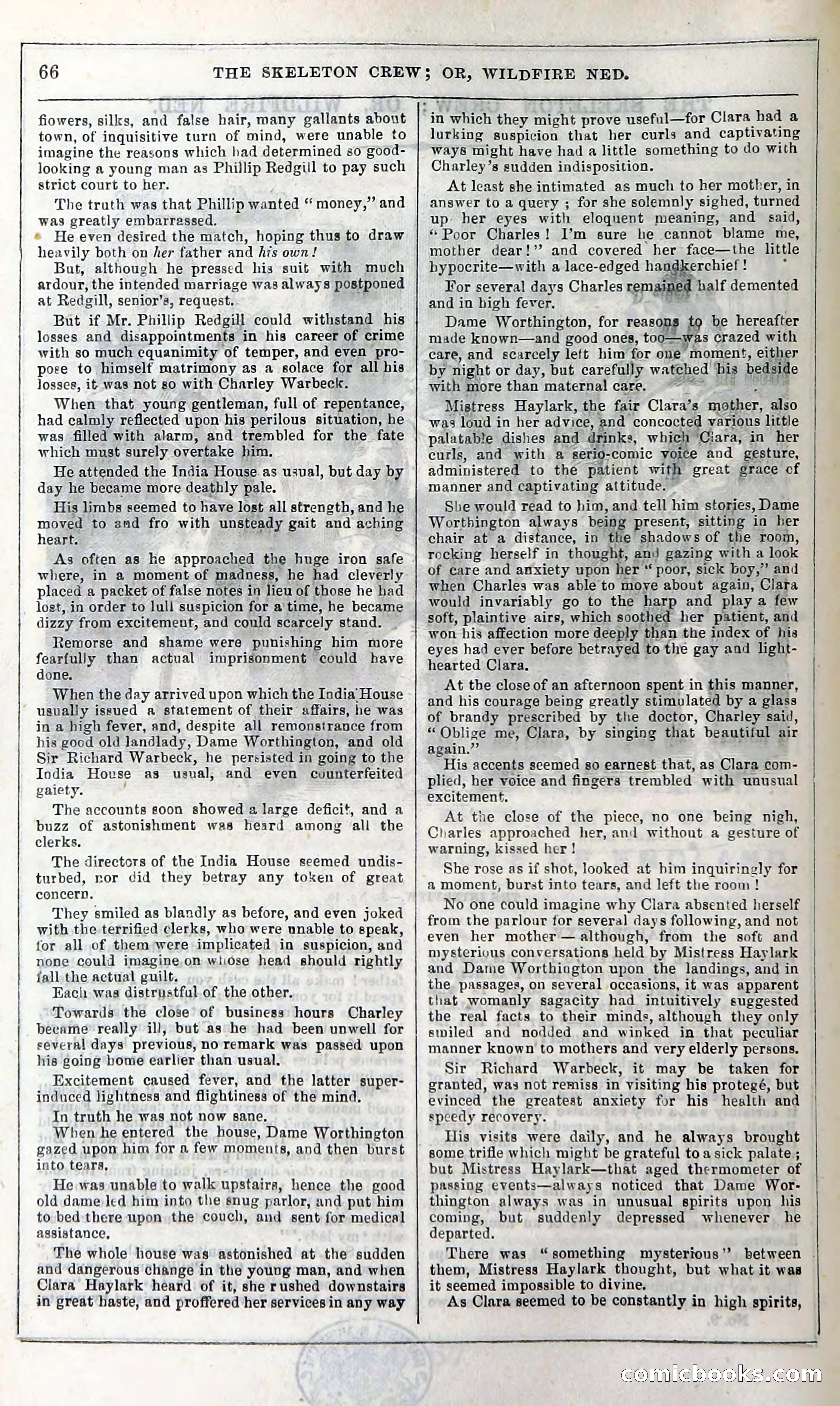
A restored page from Penny Dreadfuls, 1867. Page through the whole issue in the reader above.
📄 Transcribed text from this page (OCR, searchable)
Machine-transcribed from the original scan — historical spelling and the odd misread are preserved.
66 THE SKELETON CREW; OR, WILDFIRE NED. fiowers, silks, and false hair, many gallants about town, of inquisitive turn of mind, were unable to imagine the reasons which had determined so good- looking a young man as Phillip Redgill to pay such strict court to her. The truth was that Phillip wanted “ money,” and was greatly embarrassed. « He even desired the match, hoping thus to draw heavily both on her father and his own! But, although he pressed his suit with much ardour, the intended marriage was always postponed at Redgill, senior’s, request. But if Mr. Phillip Redgill could withstand his losses and disappointments in his career of crime with so much equanimity of temper, and even pro- pose to himself matrimony as a solace for all his losses, it was not so with Charley Warbeck. When that young gentleman, full of repentance, had calmly reflected upon his perilous situation, he was filled with alarm, and trembled for the fate which must surely overtake him. He attended the India House.as usual, but day by day he became more deathly pale. His limbs seemed to have lost all strength, and he moved to and fro with unsteady gait and aching heart. As often as he approached the huge iron safe where, in a moment of madness, he had cleverly placed a packet of false notes in lieu of those he had lost, in order to luli suspicion for a’'time, he became dizzy from excitement, and could scarcely stand. Remorse and shame were punishing him more fearfully than actual imprisonment could have done. When the day arrived upon which the India House usually issued a statement of their affairs, he was in a high fever, and, despite all remonstrance from his good old landlady, Dame Worthington, and old Sir Richard Warbeck, he persisted in going to the India Hovse as usual, and even counterfeited gaiety. The accounts soon showed a large deficit, and a buzz of astonishment was heard among all the clerks. The directors of the India House seemed undis- turbed, ror did they betray any token of great concern. They smiled as blandly as before, and even joked with the terrified clerks, who were unable to speak, for all of them were implicated in suspicion, and none could imagine.on wiiose head should rightly fall the actual guilt. Fach was distrustful of the other. Towards the close of business hours Charley became really ill, but as he had been unwell for several days previous, no remark was passed upon his going bome earlier than usual. Excitement caused fever, and the latter super- induced lightness and flightiness of the mind, In truth he was not now sane. When he entered the house, Dame Worthington gazed upon him for a few moments, and then burst into tears, He was unable to walk upstairs, hence the good old dame led him into the snug parlor, and put him to bed there upon the couch, and sent for medical assistance, The whole house was astonished at the sudden and dangerous change in the young man, and when Clara Haylark heard of it, she rushed downstairs in great haste, and proffered her services in any way ‘in which they might prove useful—for Clara had a lurking suspicion that her curls and captivating ways might have had a little something to do with Charley’s sudden indisposition. At least she intimated as much to her mother, in answer to a query ; for she solemnly sighed, turned up her eyes with eloquent meaning, and said, “ Poor Charles! I’m eure he cannot blame me, mother dear!’’ and covered her face—the little bypocrite—with a lace-edged handkerchief ! For several days Charles remaimed half demented and in high fever. or Dame Worthington, for reas be hereafter made known—and good ones, too—was crazed with care, and scarcely left him for one moment, either by night or day, but carefully watched ‘his bedside with more than maternal care, ~~ Mistress Haylark, the fair Clara’s mother, als was loud in her advice, and concocted various little palatable dishes and drinks, which Ciara, in her curls, and with a serio-comic yoice and gesture, administered to the patient with great grace cf manner and captivating attitude. ~ ‘ She would read to him, and tell him stories, Dame Worthington always being present, sitting in her chair at a distance, in the shadows of the room, rocking herself in thought, and gazing with a look of care and anxiety upon her poor, sick boy,”’ and when Charles was able to move about again, Clara would invariably go to the harp and play a few soft, plaintive airs, which soothed her patient, and won his affection more deeply than the index of his eyes had ever before betrayed to the gay and light- hearted Clara. At the close of an afternoon spent in this manner, and his courage being greatly stimulated by a glass of brandy prescribed by the doctor, Charley said, “ Oblige me, Clara, by singing that beautiful air again.” , mn | His accents seemed so earnest that, as Clara com- plied, her voice and fingers trembled with unusual excitement. At the close of the piece, no one being nigh, Charles approached her, and without a gesture of warning, kissed her ! She rose as if shot, looked at him inquiringly for a moment, burst into tears, and left the room ! No one could imagine why Clara absented herself from the parlour for several days following, and not even her mother — although, from the soft and mysterious conversations held by Mistress Haylark and Dame Worthiogton upon the landings, and in the passages, on several occasions, it was apparent that womanly sagacity had intuitively suggested the real facts to their minds, although they only swwiled and nodded and winked in that peculiar manner known to mothers and very elderly persons. Sir Richard Warbeck, it may be taken for granted, was not remiss in visiting his protegé, but evinced the greatest anxiety for his health and speedy recovery. . His visits were daily, and he always brought some trifle which might be grateful toa sick palate ; but Mistress Haylark—that aged thermometer of passing events—always noticed that Dame Wor- thington always was in unusual spirits upon his coming, but suddenly depressed whenever he departed. i a A a a nae There was “something mysterious’? between . them, Mistress Haylark thought, but what it was it seemed impossible to divine. As Clara seemed to be constantly in high spirits, tere sheets (C(O) nn Ehboo S (E(0)