
Penny Dreadfuls, 1867 · page 52 of 196
The Skeleton Crew; Or, Wildfire Ned — page 52: what you’re looking at
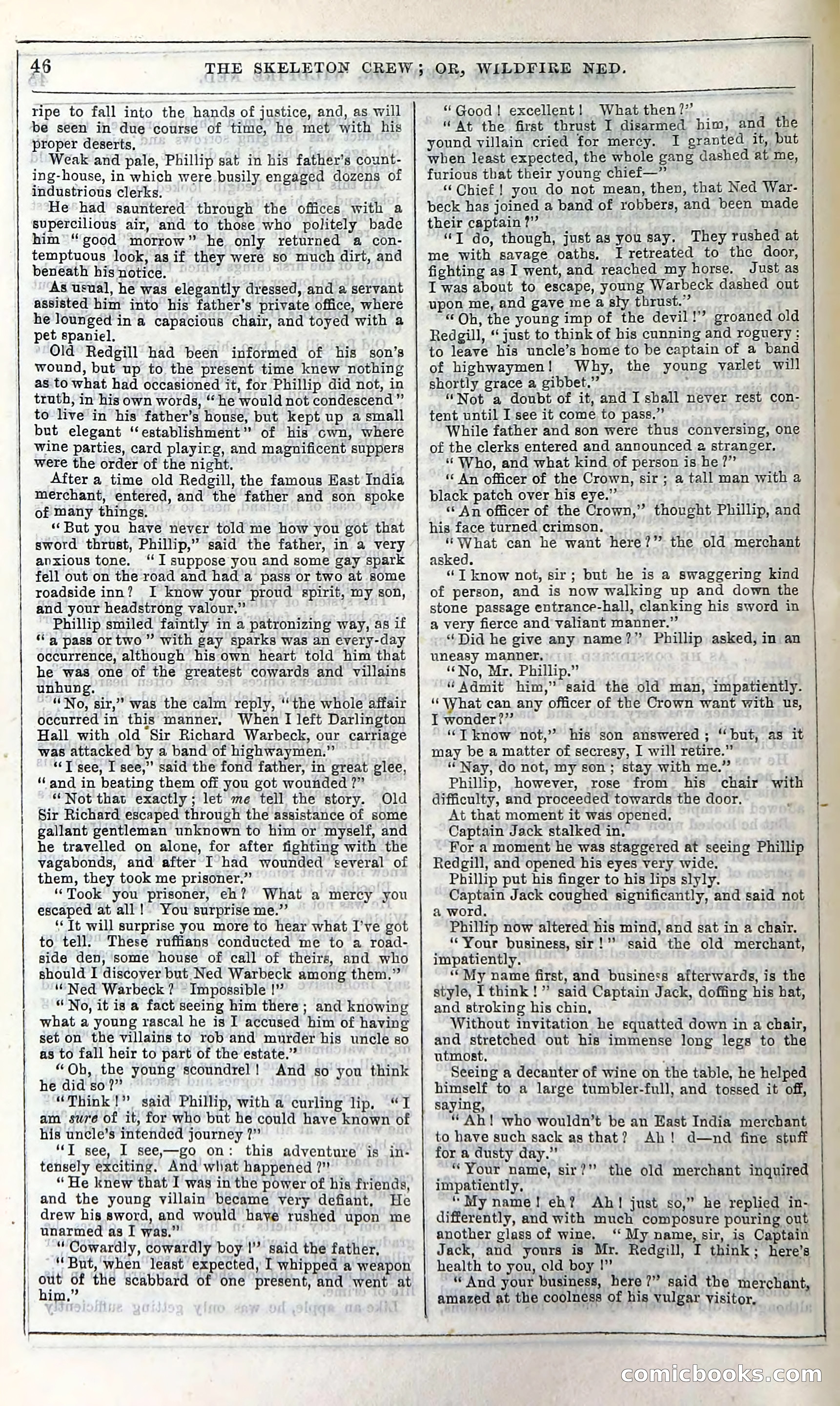
A restored page from Penny Dreadfuls, 1867. Page through the whole issue in the reader above.
📄 Transcribed text from this page (OCR, searchable)
Machine-transcribed from the original scan — historical spelling and the odd misread are preserved.
© tt LE, LE LLL LLL LAL 46 THE SKELETON CREW; OR, WILDFIRE NED. i A a te ripe to fall into the hands of justice, and, as will be seen in due course of time, he met with his proper deserts, _ Weak and pale, Phillip sat in his father’s count- ing-house, in which were busily engaged dozens of industrious clerks. He had sauntered through the offices with a supercilious air, and to those who politely bade him “good morrow” he only returned a con- temptuous look, as if they were so much dirt, and beneath his notice. As usual, he was elegantly dressed, and a servant assisted him into his father’s private office, where he lounged in a capacious chair, and toyed with a pet spaniel, Old Redgill had been informed of his son’s wound, but up to the present time knew nothing as to what had occasioned it, for Phillip did not, in truth, in his own words, “he would not condescend””’ to live in his father’s house, but kept up a small but elegant ‘‘establishment” of his cwn, where wine parties, card playirg, and magnificent suppers were the order of the night. After a time old Redgill, the famous East India merchant, entered, and the father and son spoke of Many things. “But you have never told me how you got that sword thrust, Phillip,” said the father, in a very anxious tone. ‘I suppose you and some gay spark fell out on the road and had a pass or two at some roadside inn? I know your proud spirit, my son, and your headstrong valour.” Phillip smiled faintly in a patronizing way, as if ‘a pass or two ” with gay sparks was an every-day occurrence, although his own heart told him that he was one of the greatest cowards and villains unhung. “No, sir,” was the calm reply, ‘‘the whole affair occurred in this manner, When I left Darlington Hall with old Sir Richard Warbeck, our carriage was attacked by a band of highwaymen.”’ ‘“‘T see, I see,” said the fond father, in great glee, ‘and in beating them off you got wounded ?” ‘Not that exactly; let me tell the story. Old Sir Richard escaped through the assistance of some gallant gentleman unknown to him or myself, and he travelled on alone, for after fighting with the vagabonds, and after I had wounded several of them, they took me prisoner.” ‘‘Took you prisoner, eh? What a mercy you escaped at all! You surprise me.”’ ‘‘ It will surprise you more to hear what I’ve got to tell. These ruffians conducted me to a road- side den, some house of call of theirs, and who should I discover but Ned Warbeck among them.” “Ned Warbeck ? — Impossible !” “No, it is a fact seeing him there; and knowing what a young rascal he is I accused him of having set on the villains to rob and murder his uncle so as to fall heir to part of the estate.” “Oh, the young scoundrel! And so you think he did so?” “Think!” said Phillip, with a curling lip, “T am swe of it, for who but he could have known of his uncle’s intended journey ?” ‘“T see, I see,—go on: this adventure is in- tensely exciting. And what happened ?” “He knew that I was in the power of his friends, and the young villain became very defiant, He drew his sword, and would haye rushed upon me unarmed as I was,” “Cowardly, cowardly boy |” said the father, ‘But, when least expected, I whipped a weapon on of the scabbard of one present, and went at im,’ ‘“ Good! excellent! What then?’ . “At the first thrust I disarmed him, and the yound villain cried for mercy. I granted it, but when least expected, the whole gang dashed at me, furious that their young chief—” “Chief! you do not mean, then, that Ned War- beck has joined a band of robbers, and been made their captain ?” “T do, though, just as you say. They rushed at me with savage oaths, I retreated to the door, fighting as I went, and reached my horse. Just as I was about to escape, young Warbeck dashed ont upon me, and gave me a sly thrust.” “ Oh, the young imp of the devil!” groaned old Redgill, “just to think of his cunning and roguery : to leave his uncle’s home to be captain of a band of highwaymen! Why, the young varlet will shortly grace a gibbet.” ‘Not a doubt of it, and I shall never rest con- tent until I see it come to pass.” : While father and son were thus conversing, one of the clerks entered and announced a stranger. ‘‘ Who, and what kind of person is he ?” ‘© An officer of the Crown, sir; a tall man with a black patch over his eye.” “An oficer of the Crown,” thought Phillip, and his face turned crimson. ‘What can he want here?” the old merchant asked. “T know not, sir; but he is a swaggering kind of person, and is now walking up and down the stone passage entrance-hall, clanking his sword in a very fierce and valiant manner.” “Did he give any name?” Phillip asked, in an uneasy manner, ‘“No, Mr. Phillip.” “Admit him,” said the old man, impatiently. ‘What can any officer of the Crown want with us, I wonder?” ‘““T know not,” his son answered; ‘but, as it may be a matter of secresy, I will retire.” “Nay, do not, my son; stay with me.” Phillip, however, rose from his chair with difficulty, and proceeded towards the door. At that moment it was opened. Captain Jack stalked in, For a moment he was staggered at seeing Phillip Redgill, and opened his eyes very wide. Phillip put his finger to his lips slyly. Captain Jack coughed significantly, and said not a word. 4 Phillip now altered his mind, and sat in a chair. ‘Your business, sir!” said the old merchant, impatiently. ‘“My name first, and business afterwards, is the style, I think!” said Captain Jack, doffing his hat, and stroking his chin, Without invitation he squatted down in a chair, and stretched ont his immense long legs to the utmost, ; Seeing a decanter of wine on the table, he helped himself to a large tumbler-full, and tossed it off, saying, “Ah! who wouldn’t be an East India merchant to have such sack as that? Ah! d—nd fine stnff for a dusty day.” “Your name, sir?’ the old merchant inquired impatiently, “My name! eh? Ah! just so,” he replied in- differently, and with much composure pouring out another glass of wine, ‘‘ My name, sir, is Captain Jack, and yours is Mr. Redgill, I think; here’s health to you, ald boy !” — * And your business, here?” said the merchant, amazed at the coolness of his vulgar visitor, , (E(0) nfl Ehboo cS (C(O) nA