
Penny Dreadfuls, 1867 · page 154 of 196
The Skeleton Crew; Or, Wildfire Ned — page 154: what you’re looking at
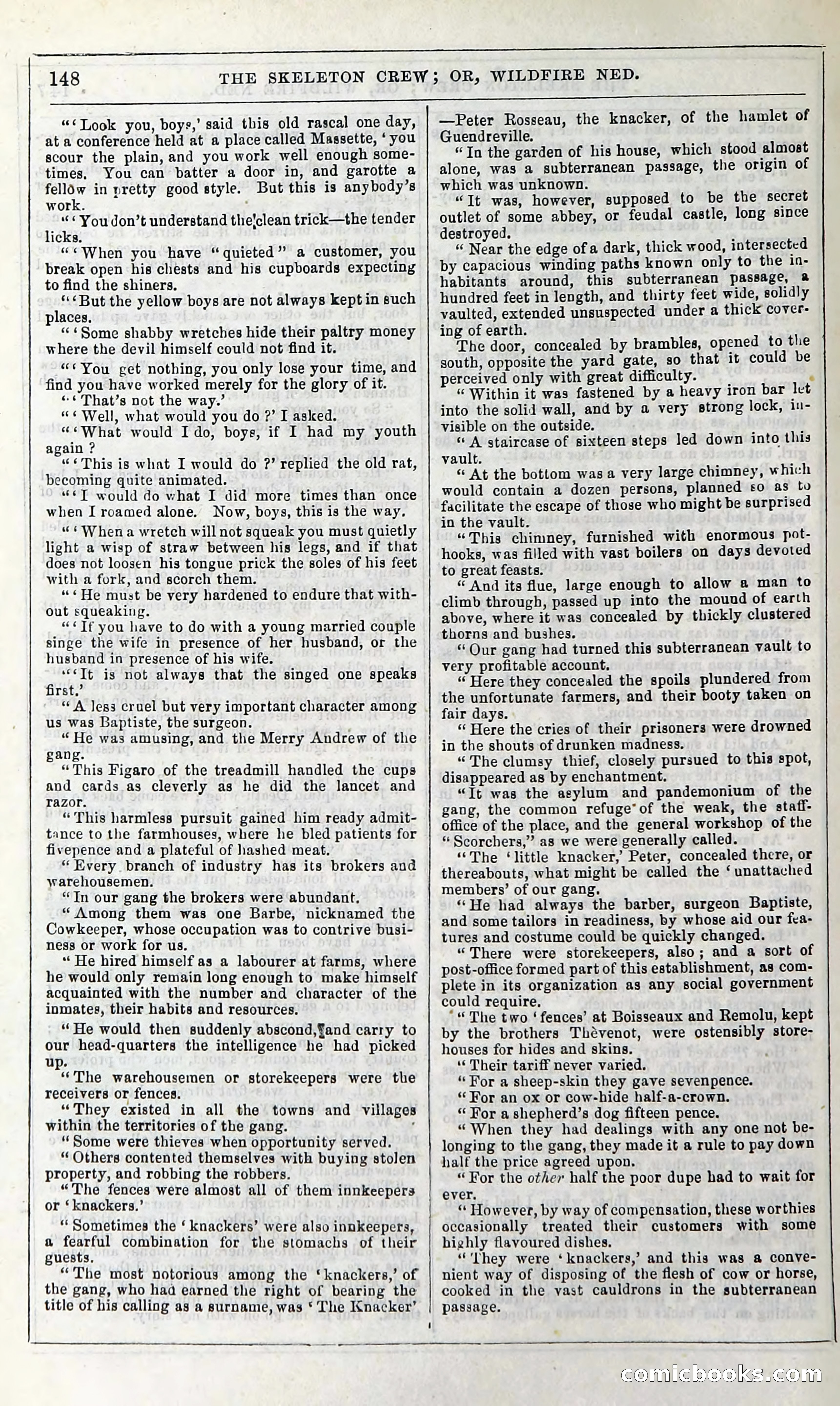
A restored page from Penny Dreadfuls, 1867. Page through the whole issue in the reader above.
📄 Transcribed text from this page (OCR, searchable)
Machine-transcribed from the original scan — historical spelling and the odd misread are preserved.
a a 148 THE SKELETON CREW; OR, WILDFIRE NED. eb?! Le et EE ae ee eee “¢Took you, boys,’ said this old rascal one day, at a conference held at a place called Massette, ‘you scour the plain, and you work well enough some- times, You can batter a door in, and garotte a fellow in pretty good style. But this is anybody’s work. “© You don’t understand the'clean trick—the tender licks. “«When you have “quieted” a customer, you break open his chests and his cupboards expecting to find the shiners. “But the yellow boys are not always kept in such places. ««¢ Some shabby wretches hide their paltry money where the devil himself could not find it. “¢ You get nothing, you only lose your time, and find you have worked merely for the glory of it. “¢ That’s not the way.’ «¢ Well, what would you do ?’ I asked. “¢What would Ido, boys, if I had my youth again ? “¢This is what I would do ?’ replied the old rat, becoming quite animated. “¢T would do what I did more times than once when I roamed alone. Now, boys, this is the way, “When a wretch will not squeak you must quietly light a wisp of straw between his legs, and if that does not loosen his tongue prick the soles of his feet with a fork, and scorch them. ““« He must be very hardened to endure that with- out squeaking. “¢Tf you have to do with a young married couple singe the wife in presence of her husband, or the husband in presence of his wife. ‘Tt is not always that the singed one speaks first,’ ** A Jes3 cruel but very important character among us was Baptiste, the surgeon. “ He was amusing, and the Merry Andrew of the gang. “This Figaro of the treadmill handled the cups and cards as cleverly as he did the lancet and razor. “This harmless pursuit gained him ready admit- tance to the farmhouses, where he bled patients for fivepence and a plateful of hashed meat. “Every branch of industry has its brokers and warehousemen. “In our gang the brokers were abundant, “ Among them was one Barbe, nicknamed the Cowkeeper, whose occupation was to contrive busi- ness or work for us. “He hired himself as a labourer at farms, where he would only remain long enough to make himself acquainted with the number and character of the inmates, their habits and resources. “He would then suddenly abscond,¥and carry to our head-quarters the intelligence he had picked p- ‘‘The warehousemen or storekeepers were the receivers or fences. “They existed in all the towns and villages within the territories of the gang. , ‘Some were thieves when opportunity served. “Others contented themselves with buying stolen property, and robbing the robbers. “The fences were almost all of them innkeepers or ‘knackers.’ “‘ Sometimes the ‘ knackers’ were also innkeepers, a fearful combination for the stomachs of their guests. “The most notorious among the ‘knackers,’ of the gang, who had earned the right of bearing the title of his calling as a surname, was * The Knacker’ LL —Peter Rosseau, the knacker, of the hamlet of Guendreville. ‘ “Tn the garden of his house, which stood almost alone, was a subterranean passage, the origin of which was unknown. “It was, however, supposed to be the secret outlet of some abbey, or feudal castle, long since destroyed. ‘ “ Near the edge of a dark, thick wood, intersected by capacious winding paths known only to the in- habitants around, this subterranean passage, & hundred feet in length, and thirty feet wide, solidly vaulted, extended unsuspected under a thick cover- ing of earth. The door, concealed by brambles, opened to the south, opposite the yard gate, so that it could be perceived only with great difficulty. ‘ “ Within it was fastened by a heavy iron bar let into the solid wall, and by a very strong lock, in- visible on the outside. t : “ A staircase of sixteen steps led down into this vault. : “ At the bottom wasa very large chimney, which would contain a dozen persons, planned so as to facilitate the escape of those who might be surprised in the vault. “This chimney, furnished with enormous pot- hooks, was filled with vast boilers on days devoted to great feasts. “ And its flue, large enough to allow a man to climb through, passed up into the mound of earth above, where it was concealed by thickly clustered thorns and bushes. “ Our gang had turned this subterranean vault to very profitable account. “Here they concealed the spoils plundered from the unfortunate farmers, and their booty taken on fair days. “ Here the cries of their prisoners were drowned in the shouts of drunken madness. “The clumsy thief, closely pursued to this spot, disappeared as by enchantment. “Tt was the asylum and pandemonium of the gang, the common refuge’ of the weak, the staff- office of the place, and the general workshop of the “ Scorchers,” as we were generally called. ‘““The ‘little knacker,’ Peter, concealed there, or thereabouts, what might be called the ‘ unattached members’ of our gang. “‘He had always the barber, surgeon Baptiste, and some tailors in readiness, by whose aid our fca- tures and costume could be quickly changed. “There were storekeepers, also; and a sort of post-office formed part of this establishment, as com- plete in its organization as any social government could require. “« The two ‘fences’ at Boisseaux and Remolu, kept by the brothers Thévenot, were ostensibly store- houses for hides and skins. ‘‘ Their tariff never varied. “For a sheep-skin they gave sevenpence. ‘Wor an ox or cow-hide half-a-crown. “ For a shepherd’s dog fifteen pence. “When they had dealings with any one not be- longing to the gang, they made it a rule to pay down half the price agreed upon. “For the other half the poor dupe had to wait for ever, “‘ However, by way of compensation, these worthies occasionally treated their customers with some highly flavoured dishes. “They were ‘knackers,’ and this was a conve- nient way of disposing of the flesh of cow or horse, cooked in the vast cauldrons in the subterranean passage. 3| 006) (E(0) im