
Penny Dreadfuls, 1868 · page 12 of 98
The Frozen Crew Of The Ice-Bound Ship; Or, Terrors Of The Arctic Region — page 12: what you’re looking at
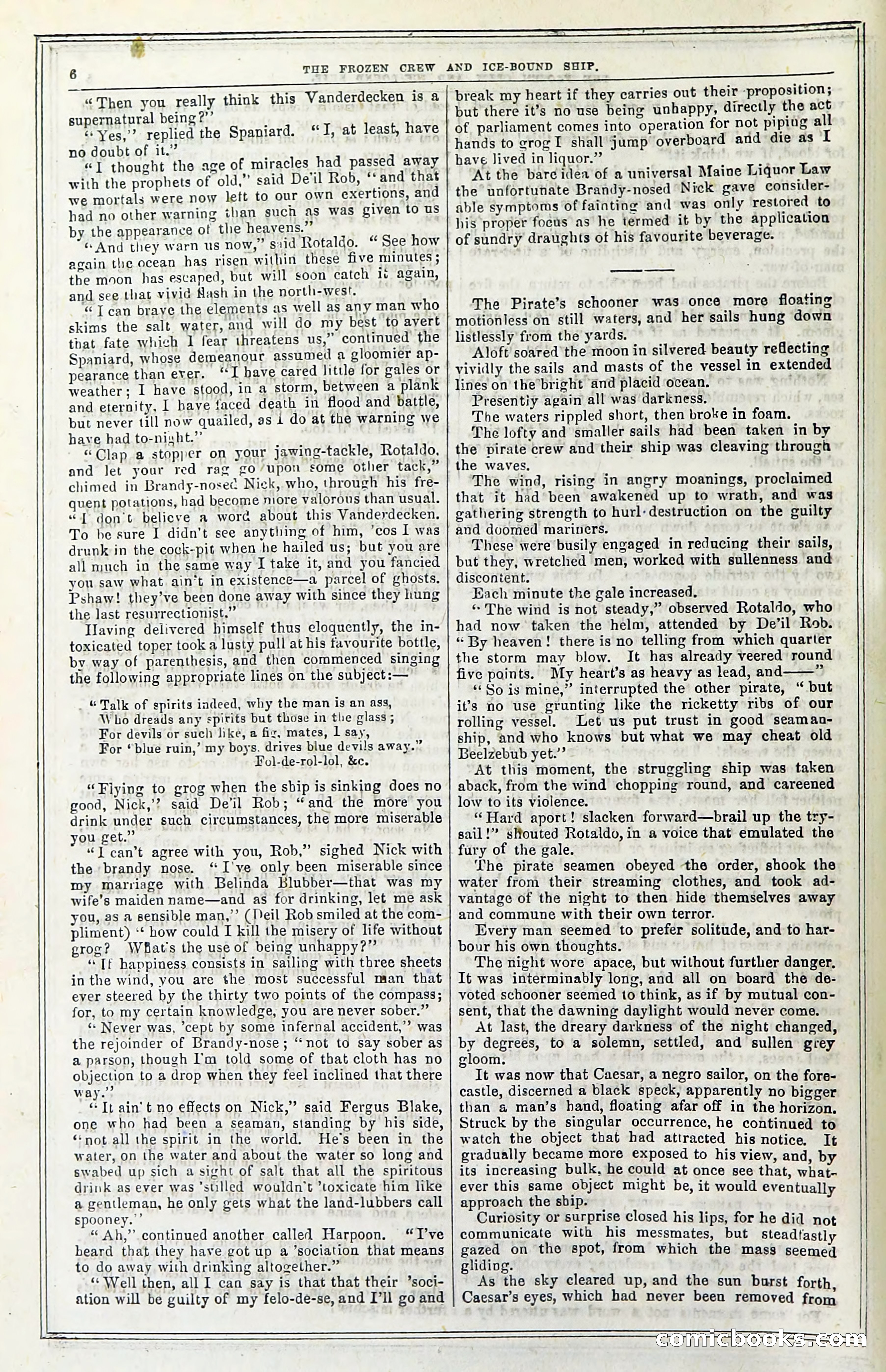
A restored page from Penny Dreadfuls, 1868. Page through the whole issue in the reader above.
📄 Transcribed text from this page (OCR, searchable)
Machine-transcribed from the original scan — historical spelling and the odd misread are preserved.
6 THE FROZEN CREW AND ICE-BOUND SHIP, — “Then you really think this Vanderdecken is a supernatural being ?”’ i “Yes,” replied the Spaniard. no doubt of it.” “I thought the age of miracles had passed away with the prophets of old,” said De'il Rob, ‘‘ and that we mortals were now left to our own exertions, and had no other warning than such as was given to us by the appearance of the heavens.” «And they warn us now,” said Rotaldo. “ See how avain the ocean has risen within these five minutes ; the moon has escaped, but will soon catch it again, and see that vivid Mash in the north-west. “ T can brave the elements as well as any man who skims the salt water, and will do my best to ayert that fate which 1 fear threatens us,” continued the Spaniard, whose demeanour assumed a gloomier ap- pearance than ever. “I have cared little for gales or weather; I have stood, in a storm, between a plank and eternity. I have faced death in flood and battle, but never till now quailed, as i do at the warning we have had to-night.” “Qlap a stopper on your jawing-tackle, Rotaldo, and Jet your red rag go “upon some other tack,” chimed in Brandy-nosec Niek, who, through his fre- quent potations, had become niore valorous than usual. “J don't belicve a wore about this Vanderdecken. To he sure I didn’t see anything of him, ’cos I was drunk in the cock-pit when he hailed us; but you are all much in the same way J take it, and you fancied you saw what ain’t in existence—a parcel of ghosts. Pshaw! they’ve been done away with since they hung the last resurrectionist.” Ilaving delivered himself thus eloquently, the in- toxicated toper took a lusty pull at his favourite bottle, by way of parenthesis, and then commenced singing the following appropriate lines on the subject:— “TJ, at least, have _ «Talk of spirits indeed, why the man is an ass, W bo dreads any spirits but those in the glass; For devils or such like, a fiz, mates, 1 say, For “blue ruin,’ my boys. drives blue devils away.” T'ol-de-rol-lol, &c. “Flying to grog when the sbip is sinking does no good, Nick,’? said De’il Rob; “and the more you drink under such circumstances, the more miserable you get.” “J can’t agree with you, Rob,” sighed Nick with the brandy nose. ‘“I'ye only been miserable since my marriage with Belinda blubber—that was my wife’s maiden name—and as for drinking, let me ask you, as a sensible man,’’ (Deil Rob smiled at the com- pliment) ‘* how could I kill the misery of life without groz? W8at's the use of being unhappy?” ‘Tf happiness consists in sailing with three sheets in the wind, you are the most successful maan that ever steered by the thirty two points of the compass; for, to my certain knowledge, you are never sober.” ‘* Never was, ’cept by some infernal accident,’ was the rejoinder of Brandy-nose; “not to say sober as a parson, though I'm told some of that cloth has no objection to a drop when they feel inclined that there way.” ‘‘Tt ain't no effects on Nick,” said Fergus Blake, one who had been a seaman, standing by his side, ‘‘not all the spirit in the world. He's been in the water, on the water and about the water so long and swabed up sich a sight of salt that all the spiritous drink as ever was ’sulled wouldn't ’toxicate him like a gentleman, he only gets what the land-lubbers call spooney.’’ “ Ah,’’ continued another called Harpoon. “I’ve heard that they have got up a ’sociation that means to do away with drinking altogether.” ‘‘ Well then, all I can say is that that their ’soci- ation will be guilty of my felo-de-se, and I’ll go and break my heart if they carries out their “proposition; but there it’s no use being unhappy, directly the act of parliament comes into operation for not pipiug all hands to erogI shall jump overboard and die as I have Jived in liquor.” . At the bare idea of a universal Maine Liquor Law the unfortunate Brandy-nosed Nick gave consider- able symptoms of fainting and was only restored to his proper focus as he termed it by the application of sundry draughts of his favourite beverage. -—_—_—_—_—— —-— The Pirate’s schooner was once more floating motionless on still waters, and her sails hung down listlessly from the yards. Aloft soared the moon in silvered beauty reflecting vividly the sails and masts of the vessel in extended lines on the’bright and placid ocean. I iad) Presentiy again all was darkness. The waters rippled short, then broke in foam. The lofty and smaller sails had been taken in by the pirate crew and their ship was cleaving through the waves. y The wind, rising in angry moanings, proclaimed that it had been awakened up to wrath, and was gathering strength to hurl-destruction on the guilty and doomed mariners. | These were busily engaged in reducing their sails, but they, wretched men, worked with sullenness and discontent. Each minute the gale increased. * The wind is not steady,” observed Rotaldo, who had now taken the helm, attended by De’il Rob. “ By heaven! there is no telling from which quarter the storm may blow. It has already veered round five points. My heart’s as heavy as lead, and——” ‘‘So is mine,” interrupted the other pirate, ‘ but it’s no use grunting like the ricketty ribs of our rolling vessel. Let us put trust in good seaman- ship, and who knows but what we may cheat old Beelzebub yet.’ At this moment, the struggling ship was taken aback, from the wind chopping round, and careened low to its violence. “Hard aport! slacken forward—brail up the try- sail!” sHouted Rotaldo, in a voice that emulated the fury of the gale. The pirate seamen obeyed the order, shook the water from their streaming clothes, and took ad- vantage of the night to then hide themselves away and commune with their own terror. Every man seemed to prefer solitude, and to har- bour his own thoughts. The night wore apace, but without further danger. It was interminably long, and all on board the de- voted schooner seemed to think, as if by mutual con- sent, that the dawning daylight would never come. At last, the dreary darkness of the night changed, by degrees, to a solemn, settled, and sullen grey gloom. It was now that Caesar, a negro sailor, on the fore- castle, discerned a black speck, apparently no bigger than a man’s hand, floating afar off in the horizon. Struck by the singular occurrence, he continued to watch the object that had attracted his notice. It gradually became more exposed to his view, and, b its increasing bulk, he could at once see that, what- ever this same object might be, it would eventually approach the sbip. Curiosity or surprise closed his lips, for he did not communicate with his messmates, but steadfastly de on the spot, from which the mass seemed gliding. As the sky cleared up, and the sun barst forth Caesar’s eyes, which had never been removed from COMlGODOOKS-COlm __