
Penny Dreadfuls, 1868 · page 10 of 98
The Frozen Crew Of The Ice-Bound Ship; Or, Terrors Of The Arctic Region — page 10: what you’re looking at
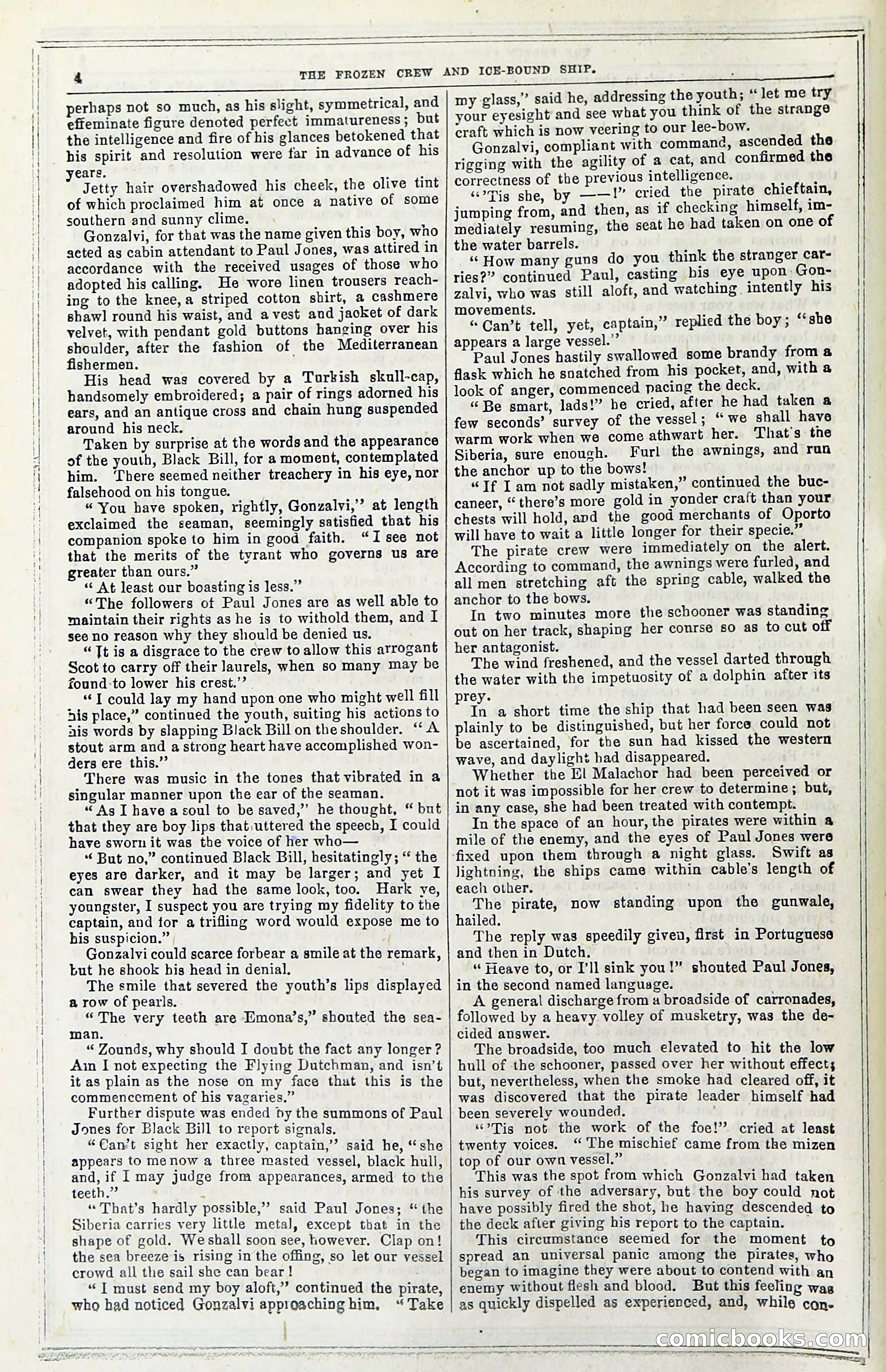
A restored page from Penny Dreadfuls, 1868. Page through the whole issue in the reader above.
📄 Transcribed text from this page (OCR, searchable)
Machine-transcribed from the original scan — historical spelling and the odd misread are preserved.
HE FROZEN CREW AND IOCE-BOUND SHIP. : eee re a ee perhaps not so much, as his slight, symmetrical, and effeminate figure denoted perfect immatureness ; but the intelligence and fire of his glances betokened that his spirit and resolution were far in advance of his ears. 5 Jetty hair overshadowed his cheek, the olive tint of which proclaimed him at once a native of some southern and sunny clime. Gonzalvi, for that was the name given this boy, who aeted as cabin attendant to Paul Jones, was attired in accordance with the received usages of those who adopted his calling. He wore linen trousers reach- ing to the knee,a striped cotton shirt, a cashmere shawl round his waist, and avest and jacket of dark velvet, with pendant gold buttons hanging over his shoulder, after the fashion of the Mediterranean fishermen. His head was covered by a Turkish skull-cap, handsomely embroidered; a pair of rings adorned his ears, and an antique cross and chain hung suspended around his neck. Taken by surprise at the words and the appearance of the youth, Black Bill, for a moment, contemplated him. ‘There seemed neither treachery in his eye, nor falsehood on his tongue. “You have spoken, rightly, Gonzalvi,’”’ at length exclaimed the seaman, seemingly satisfied that his companion spoke to him in good faith. “I see not that the merits of the tyrant who governs us are greater than ours.” “ At least our boasting is less.” “The followers of Paul Jones are as well able to maintain their rights as he is to withold them, and I see no reason why they should be denied us. “Tt is a disgrace to the crew to allow this arrogant Scot to carry off their laurels, when so many may be found:to lower his crest.’’ | “I could lay my hand upon one who might well fill his place,” continued the youth, suiting his actions to his words by slapping Black Bill on the shoulder. “A stout arm and a strong heart have accomplished won- ders ere this.” There was music in the tones that vibrated in a singular manner upon the ear of the seaman. “As I have a soul to be saved,” he thought, “ but that they are boy lips that, uttered the speech, I could have sworn it was the voice of her who— “ But no,” continued Black Bill, hesitatingly; “ the eyes are darker, and it may be larger; and yet I can swear they had the same look, too. Hark ye, youngster, I suspect you are trying my fidelity to the captain, and tor a trifling word would expose me to his suspicion.” : Gonzalvi could scarce forbear a smile at the remark, but he shook his head in denial. The smile that severed the youth’s lips displayed a row of pearls. “The very teeth are Emona’s,” shouted the sea- man. “ Zounds, why should I doubt the fact any longer? Ain I not expecting the Flying Dutchman, and isn’t it as plain as the nose on my face that this is the commencement of his vagaries.” Further dispute was ended by the summons of Paul Jones for Black Bill to report signals. “Can’t sight her exactly, captain,’’ said he, ‘she appears to menow a three masted vessel, black hull, ands I may judge from appearances, armed to the teeth.’ 2 “That’s hardly possible,” said Paul Jones; “ the Siberia carries very little metal, except that in the shape of gold. Weshall soon see, however. Clap on! the sea breeze is rising in the offing, so let our vessel crowd all the sail she can bear! ““T must send my boy aloft,” continued the pirate, who had noticed Gonzalvi approaching him, “Take my glass,” said he, addressing the youth; “let me try your eyesight and see what you think of the strange craft which is now veering to our lee-bow. Gonzalvi, compliant with command, ascended the rigging with the agility of a cat, and confirmed the correctness of the previous intelligence. um ‘Tig she, by ——!” cried the pirate. chieftain, jumping from, and then, as if checking himself, im- mediately resuming, the seat he had taken on one of the water barrels. “ How many guns do you think the stranger car- ries?” continued Paul, casting bis eye upon Gon- zalvi, who was still aloft, and watching intently his movements. “Can’t tell, yet, captain,” replied the boy; “‘she appears a large vessel.’ Paul Jones hastily swallowed some brandy from a flask which he snatched from his pocket, and, with a look of anger, commenced pacing the deck. “Be smart, lads!” he cried, after he had taken a few seconds’ survey of the vessel; “we shall have warm work when we come athwart her. That's the Siberia, sure enough. Furl the awnings, and run the anchor up to the bows! “Tf I am not sadly mistaken,” continued the buc- caneer, “there’s more gold in yonder craft than your chests will hold, and the good merchants of Oporto will have to wait a little longer for their specie.” The pirate crew were immediately on the alert. According to command, the awnings were furled, and all men stretching aft the spring cable, walked the anchor to the bows. In two minutes more the schooner was standing out on her track, shaping her course so as to cut off her antagonist. The wind freshened, and the vessel darted through the water with the impetuosity of a dolphin after its rey. : In a short time the ship that had been seen was plainly to be distinguished, but her force could not be ascertained, for the sun had kissed the western wave, and daylight had disappeared. Whether the El Malachor had been perceived or not it was impossible for her crew to determine; but, in any case, she had been treated with contempt. In the space of an hour, the pirates were within a mile of the enemy, and the eyes of Paul Jones were fixed upon them through a night glass. Swift as lightning, the ships came within cable’s length of each other. The pirate, now standing upon the gunwale, hailed. The reply was speedily given, first in Portuguese and then in Dutch. ‘“‘Heave to, or I’ll sink you!” shouted Paul Jones, in the second named language. A general discharge from a broadside of carronades, followed by a heavy volley of musketry, was the de- cided answer. The broadside, too much elevated to hit the low hull of the schooner, passed over her without effect; but, nevertheless, when the smoke had cleared off, it was discovered that the pirate leader himself had been severely wounded. “?Tig not the work of the foe!” cried at least twenty voices. “The mischief came from the mizen top of our own vessel.” This was the spot from which Gonzalvi had taken his survey of the adversary, but the boy could not have possibly fired the shot, he having descended to the deck after giving his report to the captain. This circumstance seemed for the moment to spread an universal panic among the pirates, who began to imagine they were about to contend with an enemy without flesh and blood. But this feeling wag as quickly dispelled as experienced, and, while con-