
Penny Dreadfuls, 1867 · page 59 of 390
The Boy Soldier; Or, Garibaldi's Young Captain — page 59: what you’re looking at
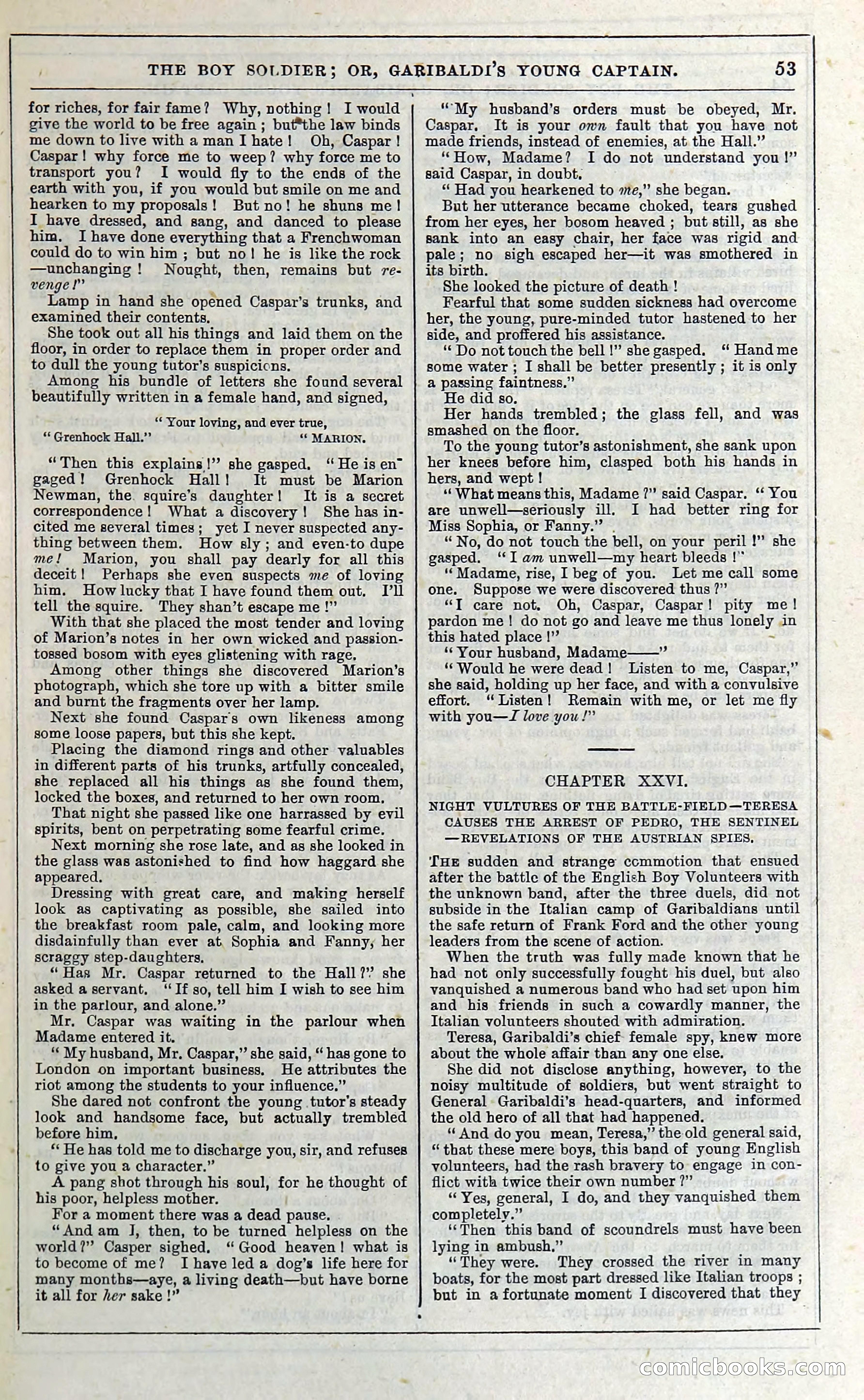
A restored page from Penny Dreadfuls, 1867. Page through the whole issue in the reader above.
📄 Transcribed text from this page (OCR, searchable)
Machine-transcribed from the original scan — historical spelling and the odd misread are preserved.
THE BOY SOLDIER; OR, GARIBALDI’S YOUNG CAPTAIN. 53 for riches, for fair fame? Why, nothing! I would give the world to be free again ; but*the law binds me down to live with a man I hate! Oh, Caspar ! Caspar! why force me to weep? why force me to transport you? I would fly to the ends of the earth with you, if you would but smile on me and hearken to my proposals! But no! he shuns me! I have dressed, and sang, and danced to please him. I have done everything that a Frenchwoman could do to win him ; but no! he is like the rock —unchanging! Nought, then, remains but re- venge!” Lamp in hand she opened Caspar’s trunks, and examined their contents, She took out all his things and laid them on the floor, in order to replace them in proper order and to dull the young tutor’s suspicions. Among his bundle of letters she found several beautifully written in a female hand, and signed, ** Your loving, and ever true, ** Grenhock Hall.’’ ““ MARION. “Then this explains!’’ she gasped, ‘He is en™ gaged! Grenhock Hall! It must be Marion Newman, the. squire’s daughter! It is a secret correspondence! What a discovery! She has in- cited me several times; yet I never suspected any- thing between them. How sly; and even-to dupe me! Marion, you shall pay dearly for all this deceit! Perhaps she even suspects me of loving him. How lucky that I have found them out. I’ll tell the squire. They shan’t escape me !” With that she placed the most tender and loving of Marion’s notes in her own wicked and passion- tossed bosom with eyes glistening with rage, Among other things she discovered Marion’s photograph, which she tore up with a bitter smile and burnt the fragments over her lamp. Next she found Caspars own likeness among some loose papers, but this she kept. Placing the diamond rings and other valuables in different parts of his trunks, artfully concealed, she replaced all his things as she found them, locked the boxes, and returned to her own room, That night she passed like one harrassed by evil spirits, bent on perpetrating some fearful crime. Next morning she rose late, and as she looked in the glass was astonished to find how haggard she appeared. Dressing with great care, and making herself look as captivating as possible, she sailed into the breakfast room pale, calm, and looking more disdainfully than ever at. Sophia and Fanny, her scragey step-daughters, “Has Mr. Caspar returned to the Hall?” she asked aservant, “If so, tell him I wish to see him in the parlour, and alone.” Mr. Caspar was waiting in the parlour when Madame entered it. “« My husband, Mr. Caspar,” she said, “ has gone to London on important business. He attributes the riot among the students to your influence.” She dared not confront the young tutor’s steady look and handsome face, but actually trembled before him, ** He has told me to discharge you, sir, and refuses to give you a character.” A pang shot through his soul, for he thought of his poor, helpless mother. : For a moment there was a dead pause. “And am J, then, to be turned helpless on the world?” Casper sighed. ‘ Good heaven! what is to become of me? [I have led a dog’s life here for many months—aye, a living death—but have borne it all for her sake !” “My husband’s orders must be obeyed, Mr. Caspar, It is your own fault that you have not made friends, instead of enemies, at the Hall.” “How, Madame? I do not understand you!” said Caspar, in doubt, “ Had you hearkened to te,” she began. But her utterance became choked, tears gushed from her eyes, her bosom heaved ; but still, as she sank into an easy chair, her face was rigid and pale; no sigh escaped her—it was smothered in its birth. She looked the picture of death ! Fearful that some sudden sickness had overcome her, the young, pure-minded tutor hastened to her side, and proffered his assistance. ‘Do not touch the bell!” she gasped. ‘‘ Handme some water ; I shall be better presently ; it is only a passing faintness.” He did so. Her hands trembled; the glass fell, and was smashed on the floor. To the young tutor’s astonishment, she sank upon her knees before him, clasped both his hands in hers, and wept ! ‘‘ What means this, Madame ?” said Caspar. ‘‘ You are unwell—seriously ill. I had better ring for Miss Sophia, or Fanny.” . “ No, do not touch the bell, on your peril !” she gasped. ‘I am unwell—my heart bleeds !* ‘Madame, rise, I beg of you. Let me call some one. Suppose we were discovered thus ?”’ “T care not. Oh, Caspar, Caspar! pity me! pardon me! do not go and leave me thus lonely in this hated place !” ~ ‘‘ Your husband, Madame » ‘‘ Would he were dead! Listen to me, Caspar,” she said, holding up her face, and with a convulsive effort. “Listen! Remain with me, or let me fly with you—Z love you !” CHAPTER XXVI. NIGHT VULTURES OF THE BATTLE-FIELD—TERESA CAUSES THE ARREST OF PEDRO, THE SENTINEL — REVELATIONS OF THE AUSTRIAN SPIES, THE sudden and strange ccmmotion that ensued after the battle of the English Boy Volunteers with the unknown band, after the three duels, did not subside in the Italian camp of Garibaldians until the safe return of Frank Ford and the other young leaders from the scene of action. When the truth was fully made known that he had not only successfully fought his duel, but also vanquished a numerous band who had set upon him and his friends in such a cowardly manner, the Italian volunteers shouted with admiration. Teresa, Garibaldi’s chief female spy, knew more about the whole affair than any one else. She did not disclose anything, however, to the noisy multitude of soldiers, but went straight to General Garibaldi’s head-quarters, and informed the old hero of all that had happened. “ And do you mean, Teresa,” the old general said, “that these mere boys, this band of young English volunteers, had the rash bravery to engage in con- flict with twice their own number ?” “Yes, general, I do, and they vanquished them completely.” ‘‘Then this band of scoundrels must have been lying in ambush,” “They were. They crossed the river in many boats, for the most part dressed like Italian troops ; but in a fortunate moment I discovered that they Conmicloool< (©