
Penny Dreadfuls, 1867 · page 300 of 390
The Boy Soldier; Or, Garibaldi's Young Captain — page 300: what you’re looking at
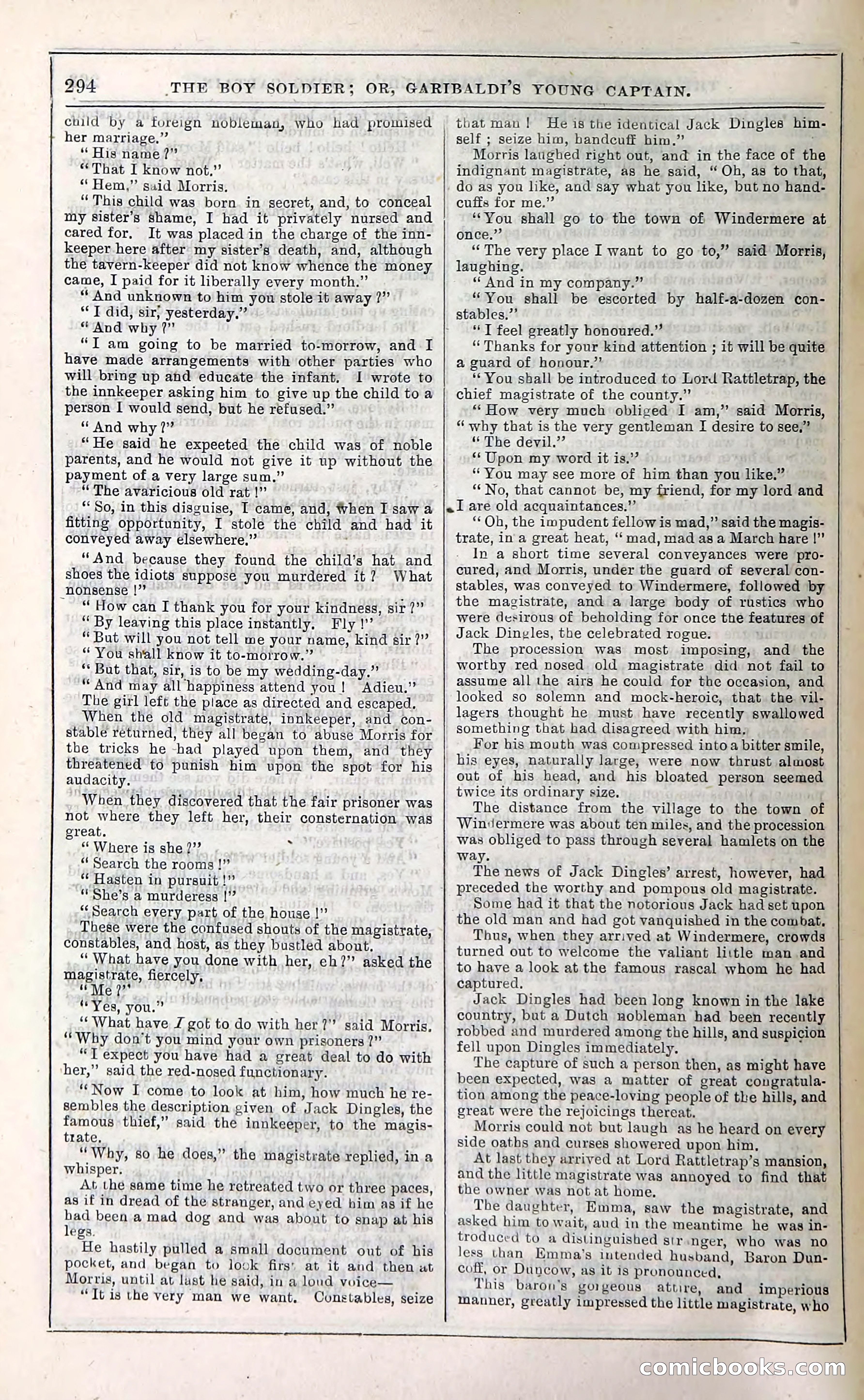
A restored page from Penny Dreadfuls, 1867. Page through the whole issue in the reader above.
📄 Transcribed text from this page (OCR, searchable)
Machine-transcribed from the original scan — historical spelling and the odd misread are preserved.
294 —— eee THE BOY SOLDIER; OR, GARIBALDI’S YOUNG CAPTAIN. child by a foreign nobleman, who had promised her marriage.” ‘“ His name?” “That I know not,” “Hem,” suid Morris. ‘This child was born in secret, and, to conceal my sister's Shame, I had it privately nursed and | cared for, It was placed in the charge of the inn- keeper here after my sister’s death, and, although the tavern-keeper did not know whence the money came, I paid for it liberally every month.”’ “And unknown to him you stole it away ?” “T did, sir; yesterday.” * And why ?” “J am going to be married to‘:morrow, and I have made arrangements with other parties who will bring up and educate the infant. I wrote to the innkeeper asking him to give up the child toa person I would send, but he refused.” “And why ?” “He said he expeeted the child was of noble parents, and he would not give it up without the payment of a very large sum,” “The avaricious old rat !” So, in this disguise, I came, and, When I saw a fitting opportunity, I stole the child and had it conveyed away elsewhere.” ‘“And because they found the child’s hat and shoes the idiots suppose you murdered it? What nonsense |” : ‘“‘ How can I thank you for your kindness, sir?” ‘‘ By leaving this place instantly, Fly!” But will you not tell me your name, kind sir?” “ You shall know it to-morrow.” * But that, sir, is to be my wedding-day.” ‘And may all happiness attend you! Adieu.” The girl left the place as directed and escaped. When the old magistrate, innkeeper, and con- stable returned, they all began to abuse Morris for the tricks he -had played upon them, and they threatened to punish him upon the spot for his audacity. When they discovered that the fair prisoner was not where they left her, their consternation was great. “ Where is she ?”’ } “ Search the rooms!” ; ** Hasten in pursuit !” ‘'She’s a murderess |” ‘Search every. part of the house !” These were the confused shouts of the magistrate, constables, and host, as they bustled about. “What have you done with her, eh?’ asked the magistrate, fiercely, Me 7?" “Yes, you.” ‘‘ What have Z got to do with her?” said Morris. ‘“Why don’t you mind your own prisoners ?” ““T expect you have had a great deal to do with her,” said the red-nosed functionary. ‘“Now I come to look at him, how much he re- sembles the description given of Jack Dingles, the famous thief,” said the innkeeper, to the magis- trate, “Why, 80 he does,” the magistrate replied, in a whisper. At the same time he retreated two or three paces, as if in dread of the stranger, and eyed him as if he rea been a mad dog and was about to snap at his egs. He hastily pulled a small document out of his pocket, and began to look firs’ at it and then at Morris, until at lust he said, in a lond voice— “It is the very man we want. Cunstables, seize that man! He is the identical Jack Dingles him self ; seize him, handcuff him.” Morris latghed right out, and in the face of the indignant magistrate, as he said, ‘ Oh, as to that, do as you like, and say what you like, but no hand- cuffs for me.” ‘“You shall go to the town of Windermere at once.” ‘The very place I want to go to,” said Morris, laughing. “ And in my company.” “You shall be escorted by half-a-dozen con- stables.”’ ‘‘T feel greatly honoured.” “Thanks for your kind attention ; it will be quite a guard of honour.” ‘You shall be introduced to Lord Rattletrap, the chief magistrate of the county.” ‘* How very much obliged I am,” said Morris, “why that is the very gentleman I desire to see,” “ The devil.” ‘Upon my word it is.” “You may see more of him than you like.” “No, that cannot be, my friend, for my lord and «1 are old acquaintances.” “‘Oh, the impudent fellow is mad,” said the magis- trate, in a great heat, ‘‘ mad, mad asa March hare |” In a short time several conveyances were pro- cured, and Morris, under the guard of several con- stables, was conveyed to Windermere, followed by the magistrate, and a large body of rustics who were desirous of beholding for once the features of Jack Dingles, the celebrated rogue. The procession was most imposing, and the worthy red nosed old magistrate did not fail to assume all the airs he could for the oceasion, and looked so solemn and mock-heroic, that the vil- lagers thought he must have recently swallowed something that had disagreed with him, For his mouth was compressed into a bitter smile, his eyes, naturally large, were now thrust almost out of his head, and his bloated person seemed twice its ordinary size. " nity The distance from the village to the town of Windermere was about ten miles, and the procession was obliged to pass through several hamlets on the way. . The news of Jack Dingles’ arrest, however, had preceded the worthy and pompous old magistrate. Some had it that the notorious Jack had set upon the old man and had got vanquished in the combat, Thus, when they arrived at Windermere, crowds turned out to welcome the valiant little man and to have a look at the famous rascal whom he had captured. Jack Dingles had been long known in the lake country, but a Dutch nobleman had been recently robbed and murdered among the hills, and suspicion fell upon Dingles immediately. The capture of such a person then, as might have been expected, was a matter of great congratula- tion among the peace-loving people of the hills, and great were the rejoicings thereat. Morris could not but laugh as he heard on every side oaths and curses showered upon him, At last they arrived at Lord Rattletrap’s mansion, and the little magistrate was annoyed to find that the owner was not at home, The daughter, Emma, saw the magistrate, and asked him to wait, aud in the meantime he was in- troduced to a distinguished sir nger, who was no less than Emma’s intended husband, Baron Dun- coff, or Duncow, as it is pronounced, This baron’s gorgeous attire, and imperious manner, greatly impressed the little magistrate, who Oe ———————————SEE cComicbooksrzeom