
Penny Dreadfuls, 1867 · page 297 of 390
The Boy Soldier; Or, Garibaldi's Young Captain — page 297: what you’re looking at
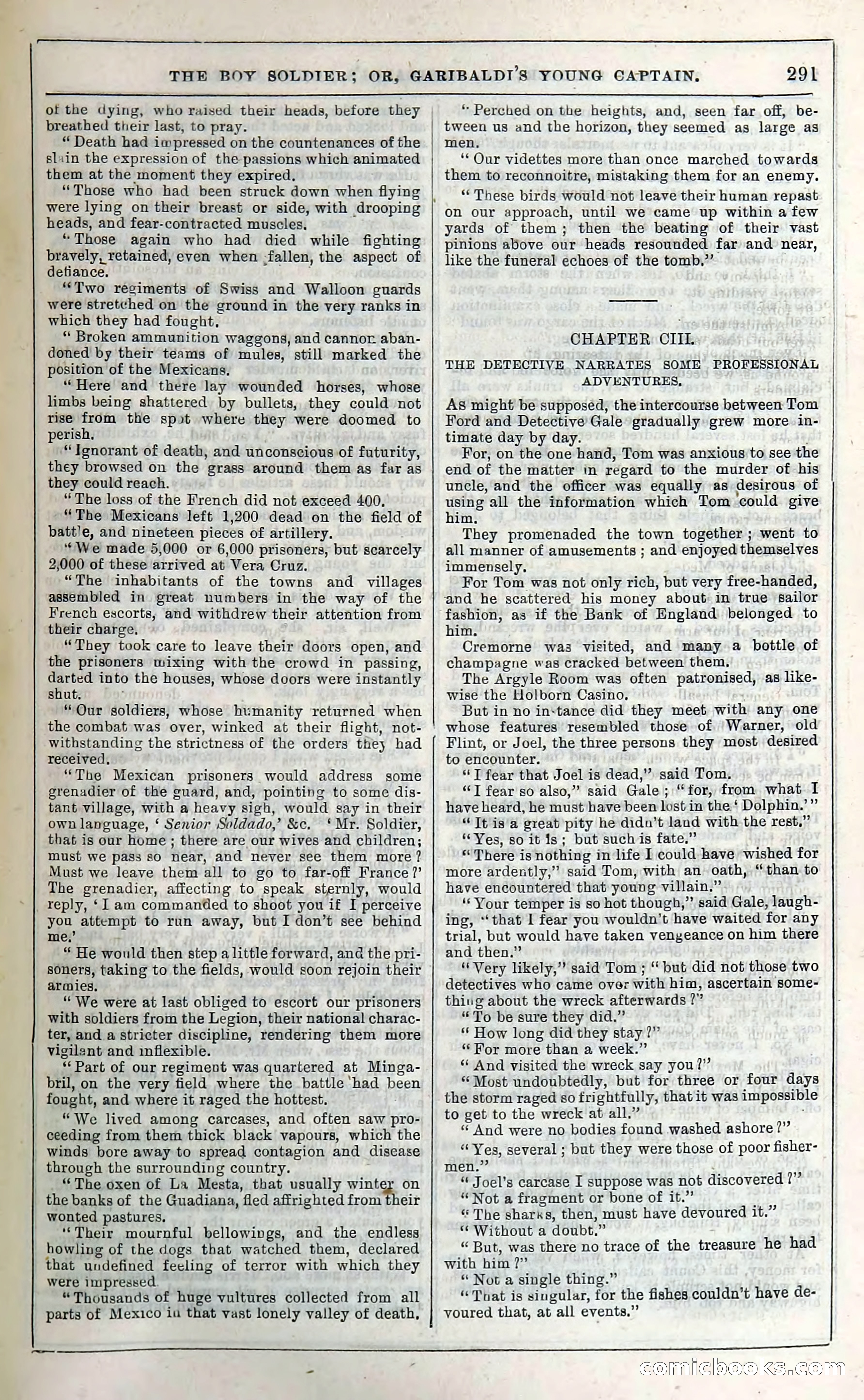
A restored page from Penny Dreadfuls, 1867. Page through the whole issue in the reader above.
📄 Transcribed text from this page (OCR, searchable)
Machine-transcribed from the original scan — historical spelling and the odd misread are preserved.
=a THE BOY SOLDIER: OR, GARIBALDI’S YOUNG CAPTAIN. 291 of the dying, who raised their heads, before they breathed their last, to pray. “Death had impressed on the countenances of the slain the expression of the passions which animated them at the moment they expired. “Those who had been struck down when flying were lying on their breast or side, with drooping heads, and fear-contracted muscles. “Those again who had died while fighting bravely, retained, even when -fallen, the aspect of detiance. “Two regiments of Swiss and Walloon guards were stretched on the ground in the very ranks in which they had fought, “ Broken ammunition waggons, and cannor aban- doned by their teams of mules, still marked the position of the Mexicans, ‘““Here and there lay wounded horses, whose limbs being shattered by bullets, they could not rise from the spot where they were doomed to perish, “Ignorant of death, and unconscious of futurity, they browsed on the grass around them as far as they could reach. “The loss of the French did not exceed 400, “The Mexicans left 1,200 dead on the field of battle, and nineteen pieces of artillery. ‘We made 5,000 or 6,000 prisoners, but scarcely 2,000 of these arrived at Vera Cruz. “The inhabitants of the towns and villages assembled in great numbers in the way of the French escorts, and withdrew their attention from their charge. “They took care to leave their doors open, and the prisoners wixing with the crowd in passing, mec into the houses, whose doors were instantly shut, “Our soldiers, whose humanity returned when the combat was over, winked at their flight, not- withstanding the strictness of the orders they had received, “The Mexican prisoners would address some grenadier of the guard, and, pointing to some dis- tant village, with a heavy sigh, would say in their own language, ‘ Senior Soldado,’ &c. ‘ Mr. Soldier, that is our home ; there are our wives and children; must we pass 80 near, and never see them more? Must we leave them all to go to far-off France?’ The grenadier, affecting to speak sternly, would _ reply, ‘1 am commanded to shoot you if I perceive you attempt to run away, but I don’t see behind me,’ ? “ He would then step alittle forward, ana the pri- soners, taking to the fields, would soon rejoin their armies, “We were at last obliged to escort our prisoners with soldiers from the Legion, their national charac- ter, and a stricter discipline, rendering them more vigilant and inflexible. *‘ Part of our regiment was quartered at Minga- bril, on the very field where the battle ‘had been fought, and where it raged the hottest. “We lived among carcases, and often saw pro- | ceeding from them thick black vapours, which the _ winds bore away to spread contagion and disease through the surrounding country. _ “The oxen of La Mesta, that usually winter on the banks of the Guadiana, fled affrighted from their wonted pastures. ‘Their mournful bellowings, and the endless howling of the dogs that watched them, declared that undefined feeling of terror with which they were impressed. “Thousands of huge vultures collected from all parts of Mexico iu that vast lonely valley of death, * Perched on the heights, and, seen far off, be- tween us and the horizon, they seemed as large as men. ‘‘Our videttes more than once marched towards them to reconnoitre, mistaking them for an enemy. ‘** These birds would not leave their human repast on our approach, until we came up within a few yards of them; then the beating of their vast pinions above our heads resounded far and near, like the funeral echoes of the tomb,”’ CHAPTER CIII. NARRATES SOME PROFESSIONAL ADVENTURES, THE DETECTIVE AS might be supposed, the intercourse between Tom Ford and Detective Gale gradually grew more. in- timate day by day. For, on the one hand, Tom was anxious to see the end of the matter in regard to the murder of his uncle, and the officer was equally as desirous of using all the information which Tom could give him. They promenaded the town together ; went to all manner of amusements ; and enjoyed themselves immensely, For Tom was not only rich, but very free-handed, and he scattered his money about in true sailor fashion, as if the Bank of England belonged to him. Cremorne was visited, and many a bottle of champagne was cracked between them. The Argyle Room was often patronised, as like- wise the Holborn Casino, But in no instance did they meet with any one whose features resembled those of 'Warner, old Flint, or Joel, the three persons they most desired to encounter. “T fear that Joel is dead,” said Tom. “T fear so also,” said Gale; “for, from what I have heard, he must have been lost in the.‘ Dolphin.’” “Tt is a great pity he didn’t land with the rest,” “Ves, so it is; but such is fate.” “There is nothing in life I could have wished for more ardently,” said Tom, with an oath, “than to have encountered that young villain.” ‘‘ Your temper is so hot though,” said Gale, laugh- ing, “that I fear you wouldn't have waited for any trial, but would have taken vengeance on him there and then.” “Very likely,” said Tom ; ‘‘ but did not those two detectives who came over with him, ascertain some- thing about the wreck afterwards ?” “To be sure they did.” “ How long did they stay?” ‘‘ Hor more than a week.” “ And visited the wreck say you?” “Most undoubtedly, but for three or four days the storm raged so frightfully, that it was impossible to get to the wreck at all.” “ And were no bodies found washed ashore?” “Yes, several ; but they were those of poor fisher- men.” “ Joel’s carcase I suppose was not discovered ?” “Not a fragment or bone of it.” “ The sharks, then, must have devoured it.” “Without a doubt.” “ But, was there no trace of the treasure he had with him ?” “ Not a single thing.” “That is singular, for the fishes couldn’t have de- youred that, at all events,” Ccomicoool CO