
Penny Dreadfuls, 1867 · page 267 of 390
The Boy Soldier; Or, Garibaldi's Young Captain — page 267: what you’re looking at
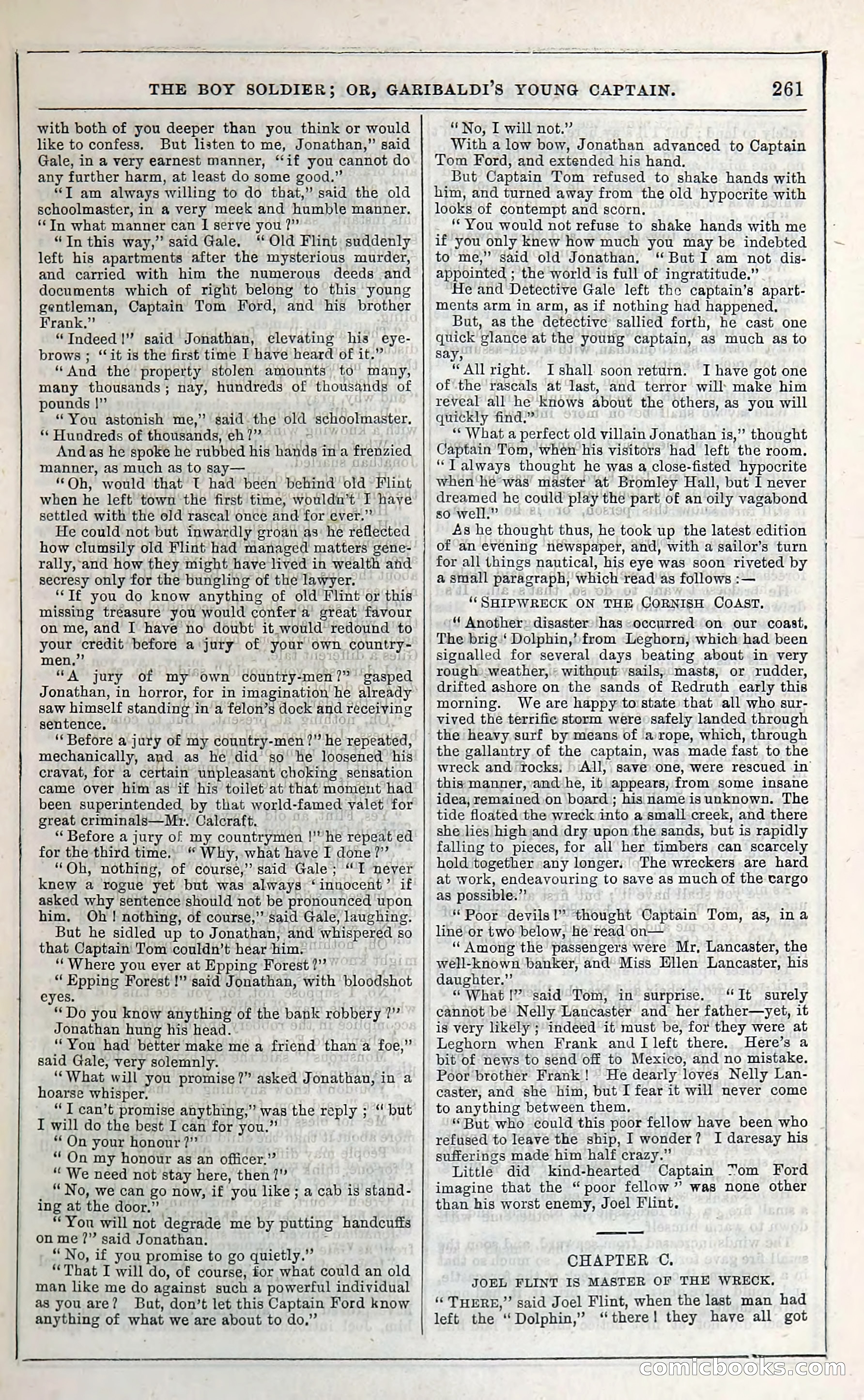
A restored page from Penny Dreadfuls, 1867. Page through the whole issue in the reader above.
📄 Transcribed text from this page (OCR, searchable)
Machine-transcribed from the original scan — historical spelling and the odd misread are preserved.
THE BOY SOLDIER; OR, GARIBALDI’S YOUNG CAPTAIN. 261 with both of you deeper than you think or would like to confess. But listen to me, Jonathan,” said Gale, in a very earnest manner, ‘‘if you cannot do any further harm, at least do some good.” “T am always willing to do that,” said the old schoolmaster, in a very meek and humble manner. ‘In what manner can I serve you ?” “In this way,’ said Gale. “Old Flint suddenly left his apartments after the mysterious murder, and carried with him the numerous deeds and documents which of right belong to this young gentleman, Captain Tom Ford, and his brother Frank,” “Indeed!” said Jonathan, elevating his eye- brows ; “‘it is the first time I have heard of it.” ‘“And the property stolen amounts to many, many thousands; nay, hundreds of thousands of pounds }” “You astonish me,” said. the old schoolmaster. ** Hundreds of thousands, eh?” | And as he spoke he rubbed his hands in a frenzied manner, as much as to say— | "Gite. ‘Oh, would that T had been behind old Flint when he left town the first time, wouldn’t I haye settled with the old rascal once and for ever.” - He could not but inwardly groan as: he reflected how clumsily old Flint had managed matters gene- rally, and how they might have lived in wealth and secresy only for the bungling of the lawyer. : ‘“Tf you do know anything of old Flint or this missing treasure you would confer a great favour on me, and I have no doubt it would redound to your credit before a jury of your own country- men,” . s\iessh * “A jury of my own country-men?” ‘gasped ; Jonathan, in horror, for in imagination he already saw himself standing in a felon’s dock and receiving sentence, | Beas ‘*Before a jury of my country-men?” he repeated, mechanically, and as he did’ so he loosened his cravat, for a certain unpleasant choking. sensation came over him as if his toilet’ at that moment had been superintended by that world-famed valet for great criminals—Mr. Calcraft. “Before a jury of my countrymen |’"he repeat ed for the third time. “ Why, what have I done ?”’ ‘Oh, nothing, of course,’ said Gale; “I neyer knew a rogue yet but was always ‘innocent’ if asked why sentence should not be pronounced upon him, Oh’! nothing, of course,’’ said Gale, laughing. But he sidled up to Jonathan, and whispered so that Captain Tom couldn’t hear him. ‘Where you eyer at Epping Forest ?” “ Epping Forest !” said Jonathan, with bloodshot eyes. “Do you know anything of the bank robbery ?” Jonathan hung his head. “You had better make me a friend than a foe,” said Gale, very solemnly. ‘““What will you promise?” asked Jonathan, in a hoarse whisper. “T can’t promise anything,” was the reply ; “ but I will do the best I can for you.” “On your honour ?” “On my honour as an officer.” ‘We need not stay here, then?” “No, we can go now, if you like ; a cab is stand- ing at the door.” “Yon will not degrade me by putting handcuffs on me ?” said Jonathan. : “ No, if you promise to go quietly.” ‘That I will do, of course, for what could an old man like me do against such a powerful individual as you are? But, don’t let this Captain Ford know anything of what we are about to do,” Gomilcboolksneoin “No, I will not.” With a low bow, Jonathan advanced to Captain Tom Ford, and extended his hand. But Captain Tom refused to shake hands with him, and turned away from the old hypocrite with looks of contempt and scorn. ‘You would not refuse to shake hands with me if you only knew how much you may be indebted to me,” said old Jonathan, “ButI am not dis- appointed ; the world is full of ingratitude.” He and Detective Gale left the captain’s apart- ments arm in arm, as if nothing had happened. But, as the detective sallied forth, he cast one quick glance at the young captain, as much as to say, “Allright. Ishall. soon return. I have got one of the rascals at last, and terror will make him reveal all he knows about the others, as you will quickly find.” “What a perfect old villain Jonathan is,” thought Captain Tom, when his visitors had left the room. ‘“T always thought he was a close-fisted hypocrite when he was’ master at Bromley Hall, but I never dreamed he could play the ‘part of an oily vagabond so well.” . As he thought thus, he took up the latest edition of an evening newspaper, and, with a sailor’s turn for all things nautical, his eye was soon riveted by a small paragraph, which read as follows :— ‘‘SHIPWRECK ON THE CORNISH COAST, ‘“ Another» disaster» has occurred on our coast, The brig ‘ Dolphin,’ from Leghorn, which had been signalled for several days beating about in very rough weather, » without ‘sails, masts, or rudder, drifted ashore on the sands of Redruth early this morning. Weare happy to:state that all who sur- vived the terrific storm were safely landed through the heavy surf by means of avrope, which, through the gallantry of the captain, was made fast to the wreck and tocks. ‘Adl, save one, were rescued in this manner, and he, it appears, from some insane idea, remained on board ; his name is unknown. The tide floated the wreck into a small creek, and there she lies high and dry upon the sands, but is rapidly falling to pieces, for all her timbers can scarcely hold together any longer. ‘The wreckers are hard at work, endeavouring to save as much of the cargo as possible.’ Poor devils!” thought Captain Tom, as, ina liné or two below, He read on— “Among the passengers were Mr, Lancaster, the well-known banker, and Miss Ellen Lancaster, his daughter.” “ What !”? said Tom, in surprise. “It surely cannot be Nelly Lancaster and her father—yet, it is very likely; indeed it must be, for they were at Leghorn when Frank and I left there. Here’s a bit of news to send off to Mexico, and no mistake. Poor brother Frank! He dearly loves Nelly Lan- caster, and she him, but I fear it will never come to anything between them, ‘But who could this poor fellow have been who refused to leave the ship, I wonder? I daresay his sufferings made him half crazy.” Little did kind-hearted Captain “om Ford imagine that the “poor fellow” was none other than his worst enemy, Joel Flint. CHAPTER C., JOEL FLINT IS MASTER OF THE WRECK. “THERE,” said Joel Flint, when the last man had left the “Dolphin,” “there! they have all got