
Penny Dreadfuls, 1867 · page 261 of 390
The Boy Soldier; Or, Garibaldi's Young Captain — page 261: what you’re looking at
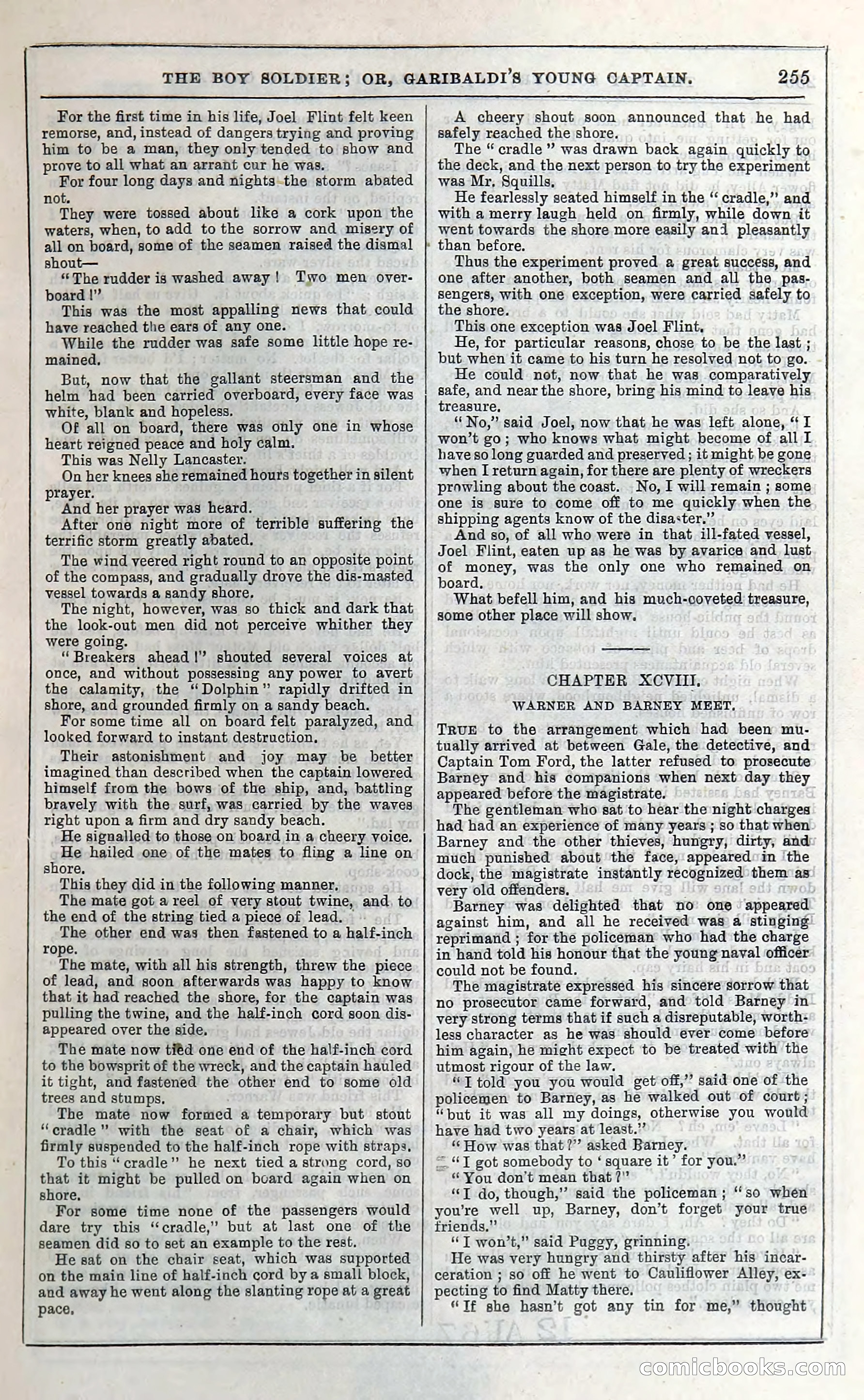
A restored page from Penny Dreadfuls, 1867. Page through the whole issue in the reader above.
📄 Transcribed text from this page (OCR, searchable)
Machine-transcribed from the original scan — historical spelling and the odd misread are preserved.
THE BOY SOLDIER; OR, GARIBALDI’S YOUNG CAPTAIN. 255 For the first time in his life, Joel Flint felt keen remorse, and, instead of dangers trying and proving him to be a man, they only tended to show and prove to all what an arrant cur he was. For four long days and nights-the storm abated not. They were tossed about like a cork upon the waters, when, to add to the sorrow and misery of all on board, some of the seamen raised the dismal shout— ‘The rudder is washed away ! board |” This was the most appalling news that could have reached the ears of any one. While the rudder was safe some little hope re- mained, But, now that the gallant steersman and the helm had been carried overboard, every face was white, blank and hopeless. Of all on board, there was only one in whose heart reigned peace and holy calm. This was Nelly Lancaster. On her knees she remained hours together in silent prayer. And her prayer was heard. After one night more of terrible suffering the terrific storm greatly abated. The wind veered right round to an opposite point of the compass, and gradually drove the dis-masted vessel towards a sandy shore, The night, however, was so thick and dark that the look-out men did not perceive whither they were going. “Breakers ahead!” shouted several voices at once, and without possessing any power to avert the calamity, the “Dolphin” rapidly drifted in shore, and grounded firmly on a sandy beach. For some time all on board felt paralyzed, and looked forward to instant destruction. Their astonishment and joy may be better imagined than described when the captain lowered himself from the bows of the ship, and, battling bravely with the surf, was carried by the waves right upon a firm and dry sandy beach. He signalled to those on board in a cheery voice. He hailed one of the mates to fling a line on shore, This they did in the following manner, The mate got a reel of very stout twine, and, to the end of the string tied a piece of lead. The other end was then fastened to a half-inch rope. The mate, with all his strength, threw the piece of lead, and soon afterwards was happy to know that it had reached the shore, for the captain was pulling the twine, and the half-inch cord soon dis- appeared over the side, The mate now tiéd one end of the half-inch cord to the bowsprit of the wreck, and the captain hauled it tight, and fastened the other end to some old trees and stumps, The mate now formed a temporary but stout “cradle ’ with the seat of a chair, which was firmly suspended to the half-inch rope with straps, To this ‘cradle’”’ he next tied a strong cord, so that it might be pulled on board again when on shore, For some time none of the passengers would dare try this “cradle,” but at last one of the seamen did so to set an example to the rest. He sat on the chair seat, which was supported on the main line of half-inch cord by a small block, and away he went along the slanting rope at a great pace, Two men over- A cheery shout soon announced that he had safely reached the shore. The “ cradle ” was drawn back again quickly to the deck, and the next person to try the experiment was Mr, Squills, He fearlessly seated himself in the “ cradle,’’ and with a merry laugh held on firmly, while down it went towards the shore more easily and pleasantly than before. Thus the experiment proved a great success, and one after another, both seamen and all the. pas- Sengers, with one exception, were carried safely to the shore. This one exception was Joel Flint, He, for particular reasons, chose to be the last ; but when it came to his turn he resolved not to go. He could not, now that he was comparatively safe, and near the shore, bring his mind to leave his treasure, “ No,” said Joel, now that he was left alone, ‘I won’t go; who knows what might become of all I have so long guarded and preserved ; it might. be gone when I return again, for there are plenty of wreckers prowling about the coast. No, I will remain ; some one is sure to come off to me quickly when the shipping agents know of the disaster.” And so, of all who were in that ill-fated vessel, Joel Flint, eaten up as he was by avarice and lust of money, was the only one who remained on board, What befell him, and his much-coveted treasure, some other place will show. CHAPTER XCVIII, WARNER AND BARNEY MEET, TRUE to the arrangement which had been mu- tually arrived at between Gale, the detective, and Captain Tom Ford, the latter refused to prosecute Barney and his companions when next day they appeared before the magistrate. The gentleman who sat to hear the night charges had had an experience of many years ; so that when Barney and the other thieves, hungry, dirty, and much punished about the face, appeared in the dock, the magistrate instantly recognized them as very old offenders. | : Barney was delighted that no one appeared against him, and all he received was a stinging reprimand ; for the policeman who had the charge in hand told his honour that the young naval officer could not be found. The magistrate expressed his sincere sorrow that no prosecutor came forward, and told Barney in very strong terms that if such a disreputable, worth- less character as he was should ever come before him again, he might expect to be treated with the utmost rigour of the law. “T told you you would get off,” said one of the policemen to Barney, as he walked out of court; “but it was all my doings, otherwise you would have had two years at least.” “How was that ?”’ asked Barney. ~ “T got somebody to ‘ square it’ for you.” “ You don’t mean that?” ‘‘T do, though,” said the policeman; ‘‘so whén you’re well up, Barney, don’t forget your true friends,” “T won’t,” said Puggy, grinning. He was very hungry and thirsty after his incar- ceration ; so off he went to Cauliflower Alley, ex- pecting to find Matty there. “Tf she hasn’t got any tin for me,” thought Ccomicbooks C©