
Penny Dreadfuls, 1867 · page 200 of 390
The Boy Soldier; Or, Garibaldi's Young Captain — page 200: what you’re looking at
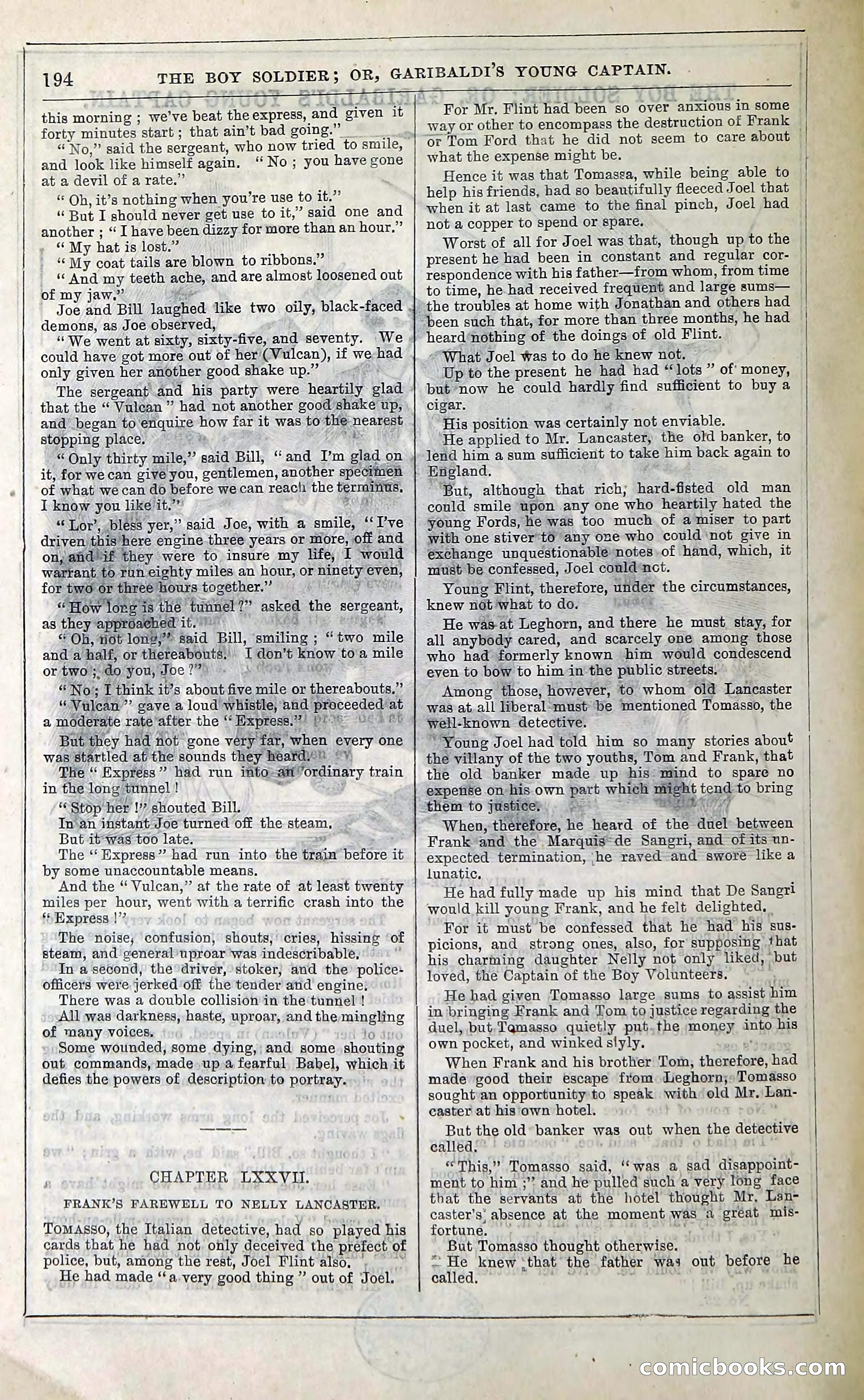
A restored page from Penny Dreadfuls, 1867. Page through the whole issue in the reader above.
📄 Transcribed text from this page (OCR, searchable)
Machine-transcribed from the original scan — historical spelling and the odd misread are preserved.
a tS a ac 194 this morning ; we’ve beat the express, and given it forty minutes start; that ain’t bad going.” _ : “No,” said the sergeant, who now tried to smile, and look like himself again. ‘‘ No; you have gone at a devil of a rate.” “ Qh, it’s nothing when you're use to it.” “ But I should never get use to it,” said one and another ; “ I have been dizzy for more than an hour.” “ My hat is lost.” ‘‘ My coat tails are blown to ribbons.” ‘And my teeth ache, and are almost loosened out of my jaw.” é Joe and Bill laughed like two oily, black-faced . demons, as Joe observed, i “We went at sixty, sixty-five, and seventy. We could have got more out of her (Vulcan), if we-had only given her another good shake up.” | The sergeant and his party were heartily glad that the “ Vulean ” had not another good shake up, and’ began to enquire how far it was to the nearest stopping place. ; dies “ Only thirty mile,” said Bill, “and I’m glad on it, for we can give you, gentlemen, another specimen of what we can do before we can reach the terminus, I know you like it.” Aa ‘Lor’, bless yer,” said Joe, with a smile, ‘‘T’ve driven this here engine three years or more, off and on, and'if they were to insure my life, I would warrant to run eighty miles an hour, or ninety even, for two or three hours together.” OP EY “How lorg is the tunnel?” asked the sergeant, as they approached it.) 5 Fa “Oh, riot lone,” said Bill, smiling ; “two mile and a half, or thereabouts.’ I don’t know toa mile or two’; do you, Joe?” Oya! b BO “No; I think it’s about five mile or thereabouts,” “Vulean’’ gave a loud whistle, and proceeded at a moderate rate after the “ Express.?) pr bo) Fh But they had not gone very far, when every one was startled at the sounds they heard” °¥. The “ Express” had run into-an ordinary train in the long/tunnel ! ag “Stop her !? shouted Bill. In an instant Joe turned off the steam, But it-was too late. sa The “‘ Express” had run into the train before it by some unaccountable means. And the “ Vulcan,” at the rate of at least twenty miles per hour, went with a terrific crash into the ** Express |” The noise; confusion, shouts, cries, hissing ‘of steam, and general uproar was indescribable, In a second, the driver, stoker, and the’ police- officers were jerked off the tender and engine, There was a double collision in the tunnel ! All was darkness, haste, uproar, and the mingling of many voices. lo Some wounded, some dying, and some shouting out commands, made up a fearful Babel, which it defies the powers of description to portray. CHAPTER LXXVII. FRANK’S FAREWELL TO NELLY LANCASTER. ToMASSO, the Italian detective, had so played his cards that he had not only deceived the prefect of police, but, among the rest, Joel Flint also, | = He had made “‘a.very good thing ” out of Joel. THE BOY SOLDIER; OR; GARIBALDI'S YOUNG CAPTAIN. them to justices \ For Mr. Flint had been so over anxious in some © way or other to encompass the destruction of Frank what the expense might be. Hence it was that Tomassa, while being able to help his friends, had so beautifully fleeced Joel that when it at last came to the final pinch, Joel had not a copper to spend or spare. Worst of all for Joel was that, though up to the | present he had been in constant and regular cor- — respondence with his father—from whom, from time | to time, he-had received frequent and large sums— ~ the troubles at home with Jonathan and others had ~ “been such that, for more than three months, he had heard nothing of the doings of old Flint. “What Joel was to do he knew not. Up to the present he had had “lots ” of’ money, but now he could hardly find sufficient to buy a cigar. His position was certainly not enviable. He applied to Mr. Lancaster, the old banker, to lend him a sum sufficient to take him back again to Efigland. But, although that rich; hard-fisted old man could smile upon any one who heartily hated the young Fords, he was too much of amiser to part with one stiver*to any one who could not give in exchange unquestionable notes.of hand, which, it must be confessed, Joel could nct. Young Flint, therefore, under the circumstances, knew not what to do. GAA He was-at Leghorn, and there he must stay, for all anybody cared, and scarcely one among those who had formerly known him would condescend eyen to bow to him in the public streets. Among those, however, to whom old Lancaster was at. all liberal-must be mentioned Tomasso, the well-known detective. “Young Joel had told him so many stories abou! the villany of the two youths, Tom and Frank, that the old banker made up his mind to spare no expense on his. own part which fee tend to bring When, therefore, he heard of the duel between Frank and the Marquis=de Sangri, and ofits un- expected termination, he raved-and swore like a lunatic, He had fully made up his mind that De Sangri would kill young Frank, and he felt delighted, | For it must be confessed that he had his sus- picions, and strong ones, also, for supposing that his charming daughter Nelly not only liked, but loved, the Captain of the Boy Volunteers. : He had given Tomasso large sums to assist him in bringing Frank and Tom to justice regarding the duel, but, Tqmasso quietly put.the money into his own pocket, and winked slyly. 5 When Frank and his brother Tom, therefore, had made ‘good their escape from Leghorn; Tomasso soughtan opportunity to speak with old Mr, Lan- caster at his own hotel. | ' But the old banker was out when the detective called. ° O35 = This,” Tomasso said, ‘was a sad disappoint- ment to him ;”? and he pulled such a very long face that the servants at the hotel thought Mr, Lan- caster’s’ absence at the moment was a gréat mis- fortune. yo a | But Tomasso thought otherwise. _ “He knew ‘that the father was out before he called, — ry — er omg or Tom Ford that he did not seem to care about —— “Eomichoo (e(@)