
Penny Dreadfuls, 1867 · page 185 of 390
The Boy Soldier; Or, Garibaldi's Young Captain — page 185: what you’re looking at
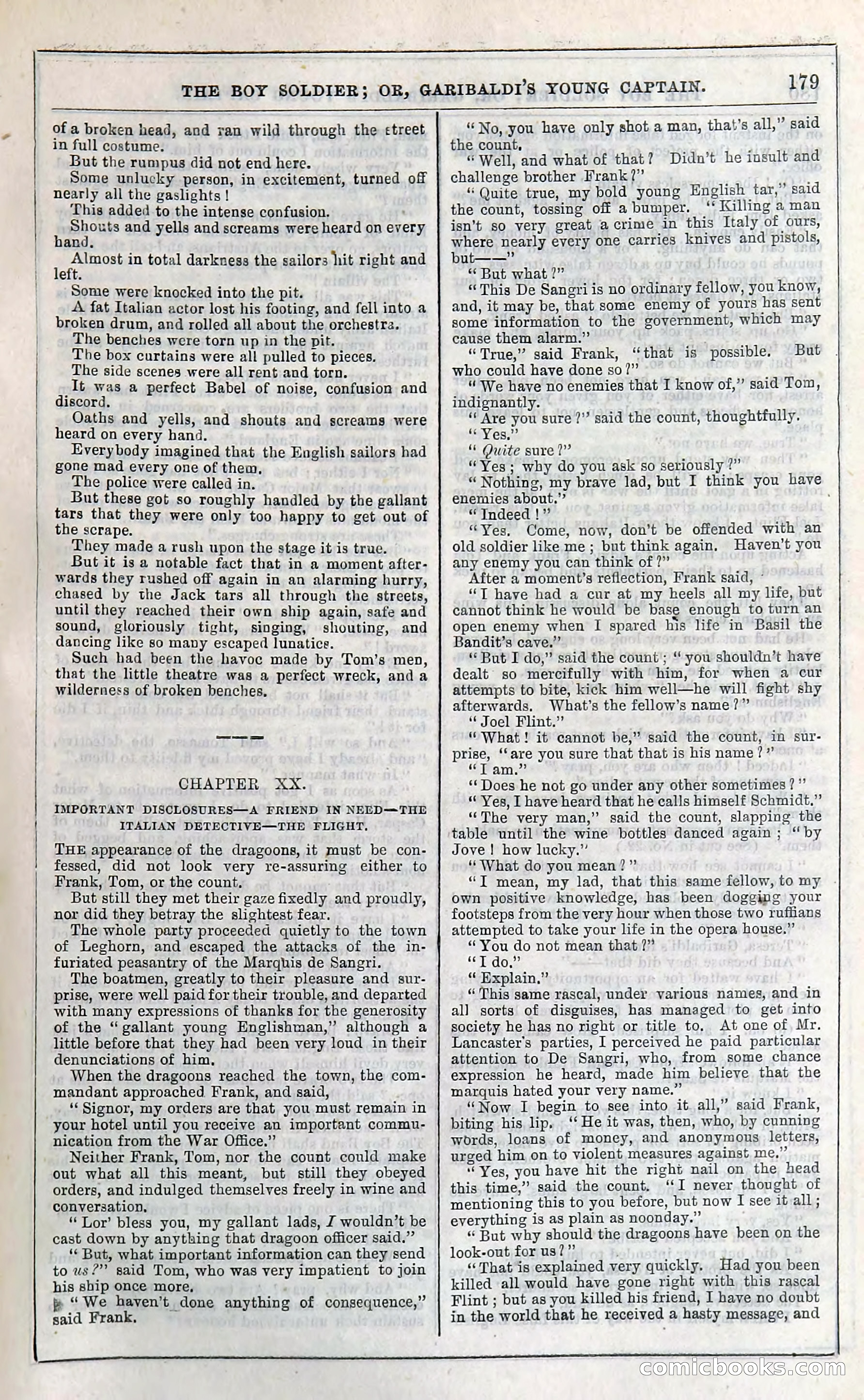
A restored page from Penny Dreadfuls, 1867. Page through the whole issue in the reader above.
📄 Transcribed text from this page (OCR, searchable)
Machine-transcribed from the original scan — historical spelling and the odd misread are preserved.
wy . : nn THE BOY SOLDIER; OB, GARIBALDI'S YOUNG CAPTAIN. 179 te Sen wee se ee of a broken head, and ran wild through the etreet In full costume. But the rumpus did not end here. Some unlucky person, in excitement, turned off nearly all the gaslights ! This added to the intense confusion. f abouts and yells and screams were heard on every and, Zones in total darkness the sailors hit right and eft. Some were knocked into the pit. A. fat Italian actor lost his footing, and fell into a broken drum, and rolled all about the orchestra. The benches were torn up in the pit. The box curtains were all pulled to pieces. The side scenes were all rent and torn. It was a perfect Babel of noise, confusion and discord. Oaths and yells, and shouts and screams were heard on every hand. Everybody imagined that the English sailors had gone mad every one of them, The police were called in. But these got so roughly handled by the gallant tars that they were only too happy to get out of the scrape. They made a rush upon the stage it is true. But it is a notable fact that in a moment after- wards they rushed off again in an alarming hurry, chased by the Jack tars all through the streets, until they reached their own ship again, safe and sound, gloriously tight, singing, shouting, and dancing like so many escaped lunatice. Such had been the havoc made by Tom’s men, that the little theatre was a perfect wreck, and a wilderness of broken benches, CHAPTER XX. IMPORTANT DISCLOSURES—A FRIEND IN NEED—THE ITALIAN DETECTIVE—THE FLIGHT. THE appearance of the dragoons, it must be con- fessed, did not look very re-assuring either to Frank, Tom, or the count, But still they met their gaze fixedly and proudly, nor did they betray the slightest fear. The whole party proceeded quietly to the town of Leghorn, and escaped the attacks of the in- furiated peasantry of the Marqhis de Sangri. The boatmen, greatly to their pleasure and sur- prise, were well paid for their trouble, and departed with many expressions of thanks for the generosity of the ‘gallant young Englishman,” although a little before that they had been very loud in their denunciations of him, When the dragoons reached the town, the com- mandant approached Frank, and said, ‘*‘ Signor, my orders are that you must remain in your hotel until you receive an important commu- nication from the War Office.” Neither Frank, Tom, nor the count could make out what all this meant, but still they obeyed orders, and indulged themselves freely in wine and conversation, ‘Lor’ bless you, my gallant lads, J wouldn’t be cast down by anything that dragoon officer said.” ‘¢ But, what important information can they send to ws?” said Tom, who was very impatient to join his ship once more, “We haven’t done anything of consequence,” said Frank, ‘No, you have only shot a man, that’s all,” said the count, “ Well, and what of that? Didn’t he insult and challenge brother Frank?” ; yeti “ Quite true, my bold young English tar,’ said the count, tossing off a bumper. ‘‘ Killing a man isn’t so very great acrime in this Italy of ours, where nearly every one carries knives and pistols, but——” “ But what ?” “This De Sangri is no ordinary fellow, you know, and, it may be, that some enemy of yours has sent some information to the government, which may cause them alarm.” “True,” said Frank, “that is possible. But who could have done so?” “ We have no enemies that I know of,” said Tom, indignantly. ‘‘ Are you sure?” said the count, thoughtfully. < Yes,”’ “' Quite sure ?” “Yes; why do you ask so seriously ?” “Nothing, my brave lad, but I think you have enemies about,” “Indeed !” “Yes, Come, now, don’t be offended with an old soldier like me; but think again, Haven’t you any enemy you can think of ?” After a moment’s reflection, Frank said, ° “T haye had a cur at my heels all my life, but cannot think he would be base enough to turn an open enemy when I spared his life in Basil the Bandit’s cave.” ‘But I do,” said the count; “ you shouldn’t have dealt so mercifully with him, for when a cur attempts to bite, kick him well—he will fight shy afterwards. What’s the fellow’s name?” ‘Joel Flint.” “What! it cannot be,” said the count, in sur- prise, ‘fare you sure that that is his name?” Fam: “Does he not go under any other sometimes ?”’ “ Yes, I have heard that he calls himself Schmidt,” ‘The very man,” said the count, slapping the table until the wine bottles danced again; “by Jove ! how lucky.” “What do you mean?” “T mean, my lad, that this same fellow, to my own positive knowledge, has been dogging your footsteps from the very hour when those two rufiians attempted to take your life in the opera house.” “You do not mean that ?” (c I do,”’ “ Explain,” “ This same rascal, under various names, and in all sorts of disguises, has managed to get into society he has no right or title to, At one of Mr. Lancaster's parties, I perceived he paid particular attention to De Sangri, who, from some chance expression he heard, made him believe that the marquis hated your very name.” “Now I begin to see into it all,” said Frank, biting his lip, ‘‘ He it was, then, who, by cunning words, loans of money, and anonymous letters, urged him on to violent measures against me,” “Yes, you have hit the right nail on the head this time,” said the count, ‘I never thought of mentioning this to you before, but now I see it all; everything is as plain as noonday.” “ But why should the dragoons have been on the look-out for us?”’ “That is explained very quickly, Had you been killed all would have gone right with this rascal Flint ; but as you killed his friend, I have no doubt in the world that he received a hasty message, and I — (elo) é Conn SoCO