
Penny Dreadfuls, 1867 · page 180 of 390
The Boy Soldier; Or, Garibaldi's Young Captain — page 180: what you’re looking at
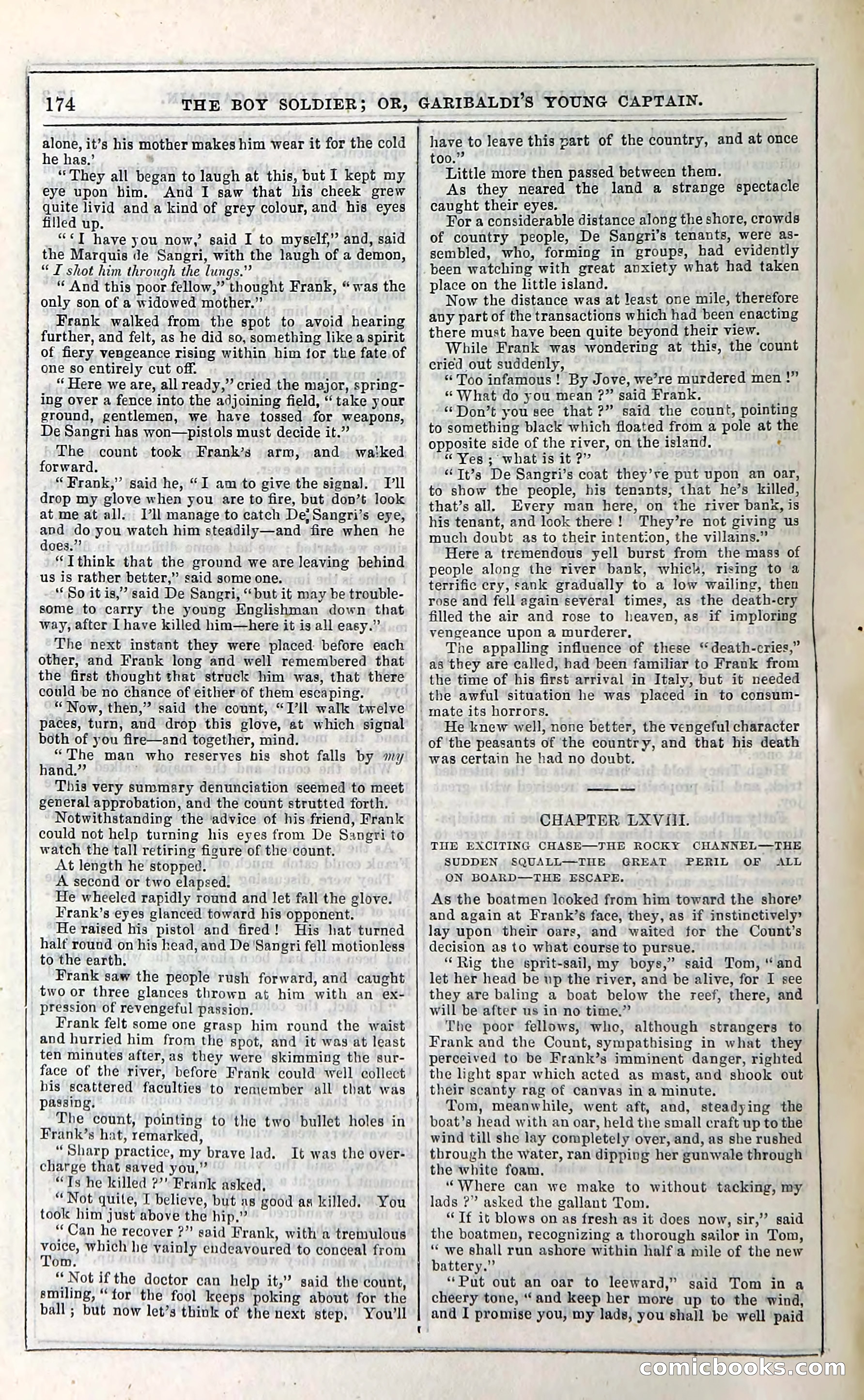
A restored page from Penny Dreadfuls, 1867. Page through the whole issue in the reader above.
📄 Transcribed text from this page (OCR, searchable)
Machine-transcribed from the original scan — historical spelling and the odd misread are preserved.
THE BOY SOLDIER; OR, GARIBALDI'S YOUNG CAPTAIN. eS SSS ; alone, it’s his mother makes him wear it for the cold he has.’ “They all began to laugh at this, but I kept my eye upon him. And I saw that his cheek grew quite livid and a kind of grey colour, and his eyes filled up. ““«T have you now,’ said I to myself,” and, said the Marquis de Sangri, with the laugh of a demon, “ I shot him through the lungs.” “And this poor fellow,” thought Frank, “was the only son of a widowed mother.” Frank walked from the spot to avoid hearing further, and felt, as he did so, something like a spirit of fiery vengeance rising within him for the fate of one so entirely cut off. “‘ Here we are, all ready,” cried the major, spring- ing over a fence into the adjoining field, “ take your ground, gentlemen, we have tossed for weapons, De Sangri has won—pistols must decide it.” The count took Frank’s arm, and waked forward. “Frank,” said he, “I am to give the signal. ll drop my glove when you are to fire, but don’t look at me at all. Ill manage to catch De Sangri’s eye, and do you watch him steadily—and fire when he does.” “IT think that the ground we are leaving behind us is rather better,” said some one. ‘So it is,” said De Sangri, “‘but it may be trouble- some to carry the young Englishman down that way, after Ihave killed him—here it is all easy.” The next instant they were placed before each other, and Frank long and well remembered that the first thought that struck him was, that there could be no chance of either of them escaping. “Now, then,” said the count, “T’ll walk twelve paces, turn, and drop this glove, at which signal both of you fire—and together, mind. “The man who reserves his shot falls by my hand.” This very summary denunciation seemed 'to meet general approbation, and the count strutted forth. Notwithstanding the advice of his friend, Frank could not help turning his eyes from De Sangri to watch the tall retiring figure of the count. At length he stopped. A second or two elapsed. He wheeled rapidly round and let fall the glove. Frank’s eyes glanced toward his opponent. He raised his pistol and fired! His hat turned half round on his head, and De 'Sangri fell motionless to the earth. Frank saw the people rush forward, and caught two or three glances thrown at him with an ex- pression of revengeful passion. Frank felt some one grasp him round the waist and hurried him from the spot, and it was at least ten minutes after,as they were skimming the sur- face of the river, before Frank could well collect bis scattered faculties to reniember all that was passing, The count, pointing to the two bullet holes in Frank’s hat, remarked, “ Sharp practice, my brave lad. It was the over- charge that saved you,” “Ts he killed ?’’ Frank asked, “Not quite, I believe, but as good as killed. You took him just above the hip,” “Can he recover ?” said Frank, with a tremulous vag which he vainly endeavoured to conceal from om. “Not ifthe doctor can help it,” said the count, smiling, tor the fool keeps poking about for the ball; but now let’s think of the next step, You'll have to leave this part of the country, and at once too.” Little more then passed between them. As they neared the land a strange spectacle caught their eyes. For a considerable distance along the shore, crowds of country people, De Sangri’s tenants, were as- sembled, who, forming in groups, had evidently been watching with great anxiety what had taken place on the little island. Now the distance was at Jeast one mile, therefore any part of the transactions which had been enacting there must have been quite beyond their view. While Frank was wondering at this, the count ' eried out suddenly, “To infamous! By Jove, we’re murdered men !” *“ What do you mean ?” said Frank. ‘Don’t you see that ?” said the count, pointing to something black which floated from a pole at the _ opposite side of the river, on the island. t “Yes ; what is it ?” . “Tt’s De Sangri’s coat they’re put upon an oar, to show the people, his tenants, that he’s killed, that’s all. Every man here, on the river bank, is his tenant, and look there! They’re not giving us much doubt as to their intention, the villains.” Here a tremendous yell burst from the mass of people along the river bank, which, rising to a terrific cry, sank gradually to a low wailing, then rose and fell again several times, as the death-cry filled the air and rose to heaven, as if imploring vengeance upon a murderer, The appalling influence of these “ death-cries,” as they are called, had been familiar to Frank from the time of his first arrival in Italy, but it needed the awful situation he was placed in to consum- ' mate its horrors. He knew well, none better, the vengeful character of the peasants of the country, and that his death was certain he had no doubt. CHAPTER LXVIIL. THE EXCITING CHASE—THE ROCKY CHANNEL—THE SUDDEN SQUALL—THE GREAT PERIL OF ALL ON BOARD—THE ESCAPE. As the boatmen looked from him toward the shore’ and again at Frank’s face, they, as if instinctively” lay upon their oars, and waited for the Count’s decision as to what course to pursue. “Rig the sprit-sail, my boys,’ said Tom, “and let her head be up the river, and be alive, for I see they are baling a boat below the reef, there, and will be after us in no time.” The poor fellows, who, although strangers to Frank and the Count, sympathising in what they perceived to be Frank’s imminent danger, righted the light spar which acted as mast, and shook out their scanty rag of Canvas in a minute. Tom, meanwhile, went aft, and, steadying the boat’s head with an oar, held the small craft up to the wind till she lay completely over, and, as she rushed through the water, ran dipping her gunwale through the white foam. ‘““Where can we make to without tacking, my lads ?” asked the gallant Tom. “If it blows on as fresh as it does now, sir,” said the boatmen, recognizing a thorough sailor in Tom, ‘we shall run ashore within half a mile of the new battery.” “Put out an oar to leeward,” said Tom in a cheery tone, “and keep her more up to the wind, and I promise you, my lads, you shall be well paid (OMKELNOOKS “—