
Penny Dreadfuls, 1867 · page 114 of 390
The Boy Soldier; Or, Garibaldi's Young Captain — page 114: what you’re looking at
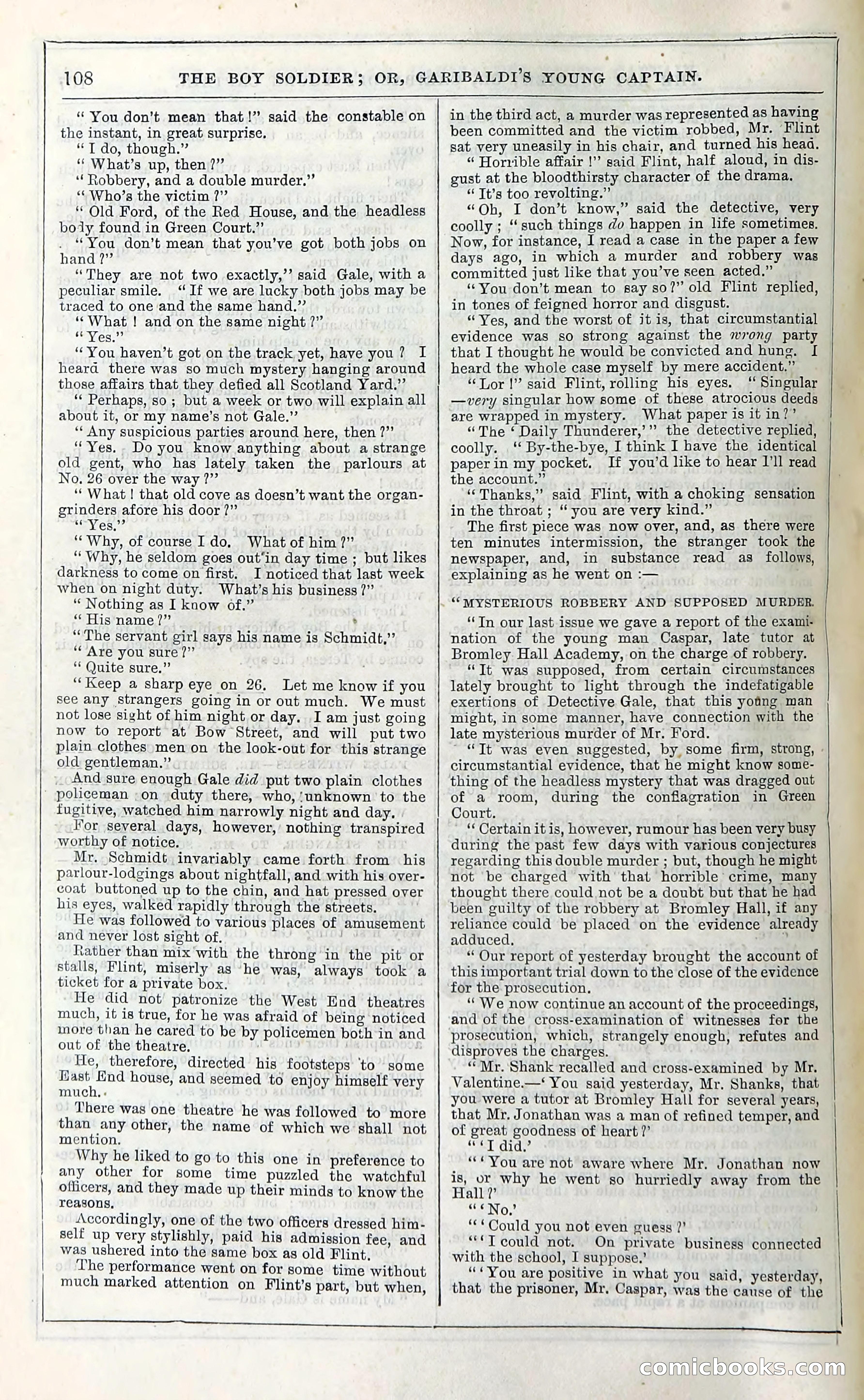
A restored page from Penny Dreadfuls, 1867. Page through the whole issue in the reader above.
📄 Transcribed text from this page (OCR, searchable)
Machine-transcribed from the original scan — historical spelling and the odd misread are preserved.
/ 108 THE BOY SOLDIER; OR, GARIBALDI’S YOUNG CAPTAIN. ee en eee ‘You don’t mean that!’ said the constable on the instant, in great surprise. “T do, though.” ‘‘ What’s up, then?” ‘Robbery, and a double murder.” “‘'Who’s the victim ?” ‘Old Ford, of the Red House, and the headless body found in Green Court.’ . “You don’t mean that you’ve got both jobs on hand ?” “They are not two exactly,’’ said Gale, with a peculiar smile. “If we are lucky both jobs may be traced to one and the same hand.” ‘“What ! and on the same night ?” Yies:¥ “You haven’t got on the track yet, have you? I heard there was so much mystery hanging around those affairs that they defied all Scotland Yard.” ‘* Perhaps, so ; but a week or two will explain all about it, or my name’s not Gale.” ‘‘ Any suspicious parties around here, then ?”’ ‘Yes. Do you know anything about a strange old gent, who has lately taken the parlours at No. 26 over the way ?” ‘* What ! that old cove as doesn’t want the organ- grinders afore his door ?” “Yes,” “Why, of course Ido. What of him ?” ‘Why, he seldom goes out’in day time ; but likes darkness to come on first. I noticed that last week when on night duty. What’s his business ?” ‘“ Nothing as I know of.” “ His name ?”’ . ‘“The servant girl says his name is Schmidt,” ‘Are you sure ?”’ ‘** Quite sure.” : ‘“Keep a sharp eye on 26. Let me know if you see any Strangers going in or out much. We must not lose sight of him night or day. I am just going now to report at Bow Street, and will put two plain clothes men on the look-out for this strange old gentleman,” And sure enough Gale did put two plain clothes policeman .on duty there, who, ‘unknown to the fugitive, watched him narrowly night and day. lor several days, however,’ nothing transpired worthy of notice. Mr. Schmidt invariably came forth from his parlour-lodgings about nightfall, and with his over- coat buttoned up to the chin, and hat pressed over his eyes, walked rapidly through the streets. He was followed to various places of amusement and never lost sight of. : Rather than mix with the throng in the pit or stalls, Flint, miserly as ‘he was, always took a ticket for a private box. He did not patronize the West End theatres much, it is true, for he was afraid of being noticed inore than he cared to be by policemen both in and out of the theatre. 1 He, therefore, ast Knd house, much. « There was one theatre he was followed to more than any other, the name of which we shall not mention. Why he liked to go to this one in preference to any other for some time puzzled the watchful officers, and they made up their minds to know the reasons, Accordingly, one of the two officers dressed him- self up very stylishly, paid his admission fee, and was ushered into the same box as old Flint. The performance went on for some time without much marked attention on Flint’s part, but when, directed his footsteps ‘to some and seemed to enjoy himself very a I in the third act, a murder was represented as having been committed and the victim robbed, Mr. ‘Flint sat very uneasily in his chair, and turned his heaa. “ Horrible affair !”’ said Flint, half aloud, in dis- gust at the bloodthirsty character of the drama. “ Tt’s too revolting.” “Oh, I don’t know,” said the detective, very coolly ; ‘such things do happen in life sometimes. Now, for instance, I read a case in the paper a few days ago, in which a murder and robbery was committed just like that you’ve seen acted.” ‘You don’t mean to say so?” old Flint replied, in tones of feigned horror and disgust. “Yes, and the worst of it is, that circumstantial evidence was so strong against the m7ong party that I thought he would be convicted and hung. [ heard the whole case myself by mere accident.” “Tor!” said Flint, rolling his eyes. ‘ Singular —very singular how some of these atrocious deeds are wrapped in mystery. What paper isit in?” | “The ‘ Daily Thunderer,’”’ the detective replied, coolly. ‘‘ By-the-bye, I think I have the identical paper in my pocket. If you'd like to hear I'll read the account.” ‘“Thanks,” said Flint, with a choking sensation in the throat ; “you are very kind.” The first piece was now over, and, as there were ten minutes intermission, the stranger took the newspaper, and, in substance read as follows, explaining as he went on :-— . “MYSTERIOUS ROBBERY AND SUPPOSED MURDER. ‘Tn our last issue we gave a report of the exami- nation of the young man Caspar, late tutor at Bromley Hall Academy, on the charge of robbery. “Tt was supposed, from certain circumstances lately brought to light through the indefatigable exertions of Detective Gale, that this yotng man might, in some manner, have connection with the late mysterious murder of Mr. Ford. ' “Tt was even suggested, by some firm, strong, - circumstantial evidence, that he might know some- thing of the headless mystery that was dragged out of a room, during the conflagration in Green Court. ‘‘ Certain itis, however, rumour has been very busy during the past few days with various conjectures regarding this double murder ; but, though he might not be charged with that horrible’ crime, many thought there could not be a doubt but that he had been guilty of the robbery at Bromley Hall, if any reliance could be placed on the evidence already adduced, “Our report of yesterday brought the account of this important trial down to the close of the evidence for the prosecution. ‘We now continue an account of the proceedings, and of the cross-examination of witnesses for the prosecution, which, strangely enough, refutes and disproves the charges. “Mr. Shank recalled and cross-examined by Mr. Valentine.—‘ You said yesterday, Mr. Shanks, that you were a tutor at Bromley Hall for several years, that Mr. Jonathan was a man of refined temper, and of great goodness of heart ?’ TET did? ‘““* You are not aware where Mr. Jonathan now is, or why he went so hurriedly away from the Hall ?’ cee No,’ ‘“* Could you not even guess ?’ “*T could not. On private business connected with the school, I suppose.’ “*You are positive in what you said, yesterday, that the prisoner, Mr, Caspar, was the cause of the Gomicbook a es i. — —_-