
Penny Dreadfuls, 1867 · page 70 of 300
Roving Jack, The Pirate Hunter — page 70: what you’re looking at
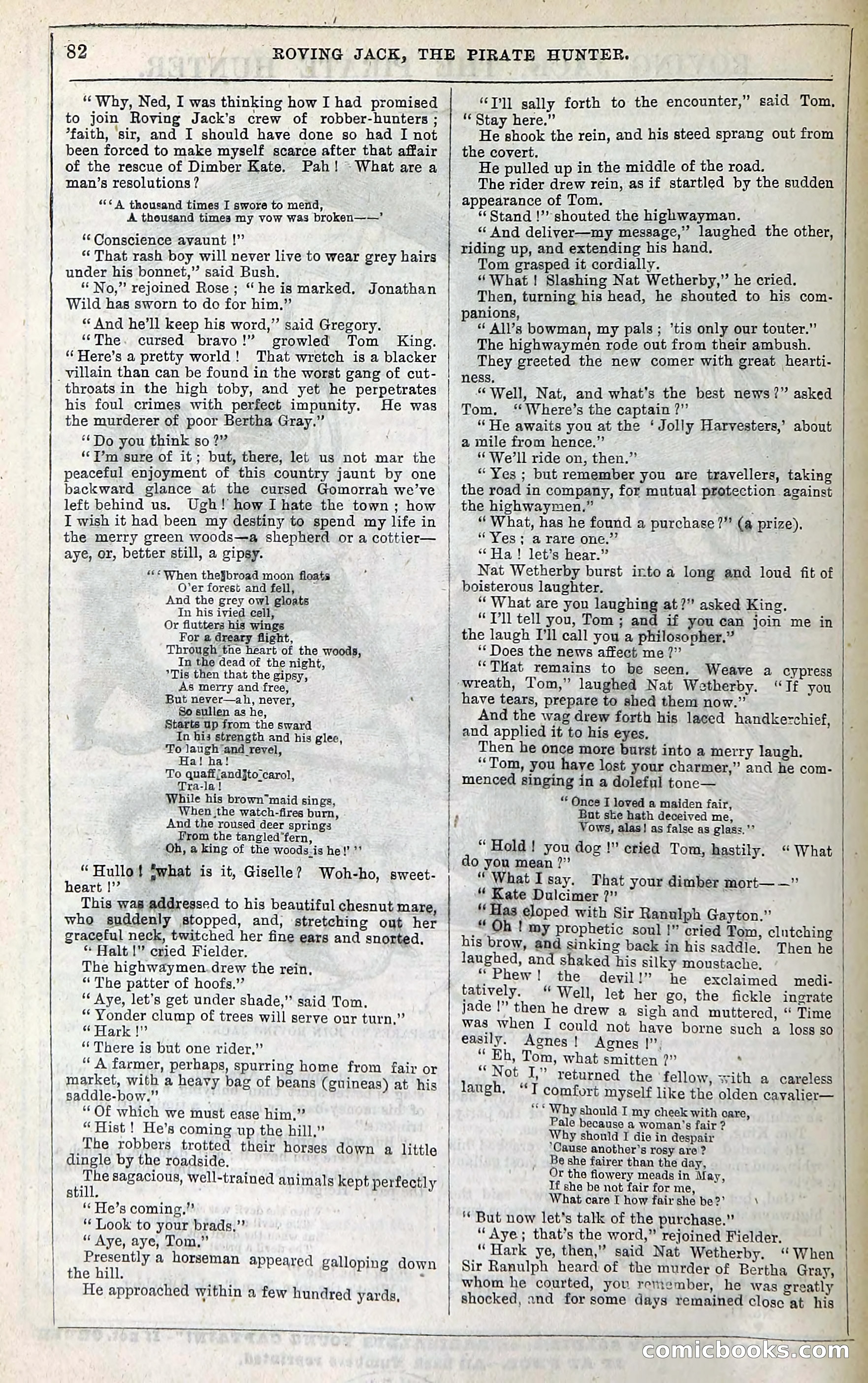
A restored page from Penny Dreadfuls, 1867. Page through the whole issue in the reader above.
📄 Transcribed text from this page (OCR, searchable)
Machine-transcribed from the original scan — historical spelling and the odd misread are preserved.
al! 82 ROVING JACK, THE PIRATE HUNTER. eS ‘Why, Ned, I was thinking how I had promised to join Roving Jack’s crew of robber-hunters ; *faith, ‘sir, and I should have done so had I not been forced to make myself scarce after that affair of the rescue of Dimber Kate. Pah! - What are a man’s resolutions? ; **¢ A thousand times I swore to mend, A thousand times my vow was broken——’ ‘Conscience ayaunt !” *‘ That rash boy will never live to wear grey hairs under his bonnet,” said Bush. ** No,” rejoined Rose; “he is marked, Jonathan Wild has sworn to do for him.” “And he’ll keep his word,” said Gregory. ““The. cursed bravo!” growled Tom King. “Here’s a pretty world! That wretch is a blacker _villain than can be found in the worst gang of cut- throats in the high toby, and yet he perpetrates his foul crimes with perfect impunity. He was the murderer of poor Bertha Gray.” ‘Do you think so 2?” | ‘“1’m sure of it; but, there, let us not mar the peaceful enjoyment of this country jaunt by one backward glance at the cursed Gomorrah we’ve left behind us. Ugh! how I hate the town; how I wish it had been my destiny to spend my life in the merry green woods—a shepherd or a cottier— aye, or, better still, a gipsy. *** When the§broad moon floats O’er forest and fell, And the grey owl gloats In his ivied cell, Or flutters his wings For a dreary flight, Through tne heart of the woods, In the dead of the night, ’*Tis then that the gipsy, As merry and free, But never—ah, never, . So sullen as he, Starts up from the sward In his strength and his glee, To laugh’and revel, Ha! ha! To quaft/andjto carol, Tra-la! While his brown maid sings, When the watch-fires burn, And the roused deer springs From the tangled’fern, Oh, a king of the woods.is he!’ ’’ “Hullo! fwhat is it, Giselle? Woh-ho, sweet- heart !’” This was addressed to his beautiful chesnut mare, who suddenly stopped, and, stretching out her graceful neck, twitched her fine ears and snorted. * Halt!” cried Fielder, The highwaymen.drew the rein, “ The patter of hoofs.” ** Aye, let’s get under shade,” said Tom, “ Yonder clump of trees will serve our turn,” “ Hark !” ‘‘ There is but one rider,” ‘A farmer, perhaps, spurring home from fair or market, with a heavy bag of beans (guineas) at his saddle-bow.” ‘““Of which we must ease him,” “ Hist ! He’s coming up the hill,” The robbers trotted their horses down a little dingle by the roadside. . i sagacious, well-trained animals kept perfectly still. ‘‘ He’s coming,” € Look to your brads,”’ “ Aye, aye, Tom,” Presently a horseman appeared galloping down the hill. : He approached within a few hundred yards, “Pll sally forth to the encounter,” said Tom, ‘ Stay here.” He shook the rein, and his steed sprang out from the covert. He pulled up in the middle of the road. The rider drew rein, as if startled by the sudden appearance of Tom. ‘Stand !’’ shouted the highwayman. “ And deliver—my message,”’ laughed the other, riding up, and extending his hand, Tom grasped it cordially. - “What! Slashing Nat Wetherby,” he cried. Then, turning his head, he shouted to his com- panions, “ All’s bowman, my pals; ‘tis only our touter.” The highwaymen rode out from their ambush. They greeted the new comer with great hearti- ness, “Well, Nat, and what’s the best news?” asked Tom, ‘“ Where’s the captain ?” “He awaits you at the ‘Jolly Harvesters,’ about a mile from hence.” “We'll ride on, then.”’ “Yes ; but remember you are travellers, taking the road in company, for mutual protection against the highwaymen,” . “What, has he found a purchase?” (a prize). “Yes; a rare one.” | “Ha! let’s hear.” Nat Wetherby burst into a long and loud fit of boisterous laughter. , ‘‘ What are you laughing at?” asked King, “T’ll tell you, Tom; and if you can join me in the laugh I'll call you a philosopher.” ‘Does the news affect me ?”’ ‘““THat remains to be seen. Weave a cypress wreath, Tom,” laughed Nat Wetherby. “If you have tears, prepare to shed them now.” And the wag drew forth his laced handkerchief, and applied it to his eyes, Then he once more burst into a merry laugh. “Tom, you have lost your charmer,” and he com- menced singing in a doleful tone— “ Once I loved a maiden fair, But ske hath deceived me, Vows, alas! as false as glass."” “Hold! you dog !” cried Tom, hastily. do you mean ?”’ “What Isay. That “ Kate Dulcimer ?” ‘Has eloped with Sir Ranulph Gayton.” “ Oh ! my prophetic soul !” cried Tom, clutching his brow, and sinking back in his saddle. Then he laughed, and shaked his silky moustache. ** Phew | “ What your dimber mort— —” the devil!” he exclaimed medi- tatively. “Well, let her go, the fickle ingrate Jade |” then he drew a sigh and muttered, “ Time was when I could not have borne such a loss so easily. Aones | Agnes !’’, ‘ Eh, Tom, what smitten ?” ; “Not I,” returned the fellow, sith a careless laugh, “T comfort myself like the olden cayalier— ‘** Why should I my cheek with care, Pale because a woman's fair ? Why shonld I die in despair Cause another’s rosy are ? Be she fairer than the day, Or the flowery meads in May, If she be not fair for me, What care I how fair she be?’ \ ‘* But now let's talk of the purchase.” ‘‘Aye; that’s the word,” rejoined Fielder. “Hark ye, then,” said Nat Wetherby. “When Sir Ranulph heard of the murder of Bertha Gray, | whom he courted, you retiember, he was greatly shocked, and for some days remained close at his Eomichoo S com | ; aS Ce ie