
Penny Dreadfuls, 1867 · page 67 of 300
Roving Jack, The Pirate Hunter — page 67: what you’re looking at
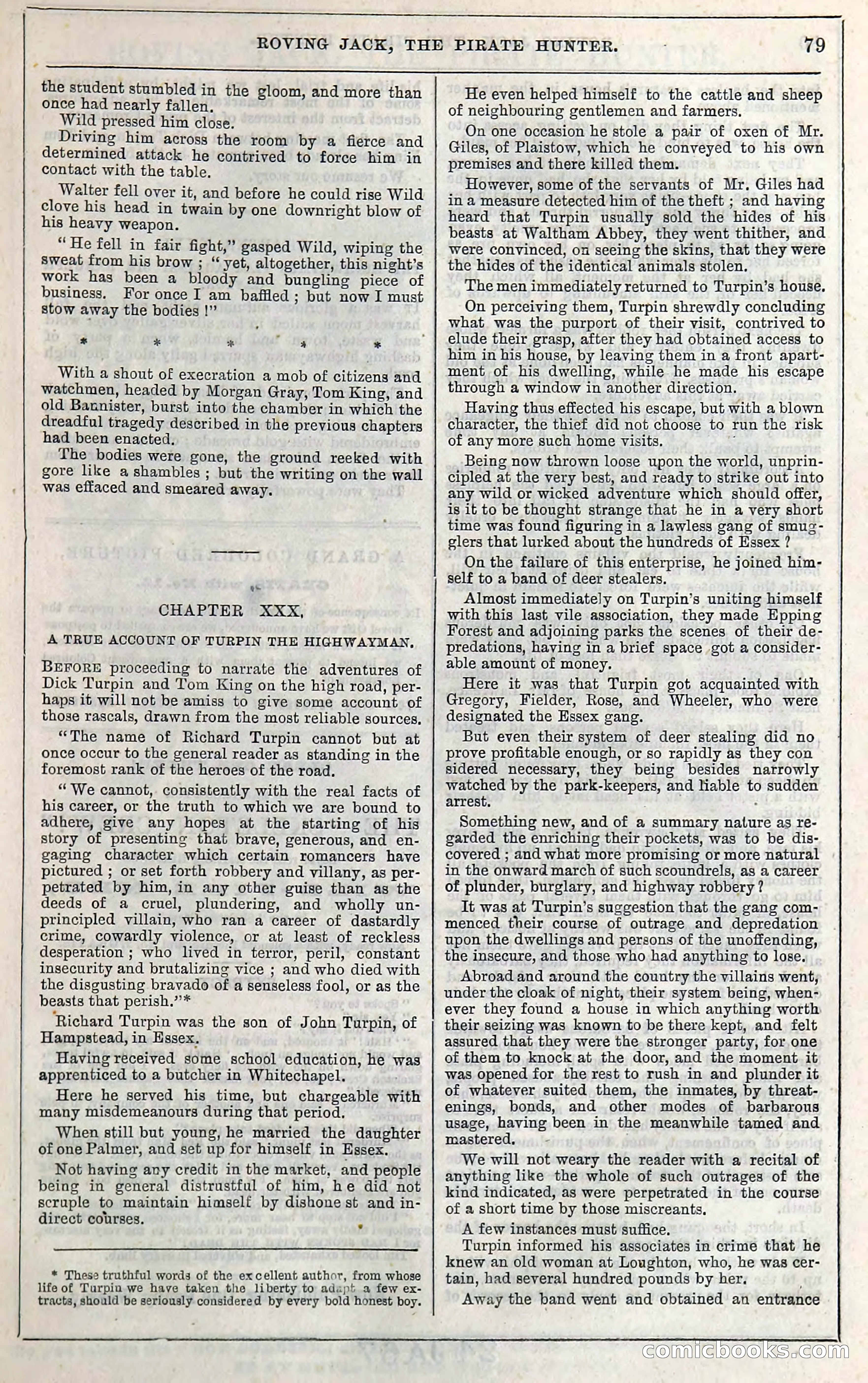
A restored page from Penny Dreadfuls, 1867. Page through the whole issue in the reader above.
📄 Transcribed text from this page (OCR, searchable)
Machine-transcribed from the original scan — historical spelling and the odd misread are preserved.
a ara 8 ed a ROVING JACK, THE PIRATE HUNTER. 79 ee the student stumbled in the gloom, and more than once had nearly fallen, Wild pressed him close. Driving him across the room by a fierce and determined attack he contrived to force him in contact with the table. Walter fell over it, and before he could rise Wild clove his head in twain by one downright blow of his heavy weapon. “ He fell in fair fight,” gasped Wild, wiping the sweat from his brow ; “yet, altogether, this night’s work has been a bloody and bungling piece of business, For once I am baffled; but now I must stow away the bodies !” * * * » SNe * With a shout of execration a mob of citizens and watchmen, headed by Morgan Gray, Tom King, and old Bannister, burst into the chamber in which the dreadful tragedy described in the previous chapters had been enacted. : The bodies were gone, the ground reeked with gore like ashambles ; but the writing on the wall was effaced and smeared away. g CHAPTER XXX, A TRUE ACCOUNT OF TURPIN THE HIGHWAYMAN, BEFORE proceeding to narrate the adventures of Dick Turpin and Tom King on the high road, per- haps it will not be amiss to give some account of those rascals, drawn from the most reliable sources, “The name of Richard Turpin cannot but at once occur to the general reader as standing in the foremost rank of the heroes of the road. “We cannot, consistently with the real facts of his career, or the truth to which we are bound to adhere, give any hopes at the starting of his story of presenting that brave, generous, and en- gaging character which certain romancers have pictured ; or set forth robbery and villany, as per- petrated by him, in any other guise than as the deeds of a cruel, plundering, and wholly un- principled villain, who ran a career of dastardly crime, cowardly violence, or at least of reckless desperation ; who lived in terror, peril, constant insecurity and brutalizing vice ; and who died with the disgusting bravado of a senseless fool, or as the beasts that perish.’’* Richard Turpin was the son of John Turpin, of Hampstead, in Hssex, Having received some school education, he was apprenticed to a butcher in Whitechapel. Here he served his time, but chargeable with many misdemeanours during that period. When still but young, he married the daughter of one Palmer, and set up for himself in Essex. Not having any credit in the market, and people being in general distrustful of him, he did not scruple to maintain himself by dishonest and in- direct courses. * These truthful words of the excellent author, from whose life of Turpin we have taken the liberty to adapt a few ex- tracts, should be seriously considered by every bold honest boy. He even helped himself to the cattle and sheep of neighbouring gentlemen and farmers. On one occasion he stole a pair of oxen of Mr. Giles, of Plaistow, which he conveyed to his own premises and there killed them. However, some of the servants of Mr. Giles had in a measure detected him of the theft ; and having heard that Turpin usually sold the hides of his beasts at Waltham Abbey, they went thither, and were convinced, on seeing the skins, that they were the hides of the identical animals stolen. The men immediately returned to Turpin’s house. On perceiving them, Turpin shrewdly concluding what was the purport of their visit, contrived to elude their grasp, after they had obtained access to him in his house, by leaving them in a front apart- ment of his dwelling, while he made his escape through a window in another direction. Having thus effected his escape, but with a blown character, the thief did not choose to run the risk of any more such home visits, : Being now thrown loose upon the world, unprin- cipled at the very best, and ready to strike out into any wild or wicked adventure which should offer, is it to be thought strange that he in a very short time was found figuring in a lawless gang of smug- glers that lurked about the hundreds of Essex ? On the failure of this enterprise, he joined him- self to a band of deer stealers. Almost immediately on Turpin’s uniting himself with this last vile association, they made Epping Forest and adjoining parks the scenes of their de- predations, haying in a brief space got a consider- able amount of money. Here it was that Turpin got acquainted with Gregory, Fielder, Rose, and Wheeler, who were designated the Essex gang. But even their system of deer stealing did no prove profitable enough, or so rapidly as they con sidered necessary, they being besides narrowly watched by the park-keepers, and Hable to sudden arrest. . Something new, and of a summary nature as re- garded the enriching their pockets, was to be dis- covered ; and what more promising or more natural in the onward march of such scoundrels, as a career of plunder, burglary, and highway robbery ? It was at Turpin’s suggestion that the gang com- menced their course of outrage and depredation upon the dwellings and persons of the unoffending, the insecure, and those who had anything to lose. Abroad and around the country the villains went, under the cloak of night, their system being, when- ever they found a house in which anything worth their seizing was known to be there kept, and felt assured that they were the stronger party, for one of them to knock at the door, and the moment it was opened for the rest to rush in and plunder it of whatever suited them, the inmates, by threat- enings, bonds, and other modes of barbarous usage, having been in the meanwhile tamed and mastered, | We will not weary the reader with a recital of anything like the whole of such outrages of the kind indicated, as were perpetrated in the course of a short time by those miscreants. A few instances must sufiice. Turpin informed his associates in crime that he knew an old woman at Loughton, who, he was cer- tain, had several hundred pounds by her. Away the band went and obtained an entrance (CO) COMNMUICVOOLKS