
Penny Dreadfuls, 1867 · page 49 of 300
Roving Jack, The Pirate Hunter — page 49: what you’re looking at
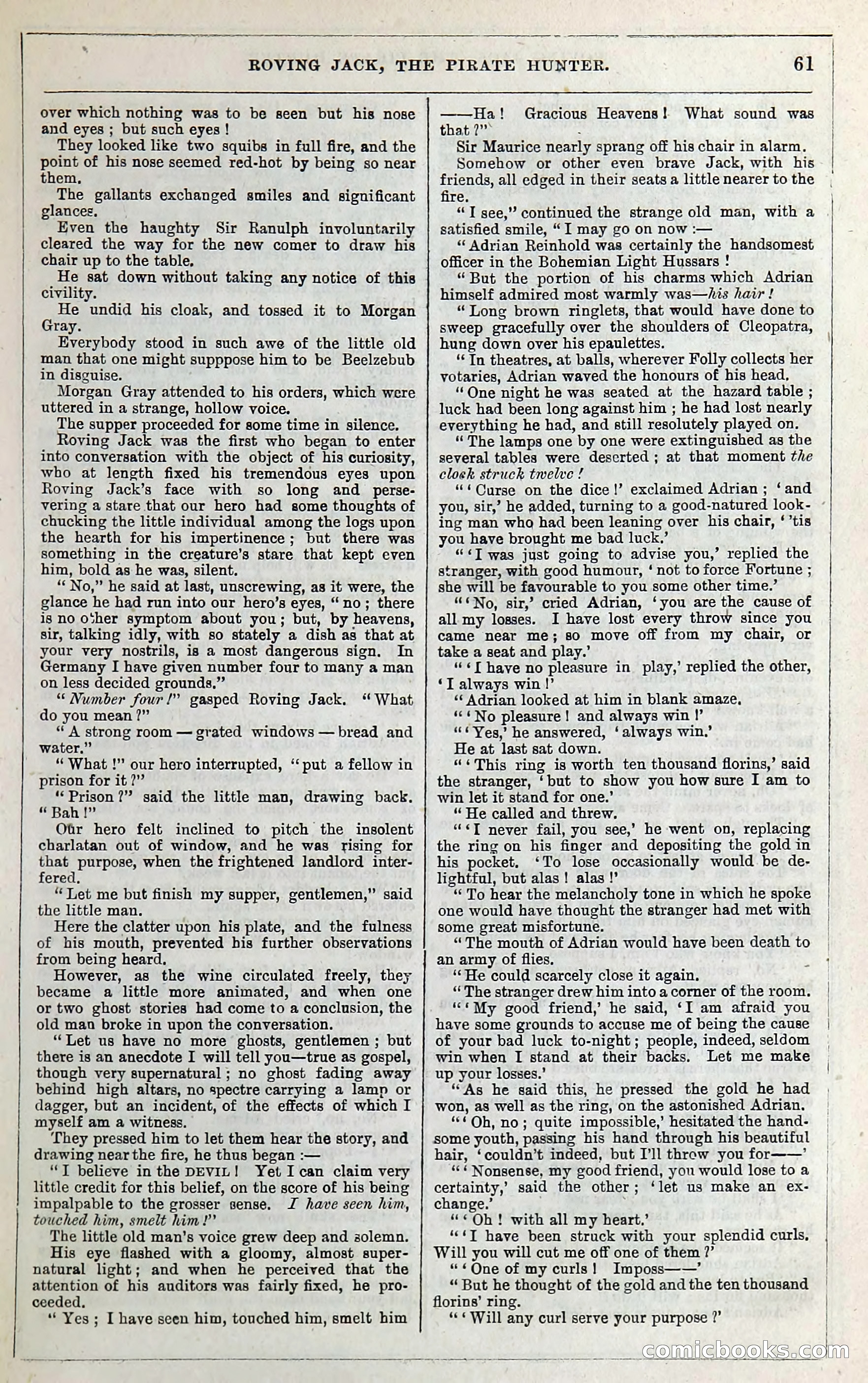
A restored page from Penny Dreadfuls, 1867. Page through the whole issue in the reader above.
📄 Transcribed text from this page (OCR, searchable)
Machine-transcribed from the original scan — historical spelling and the odd misread are preserved.
(+ ROVING JACK, THE PIRATE HUNTER. over which nothing was to be seen but his nose and eyes ; but such eyes ! They looked like two squibs in full fire, and the pout of his nose seemed red-hot by being so near them, The gallants exchanged smiles and significant glances. Even the haughty Sir Ranulph involuntarily cleared the way for the new comer to draw his chair up to the table, He sat down without taking any notice of this civility. He undid his cloak, and tossed it to Morgan Gray. Everybody stood in such awe of the little old man that one might supppose him to be Beelzebub in disguise. Morgan Gray attended to his orders, which were uttered in a strange, hollow voice. The supper proceeded for some time in silence. Oving Jack was the first who began to enter into conversation with the object of his curiosity, who at length fixed his tremendous eyes upon Roving Jack’s face with so long and _ perse- vering a stare that our hero had some thoughts of chucking the little individual among the logs upon the hearth for his impertinence; but there was something in the creature’s stare that kept even him, bold as he was, silent. ““No,” he said at last, unscrewing, as it were, the glance he had run into our hero’s eyes, “no; there is no Osher symptom about you; but, by heavens, sir, talking idly, with so stately a dish as that at your very nostrils, is a most dangerous sign. In Germany I have given number four to many a man on less decided grounds,” “Number four!” gasped Roving Jack. ‘“ What, do you mean ?” “ A strong room — grated windows — bread and water.” ‘What !” our hero interrupted, ‘‘put a fellow in prison for it ?” “Prison?” said the little man, drawing back. “ Bah !” Ofr hero felt inclined to pitch the insolent charlatan out of window, and he was rising for that purpose, when the frightened landlord inter- fered, “Let me but finish my supper, gentlemen,” said the little man. Here the clatter upon his plate, and the fulness of his mouth, prevented his further observations from being heard, However, as the wine circulated freely, they became a little more animated, and when one or two ghost stories had come to a conclusion, the old man broke in upon the conversation. “Let us have no more ghosts, gentlemen ; but there is an anecdote I will tell you—true as gospel, though very supernatural ; no ghost fading away behind high altars, no spectre carrying a lamp or dagger, but an incident, of the effects of which I myself am a witness. They pressed him to let them hear the story, and drawing near the fire, he thus began :— “T believe inthe DEVIL! Yet I can claim very little credit for this belief, on the score of his being impalpable to the grosser sense. J have seen him, touched him, smelt him I” The little old man’s voice grew deep and zolemn. His eye flashed with a gloomy, almost super- natural light; and when he perceived that the attention of his auditors was fairly fixed, he pro- ceeded, “Yes; I have seen him, touched him, smelt him r,s ——————_—. —— - 61 Ha! Gracious Heavens! What sound was that?” : Sir Maurice nearly sprang off his chair in alarm. Somehow or other even brave Jack, with his friends, all edged in their seats a little nearer to the fire. “T see,” continued the strange old man, with a satisfied smile, “I may go on now :— “ Adrian Reinhold was certainly the handsomest officer in the Bohemian Light Hussars ! “But the portion of his charms which Adrian himself admired most warmly was—his hair ! “Tonge brown ringlets, that would have done to sweep gracefully over the shoulders of Cleopatra, hung down over his epaulettes. ‘Tn theatres, at balls, wherever Folly collects her votaries, Adrian waved the honours of his head, ‘One night he was seated at the hazard table ; luck had been long against him ; he had lost nearly everything he had, and still resolutely played on. “The lamps one by one were extinguished as the several tables were deserted ; at that moment the clock struck twelve ! “Curse on the dice!’ exclaimed Adrian ; ‘and you, sir,’ he added, turning to a good-natured look- ing man who had been leaning over his chair, ‘ ’tis you have brought me bad luck.’ “<¢T was just going to advise you,’ replied the stranger, with good humour, ‘ not to force Fortune ; she will be favourable to you some other time.’ “No, sir,’ cried Adrian, ‘you are the cause of all my losses. I have lost every throw since you came near me; so move off from my chair, or take a seat and play.’ ‘‘¢T have no pleasure in play,’ replied the other, ‘T always win !’ ‘“‘ Adrian looked at him in blank amaze, ‘<* No pleasure! and always win !’ “6 Yes,’ he answered, ‘always win.’ He at last sat down. “¢This ring is worth ten thousand florins,’ said the stranger, ‘but to show you how sure I am to win let it stand for one.’ “ He called and threw. ““<T never fail, you see,’ he went on, replacing the ring on his finger and depositing the gold in his pocket. ‘To lose occasionally would be de- lightful, but alas! alas !’ ‘To hear the melancholy tone in which he spoke one would have thought the stranger had met with some great misfortune. “The mouth of Adrian would have been death to an army of flies. 4 ‘He could scarcely close it again. “The stranger drew him into a corner of the room. ‘“* My good friend,’ he said, ‘I am afraid you have some grounds to accuse me of being the cause of your bad luck to-night; people, indeed, seldom win when I stand at their backs. Let me make up your losses.’ “As he said this, he pressed the gold he had won, as well as the ring, on the astonished Adrian. ‘© Oh, no; quite impossible,’ hesitated the hand- some youth, passing his hand through his beautiful hair, ‘couldn’t indeed, but I'll throw you for——’ ‘«<é Nonsense, my good friend, you would lose to a certainty,’ said the other; ‘let us make an ex- change.’ “¢ Oh! with all my heart,’ ‘«¢T have been struck with your splendid curls, Will you will cut me off one of them ?’ “¢QOne of my curls! Imposs——’ “But he thought of the gold and the ten thousand florins’ ring. ‘«« Will any curl serve your purpose ?’ __COmmco@olks (2) $$ gs — -— Sn ~ OPSESs3 Sa Se =