
Penny Dreadfuls, 1867 · page 46 of 300
Roving Jack, The Pirate Hunter — page 46: what you’re looking at
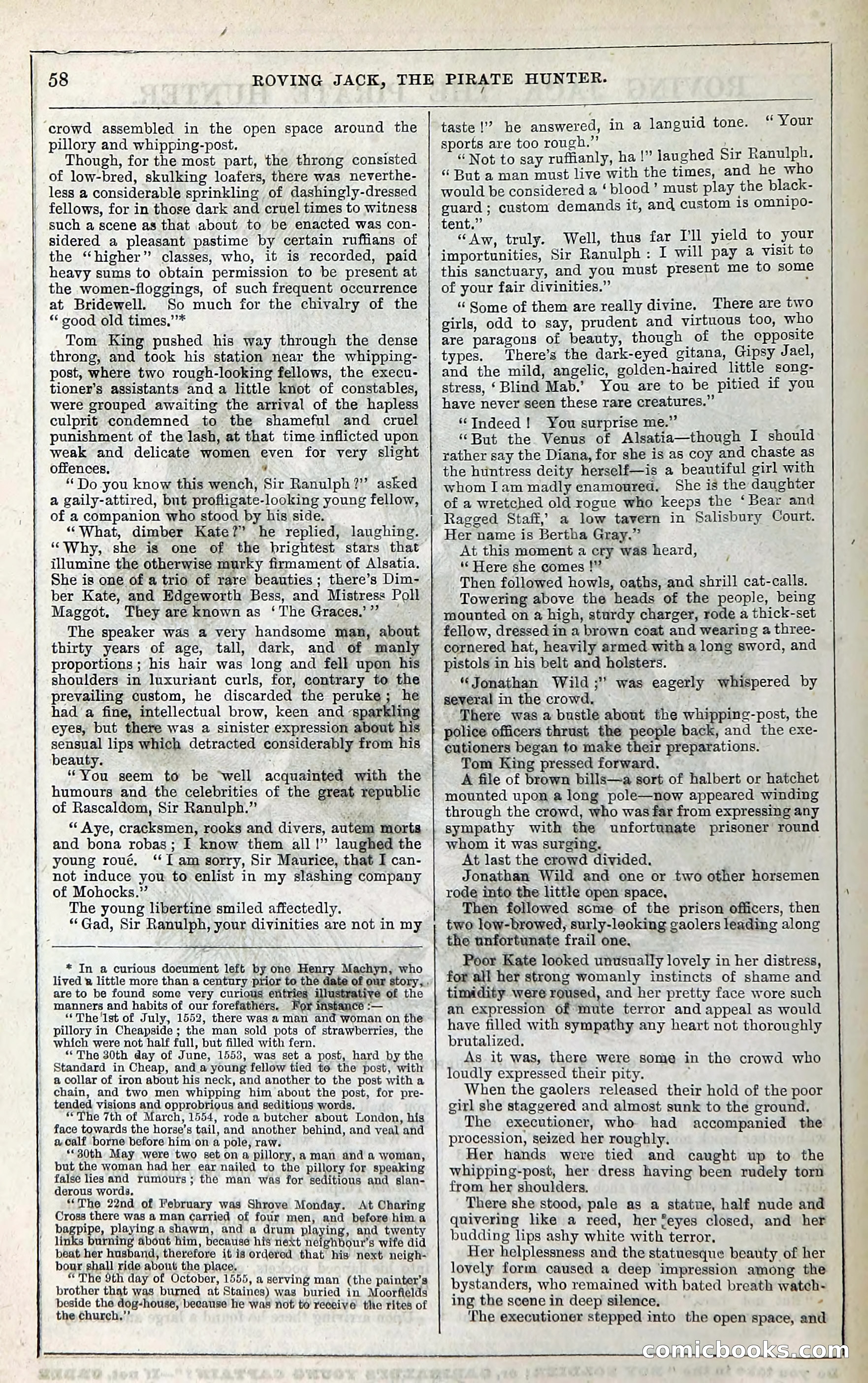
A restored page from Penny Dreadfuls, 1867. Page through the whole issue in the reader above.
📄 Transcribed text from this page (OCR, searchable)
Machine-transcribed from the original scan — historical spelling and the odd misread are preserved.
58 ROVING JACK, THE PIRATE HUNTER. oe 2 ENE A FANE NAD AE DCE ee See ‘crowd assembled in the open space around the pillory and whipping-post. Though, for the most part, the throng consisted of low-bred, skulking loafers, there was neverthe- less a considerable sprinkling of dashingly-dressed fellows, for in those dark and cruel times to witness such a scene as that about to be enacted was con- sidered a pleasant pastime by certain ruffians of the ‘higher’ classes, who, it is recorded, paid heavy sums to obtain permission to be present at the womer-floggings, of such frequent occurrence at Bridewell. “good old times,’’* Tom King pushed his way through the dense throng, and took his station near the whipping- post, where two rough-looking fellows, the execu- tioner’s assistants and a little knot of constables, were grouped awaiting the arrival of the hapless culprit condemned to the shameful and cruel _ punishment of the lash, at that time inflicted upon weak and delicate women even for very slight offences, , 4 “Do you know this wench, Sir Ranulph?’’ asked a gaily-attired, but profligate-looking young fellow, of a companion who stood by his side. ‘““What, dimber Kate?’ he replied, laughing. ‘‘Why, she is one of the brightest stars that illumine the otherwise murky firmament of Alsatia. She is one of a trio of rare beauties; there’s Dim- ber Kate, and Edgeworth Bess, and Mistress Poll Maggot. They are known as ‘The Graces.’” — The speaker was a very handsome man, about thirty years of age, tall, dark, and of manly proportions ; his hair was long and fell upon his shoulders in luxuriant curls, for, contrary to the prevailing custom, he discarded the peruke; he had a fine, intellectual brow, keen and ‘sparkling eyes, but there was a sinister expression about his sensual lips which detracted considerably from his beauty. sia es “You seem to be ‘well acquainted with the humours and the celebrities of the great republic of Rascaldom, Sir Ranulph.”’ hey * Aye, cracksmen, rooks and divers, autem morts and bona robas; I know them all!” laughed the young roué, ‘‘ {am sorry, Sir Maurice, that I can- not induce you to enlist in my slashing company of Mohocks.” The young libertine smiled affectedly. “Gad, Sir Ranulph, your divinities are not in my * In a curious doeument left by one Henry Machyn, who lived & little more than a century prior to the date of our story,. are to be found some very curious elifries illustrative of the manners and habits of our forefathers. For instance :-— “‘The'Ist of July, 1552, there was a man and woman on the pillory in Cheapside ; the man sold pots of strawberries, the which were not half full, but filled with fern. “The 30th day of June, 1553, was set a post, hard by the Standard in Cheap, and a young fellow tied to the post, with a collar of iron about his neck, and another to the post witha chain, and two men whipping him about the post, for pre- tended visions and opprobrious and seditious words. “The 7th of March, 1554, rode a butcher about London, his face towards the horse’s tail, and another behind, and veal and a calf borne before him on a pole, raw. **30th May were two set on a pillory, a man and a woman, but the woman had her ear nailed to the pillory for speaking false lies and rumours; the man was for seditious and slan- derous words. “The 22nd of February was Shrove Monday. At Charing Cross there was a man Carried of four men, and before hima poe pe, playing a shawm, and a drum playing, and twenty links burning about him, because his next neighbour's wife did beat her husband, therefore it is ordered that his next neigh- bour shall ride about the place. “The 9th day of October, 1555, a serving man (the painter’s brother that was bummed at Staines) was buried in Moorfields beside the dog-house, beeause he was not to receive the rites of the ¢hurch,”’ So much for the chivalry of the taste!’ be answered, in a languid tone. “ Your 8 are too rough.”’ , Neha PAO ha!” laughed Sir Ranulph. “ But a man must live with the times, and he who would be considered a ‘blood’ must play the black- guard; custom demands it, and custom 1s omnipo- tent.” “Aw, truly. Well, thus far Ill yield to your importunities, Sir Ranulph: I will pay a visit to this sanctuary, and you must present me to some of your fair divinities.” “ Some of them are really divine. There are two girls, odd to say, prudent and virtuous too, who are paragons of beauty, though of the opposite types. There’s the dark-eyed gitana, Gipsy Jael, and the mild, angelic, golden-haired little song- stress, ‘Blind Mab.’ You are to be pitied if you have never seen these rare creatures.” “Indeed! You surprise me.” | “But the Venus of Alsatia—though I should rather say the Diana, for she is as coy and chaste as the huntress deity herself—is a beautiful girl with whom Iam madly enamoured. She is the daughter of a wretched old rogue who keeps the ‘Bear and Ragged Staff,’ a low tavern in Salisbury Court. Her name is Bertha Gray.” At this moment a cry was heard, ‘Here she comes !” Then followed howls, oaths, and shrill cat-calls. Towering above the heads of the people, being mounted on a high, sturdy charger, rode a thick-set fellow, dressed in a brown coat and wearing a three- cornered hat, heavily armed with a long sword, and pistols in his belt and holsters. “Jonathan Wild; was eagerly whispered by several in the crowd, There was a bustle about the whipping-post, the police officers thrust the people back, and the exe- eutioners began to make their preparations. Tom King pressed forward. A file of brown bills—a sort of halbert or hatchet mounted upon a long pole—now appeared winding through the crowd, who was far from expressing any sympathy with the unfortunate prisoner round whom it was surging. At last the crowd divided. Jonathan Wild and one or two other horsemen rode into the little open space. Then followed scme of the prison officers, then two low-browed, surly-leooking gaolers leading along the unfortunate frail one, Poor Kate looked unusually lovely in her distress, for all her strong womanly instincts of shame and timidity were roused, and her pretty face wore such an expression of mute terror and appeal as would have filled with sympathy any heart not thoroughly brutalized. As it was, there were some in the crowd who loudly expressed their pity. When the gaolers released their hold of the poor girl she staggered and almost sunk to the ground. The executioner, who had accompanied the procession, seized her roughly. Her hands were tied and caught up to the whipping-post, her dress having been rudely torn from her shoulders. There she stood, pale as a statue, half nude and quivering like a reed, her eyes closed, and her budding lips ashy white with terror, Her helplessness and the statuesque beauty of her lovely form caused a deep impression among the bystanders, who remained with bated breath wateh- ing the scene in deep silence. — , ‘The executioner stepped into the open space, and at SA SE a