
Penny Dreadfuls, 1867 · page 41 of 300
Roving Jack, The Pirate Hunter — page 41: what you’re looking at
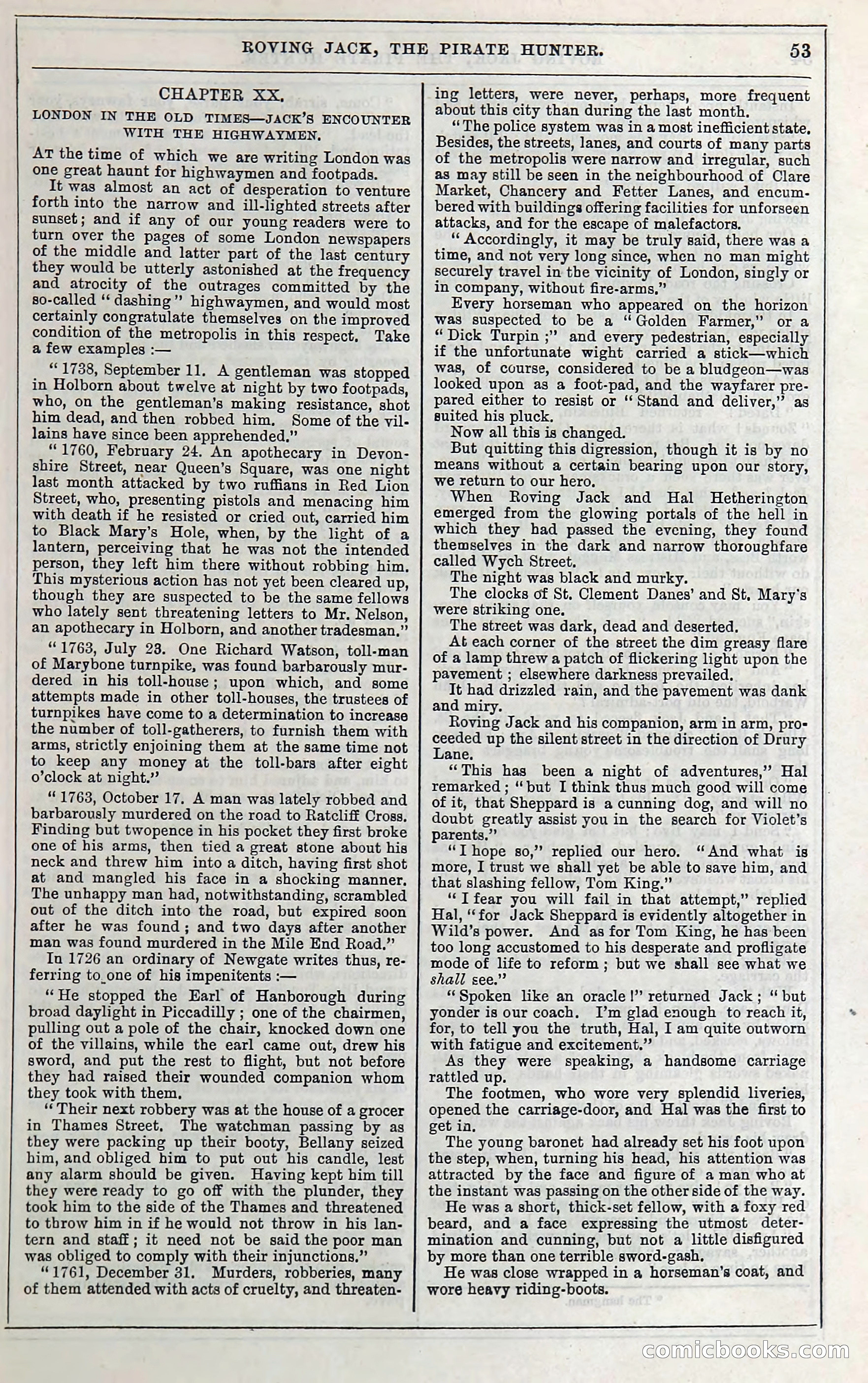
A restored page from Penny Dreadfuls, 1867. Page through the whole issue in the reader above.
📄 Transcribed text from this page (OCR, searchable)
Machine-transcribed from the original scan — historical spelling and the odd misread are preserved.
SS ROVING JACK, THE PIRATE HUNTER. 53 a SS eA CHAPTER XX, LONDON IN THE OLD TIMES—JACK’S ENCOUNTER WITH THE HIGHWAYMEN, AT the time of which we are writing London was one great haunt for highwaymen and footpads. It was almost an act of desperation to venture forth into the narrow and ill-lighted streets after sunset; and if any of our young readers were to turn over the pages of some London newspapers of the middle and latter part of the last century they would be utterly astonished at the frequency and atrocity of the outrages committed by the so-called ‘‘ dashing” highwaymen, and would most certainly congratulate themselves on the improved condition of the metropolis in this respect, Take a few examples :— “1738, September 11. A gentleman was stopped in Holborn about twelve at night by two footpads, who, on the gentleman’s making resistance, shot him dead, and then robbed him. Some of the vil- Jains have since been apprehended.” 1760, February 24. An apothecary in Deyvon- shire Street, near Queen’s Square, was one night last month attacked by two ruffians in Red Lion Street, who, presenting pistols and menacing him with death if he resisted or cried out, carried him to Black Mary’s Hole, when, by the light of a lantern, perceiving that he was not the intended person, they left him there without robbing him. This mysterious action has not yet been cleared up, though they are suspected to be the same fellows who lately sent threatening letters to Mr. Nelson, an apothecary in Holborn, and another tradesman,” “1763, July 23. One Richard Watson, toll-man of Marybone turnpike, was found barbarously mur- dered in his toll-house; upon which, and some attempts made in other toll-houses, the trustees of turnpikes have come to a determination to increase the number of toll-gatherers, to furnish them with arms, strictly enjoining them at the same time not to keep any money at the toll-bars after eight o’clock at night.’’ “1763, October 17. A man was lately robbed and barbarously murdered on the road to Ratcliff Cross. Finding but twopence in his pocket they first broke one of his arms, then tied a great stone about his neck and threw him into a ditch, having first shot at and mangled his face in a shocking manner, The unhappy man had, notwithstanding, scrambled out of the ditch into the road, but expired soon after he was found; and two days after another man was found murdered in the Mile End Road.” In 1726 an ordinary of Newgate writes thus, re- ferring to_one of his impenitents :— ““He stopped the Earl of Hanborough during broad daylight in Piccadilly ; one of the chairmen, pulling out a pole of the chair, knocked down one of the villains, while the earl came out, drew his sword, and put the rest to flight, but not before they had raised their wounded companion whom they took with them, ‘Their next robbery was at the house of a grocer in Thames Street, The watchman passing by as they were packing up their booty, Bellany seized him, and obliged him to put out his candle, lest any alarm should be given. Having kept him till they were ready to go off with the plunder, they took him to the side of the Thames and threatened to throw him in if he would not throw in his lan- tern and staff; it need not be said the poor man was obliged to comply with their injunctions.” “1761, December 31. Murders, robberies, many of them attended with acts of cruelty, and threaten- ing letters, were never, perhaps, more frequent about this city than during the last month. “The police system was in a most inefficient state, Besides, the streets, lanes, and courts of many parts of the metropolis were narrow and irregular, such as may still be seen in the neighbourhood of Clare Market, Chancery and Fetter Lanes, and encum- bered with buildings offering facilities for unforseen attacks, and for the escape of malefactors. “Accordingly, it may be truly said, there was a time, and not very long since, when no man might securely travel in the vicinity of London, singly or in company, without fire-arms,” Every horseman who appeared on the horizon was suspected to be a “Golden Farmer,” or a “Dick Turpin ;” and every pedestrian, especially if the unfortunate wight carried a stick—which was, Of course, considered to be a bludgeon—was looked upon as a foot-pad, and the wayfarer pre- pared either to resist or ‘‘ Stand and deliver,” as suited his pluck. Now all this is changed. But quitting this digression, though it is by no means without a certain bearing upon our story, we return to our hero. When Roving Jack and Hal Hetherington emerged from the glowing portals of the hell in which they had passed the evening, they found themselves in the dark and narrow thoroughfare called Wych Street, The night was black and murky. The clocks of St. Clement Danes’ and St, Mary‘s were striking one. The street was dark, dead and deserted. At each corner of the street the dim greasy flare of a lamp threw a patch of flickering light upon the pavement ; elsewhere darkness prevailed. It had drizzled rain, and the pavement was dank and miry. Roving Jack and his companion, arm in arm, pro- ceeded up the silent street in the direction of Drury Lane. “This has been a night of adventures,” Hal remarked ; “but I think thus much good will come of it, that Sheppard is a cunning dog, and will no doubt greatly assist you in the search for Violet’s parents.” “T hope so,’ replied our hero. “And what is more, I trust we shall yet be able to save him, and that slashing fellow, Tom King.” ““T fear you will fail in that attempt,” replied Hal, ‘for Jack Sheppard is evidently altogether in Wild’s power. And as for Tom King, he has been too long accustomed to his desperate and profligate mode of life to reform; but we shall see what we shall see.” “Spoken like an oracle !’’ returned Jack; “ but yonder is our coach. I’m glad enough to reach it, for, to tell you the truth, Hal, I am quite outworn with fatigue and excitement.” As they were speaking, a handsome carriage rattled up. The footmen, who wore very splendid liveries, opened the carriage-door, and Hal was the first to et ia. : The young baronet had already set his foot upon the step, when, turning his head, his attention was attracted by the face and figure of a man who at the instant was passing on the other side of the way. He was a short, thick-set fellow, with a foxy red beard, and a face expressing the utmost deter- mination and cunning, but not a little disfigured by more than one terrible sword-gash. He was close wrapped in a horseman’s coat, and wore heavy riding-boots. 555g CoOmmicoooks.e©