
Penny Dreadfuls, 1867 · page 293 of 300
Roving Jack, The Pirate Hunter — page 293: what you’re looking at
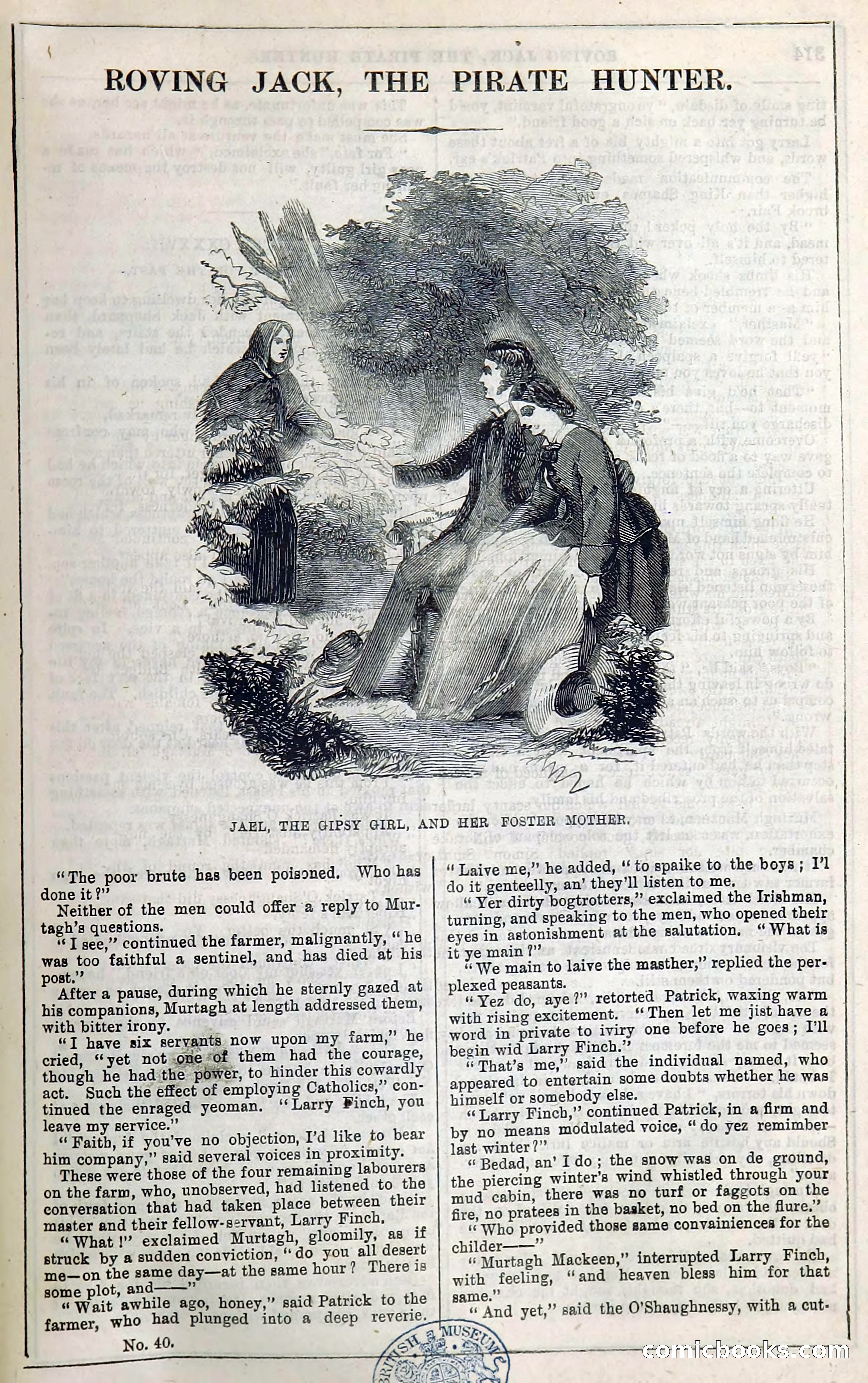
A restored page from Penny Dreadfuls, 1867. Page through the whole issue in the reader above.
📄 Transcribed text from this page (OCR, searchable)
Machine-transcribed from the original scan — historical spelling and the odd misread are preserved.
ROVING JACK, THE PIRATE HUNTER. JAEL, THE GIPSY GIRL, AND HER FOSTER MOTHER. “The poor brute has been poisoned. Who has done it?” Neither of the men could offer a reply to Mur- tagh’s questions. ““T see,” continued the farmer, malignantly, “he was too faithful a sentinel, and has died at his post.’ After a pause, during which he sternly gazed at his companions, Murtagh at length addressed them, with bitter irony. ; «“T have six servants now upon my farm,” he cried, “yet not one “of them had the courage, though he had the power, to hinder this cowardly act. Such the effect of employing Catholics,” con- tinued the enraged yeoman. ‘Larry Pinch, you leave my service.’ “Faith, if you’ve no objection, I’d like to bear him company,” said several voices in proximity. These were those of the four remaining labourers on the farm, who, unobserved, had listened to the conversation that had taken place between their master and their fellow-servant, Larry Finch, “What!” exclaimed Murtagh, gloomily, as if struck by a sudden conviction, “do you all desert me—on the same day—at the same hour? There is some plot, and——” “ Wait awhile ago, honey,” said Patrick to the farmer, who had plunged into a deep reverie. No. 40. “ Laive me,” he added, '‘ to spaike to the boys; I'l do it genteelly, an’ they’ll listen to me. “ Yer dirty bogtrotters,” exclaimed the Irishman, turning, and speaking to the men, who opened their eyes in astonishment at the salutation, “ What is it ye main ?” We main to laive the masther,” replied the per- plexed peasants. “Yez do, aye?” retorted Patrick, waxing warm with rising excitement. “ Then let me jist have a word in private to iviry one before he goes; I'll begin wid Larry Fine 172 “ That’s me,” said the individual named, who appeared to entertain some doubts whether he was himself or somebody else. “Larry Finch,” continued Patrick, in a firm and by no means modulated voice, “do yez remimber last winter?” “ Bedad, an’ ido; the snow was on de ground, the piercing winter's wind whistled through your mud cabin, there was no turf or faggots on the fire, no pratees in the basket, no bed on the flure.” ‘Who provided those same convainiences for the childer——” “Murtagh Mackeen,” interrupted Larry Finch, with feeling, “and heaven bless him for that game.” “ And yet,” said the O'Shaughnessy, with a cut- ——— en GOMMGIOOKSHEOM es