
Penny Dreadfuls, 1867 · page 287 of 300
Roving Jack, The Pirate Hunter — page 287: what you’re looking at
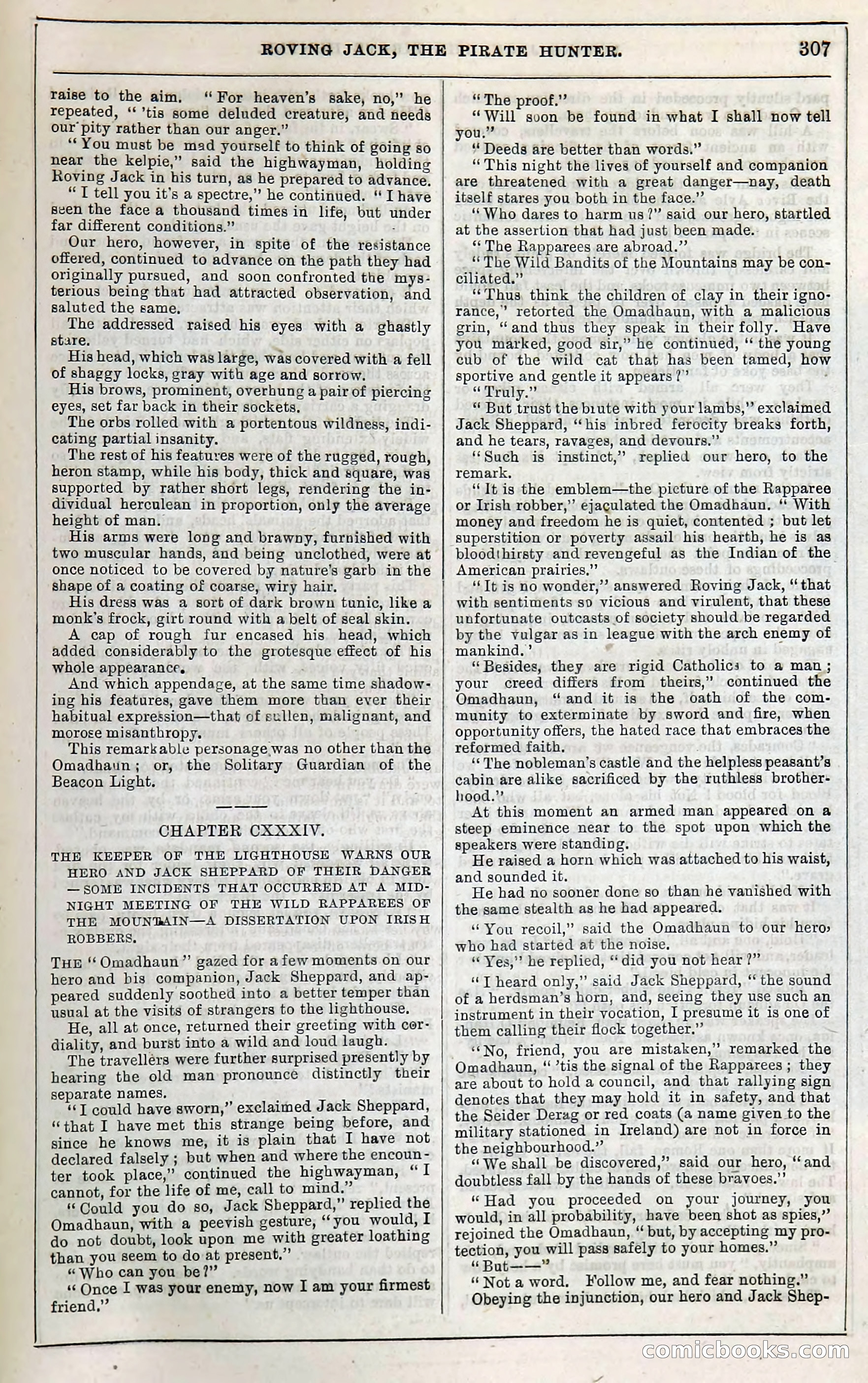
A restored page from Penny Dreadfuls, 1867. Page through the whole issue in the reader above.
📄 Transcribed text from this page (OCR, searchable)
Machine-transcribed from the original scan — historical spelling and the odd misread are preserved.
a EEE ee ROVING JACK, THE PIRATE HUNTER. 307 naan ee raise to the aim. ‘For heaven’s sake, no,” he repeated, ‘‘’tis some deluded creature, and needs our pity rather than our anger.” ‘“‘You must be mad yourself to think of going so near the kelpie,” said the highwayman, holding Roving Jack in his turn, as he prepared to advance. “T tell you it’s a spectre,” he continued. ‘ I have seen the face a thousand times in life, but under far different conditions.” Our hero, however, in spite of the resistance offered, continued to advance on the path they had originally pursued, and soon confronted the mys- terious being that had attracted observation, and saluted the same, : The addressed raised his eyes with a ghastly stare. His head, which was large, was covered with a fell of shaggy locks, gray with age and sorrow. His brows, prominent, overhung a pair of piercing eyes, set far back in their sockets. The orbs rolled with a portentous wildness, indi- cating partial insanity. The rest of his features were of the rugged, rough, heron stamp, while his body, thick and square, was supported by rather short legs, rendering the in- dividual herculean in proportion, only the average height of man. His arms were long and brawny, furnished with two muscular hands, and being unclothed, were at once noticed to be covered by nature’s garb in the shape of a coating of coarse, wiry hair. His dress was a sort of dark brown tunic, like a monk’s frock, girt round with a belt of seal skin. A cap of rough fur encased his head, which added considerably to the Beate eae effect. of his whole appearance, And which appendage, at the same time shadow- ing his features, gave them more than ever their habitual expression—that of sullen, malignant, and morose misanthropy. This remarkable personage was no other than the Omadhaun; or, the Solitary Guardian of the Beacon Light. CHAPTER CXXXIV. THE KEEPER OF THE LIGHTHOUSE WARNS OUR HERO AND JACK SHEPPARD OF THEIR DANGER — SOME INCIDENTS THAT OCCURRED AT A MID- NIGHT MEETING OF THE WILD RAPPAREES OF THE MOUNTAIN—A DISSERTATION UPON IRISH ROBBERS. THE ‘Omadhaun”’ gazed for afew moments on our hero and bis companion, Jack Sheppard, and ap- peared suddenly soothed into a better temper than usual at the visits of strangers to the lighthouse. He, all at once, returned their greeting with cer- diality, and burst into a wild and loud laugh. The travellérs were further surprised presently by hearing the old man pronounce distinctly their separate names, ‘‘T could have sworn,” exclaimed Jack Sheppard, “that I have met this strange being before, and since he knows me, it is plain that I have not declared falsely ; but when and where the encoun- ter took place,” continued the highwayman, HA cannot, for the life of me, call to mind.” ‘§ Could you do so, Jack Sheppard,” replied the Omadhaun, with a peevish gesture, “you would, I do not doubt, look upon me with greater loathing than you seem to do at present.” «“ Who can you be?” ‘Once I was your enemy, now I am your firmest friend,” “The proof,” sé Will soon be found in what I shall now tell you,’ “Deeds are better than words.” “This night the lives of yourself and companion are threatened with a great danger—nay, death itself stares you both in the face.” ‘‘ Who dares to harm us?” said our hero, startled at the assertion that had just been made. ‘**The Rapparees are abroad.” ‘The Wild Bandits of the Mountains may be con- ciliated.” ‘Thus, think the children of clay in their igno- rance,’ retorted the Omadhaun, with a malicious grin, “and thus they Speak in their folly. Have you marked, good sir,” he continued, “‘ the young cub of the wild cat that has been tamed, How sportive and gentle it appears?” Satay.” “ But trust the biute with your lambs,” exclaimed Jack Sheppard, “his inbred ferocity breaks forth, and he tears, ravages, and devours.” ‘Such is instinct,” replied our hero, to the remark, ‘It is the emblem—the picture of the Rapparee or Irish robber,” ejaculated the Omadhaun. * With money and freedom he is quiet, contented ; but let superstition or poverty assail his hearth, he is as bloodthirsty and revengetul as the Indian of the American prairies,’ ‘‘Tt is no wonder,” answered Roving Jack, ‘that with sentiments sp vicious and virulent, that these unfortunate outcasts of society should be regarded by the vulgar as in league with the arch enemy of mankind,’ “ Besides, they are rigid Catholics to a man; your creed differs from theirs,” continued the Omadhaun, ‘‘and it is the oath of the com- munity to exterminate by sword and fire, when opportunity offers, the hated race that embraces the reformed faith. “The nobleman’s castle and the helpless peasant’s cabin are alike sacrificed by the ruthless brother- hood.”’ At this moment an armed man appeared on a steep eminence near to the spot upon which the speakers were standing. He raised a horn which was attached to his waist, and sounded it. He had no sooner done so than he vanished with the same stealth as he had appeared. “You recoil,” said the Omadhaun to our hero» who had started at the noise. ‘‘Yes,”’ he replied, “did you not hear?” ‘“T heard only,” said Jack Sheppard, “the sound of a herdsman’s horn, and, seeing they use such an instrument in their vocation, I presume it is one of them calling their flock together.” ‘‘No, friend, you are mistaken,” remarked the Omadhaun, «tig the signal of the Rapparees; they are about to hold a council, and that rallying sign denotes that they may hold it in safety, and that the Seider Derag or red coats (a name given to the military stationed in Ireland) are not in force in the neighbourhood.” ‘We shall be discovered,”’ said our hero, ‘‘and doubtless fall by the hands of these bravoes. : “Had you proceeded on your journey, you would, in all probability, have been shot as spies,” rejoined the Omadhaun, “ but, by accepting my pro- tection, ya will pass safely to your homes.” “ Bat— “ Not a word: Follow me, and fear nothing.” Obeying the injunction, our hero and Jack Shep- con a - eemiicdoaks.com <SuGOin