
Penny Dreadfuls, 1867 · page 277 of 300
Roving Jack, The Pirate Hunter — page 277: what you’re looking at
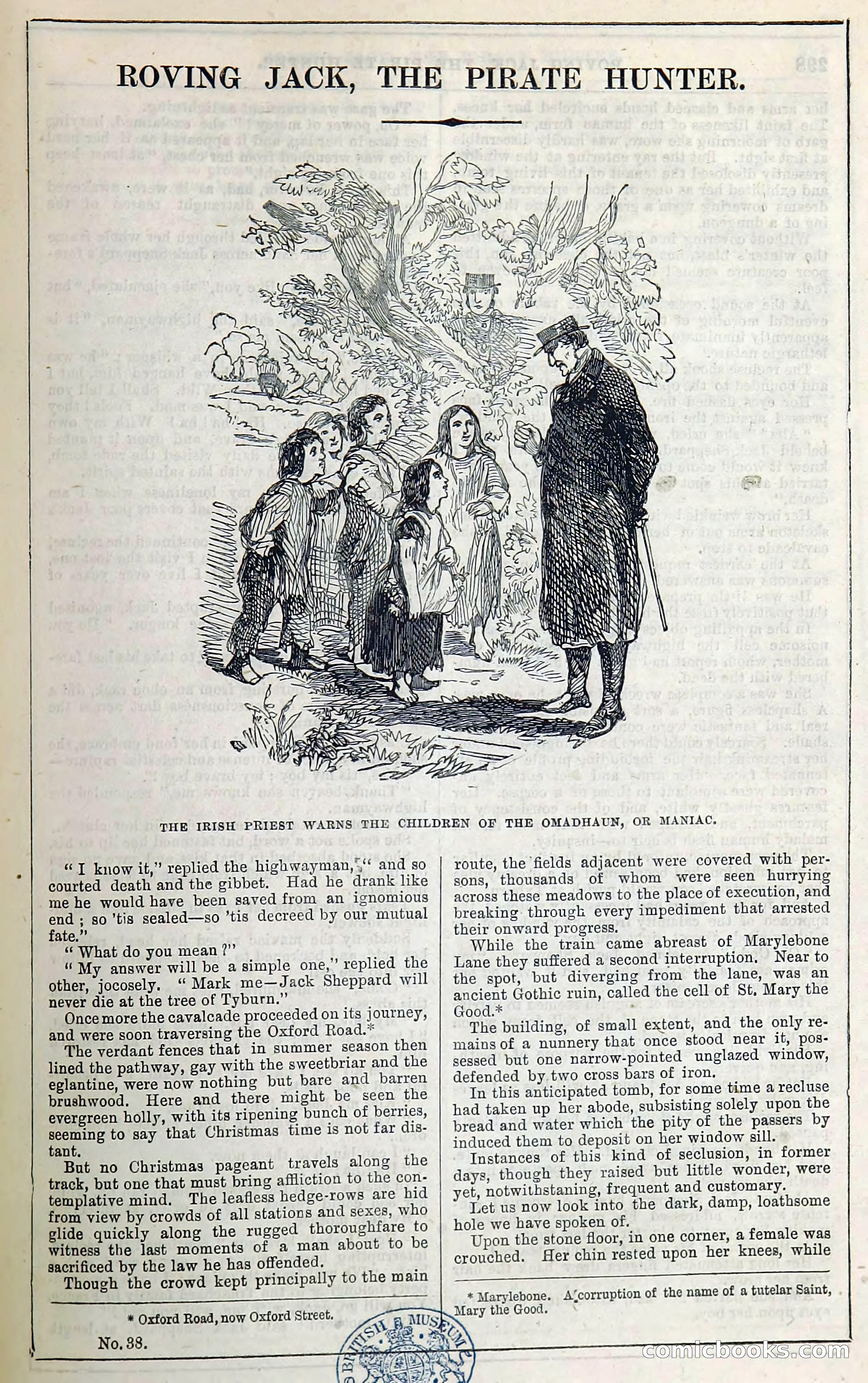
A restored page from Penny Dreadfuls, 1867. Page through the whole issue in the reader above.
📄 Transcribed text from this page (OCR, searchable)
Machine-transcribed from the original scan — historical spelling and the odd misread are preserved.
ROVING JACK, THE PIRATE HUNTER. NY \\ Nits a aw ASSN Q = N THE IRISH PRIEST WARNS THE CHILDREN OF THE OMADHAUN, OR MANIAC, “TJ know it,” replied the highwayman, ,‘‘ and so courted death and the gibbet. Had he drank like me he would have been saved from an ignomious oe go ’tis sealed—so ’tis decreed by our mutual ate,” “‘ What do you mean ?”’ “ My answer will be a simple one,’ replied the other, jocosely. ‘“ Mark me—Jack Sheppard will never die at the tree of Tyburn.” Once more the cavalcade proceeded on its journey, and were soon traversing the Oxford Road.* The verdant fences that in summer season then lined the pathway, gay with the sweetbriar and the eglantine, were now nothing but bare and barren brushwood. Here and there might be seen the evergreen holly, with its ripening bunch of berries, seeming to say that Christmas time is not far dis- tant. But no Christmas pageant travels along the track, but one that must bring affliction to the con- templative mind. The leafless hedge-rows are hid from view by crowds of all stations and sexes, who glide quickly along the rugged thoroughfare to witness the last moments of a man about to be sacrificed by the law he has offended. Though the crowd kept principally to the main es eeeeEeESFSsasaoO * Oxford Road, now Oxford Street. Mary the Good. a eet / BDI 7a \ route, the fields adjacent were covered with per- sons, thousands of whom were seen hurrying across these meadows to the place of execution, and breaking through every impediment that arrested their onward progress. While the train came abreast of Marylebone Lane they suffered a second interruption. Near to the spot, but diverging from the lane, was an ancient Gothic ruin, called the cell of St, Mary the Good.* The building, of small extent, and the only re- mains of a nunnery that once stood near it, pos- sessed but one narrow-pointed unglazed window, defended by two cross bars of iron. In this anticipated tomb, for some time a recluse had taken up her abode, subsisting solely upon the bread and water which the pity of the passers by induced them to deposit on her window sill. Instances of this kind of seclusion, in former days, though they raised but little wonder, were yet, notwithstaning, frequent and customary. Let us now look into the dark, damp, loathsome hole we have spoken of. Upon the stone floor, in one corner, a female was crouched. ler chin rested upon her knees, while Val) eee ee eee * Marylebone. A‘corruption of the name of a tutelar Saint,