
Penny Dreadfuls, 1867 · page 275 of 300
Roving Jack, The Pirate Hunter — page 275: what you’re looking at
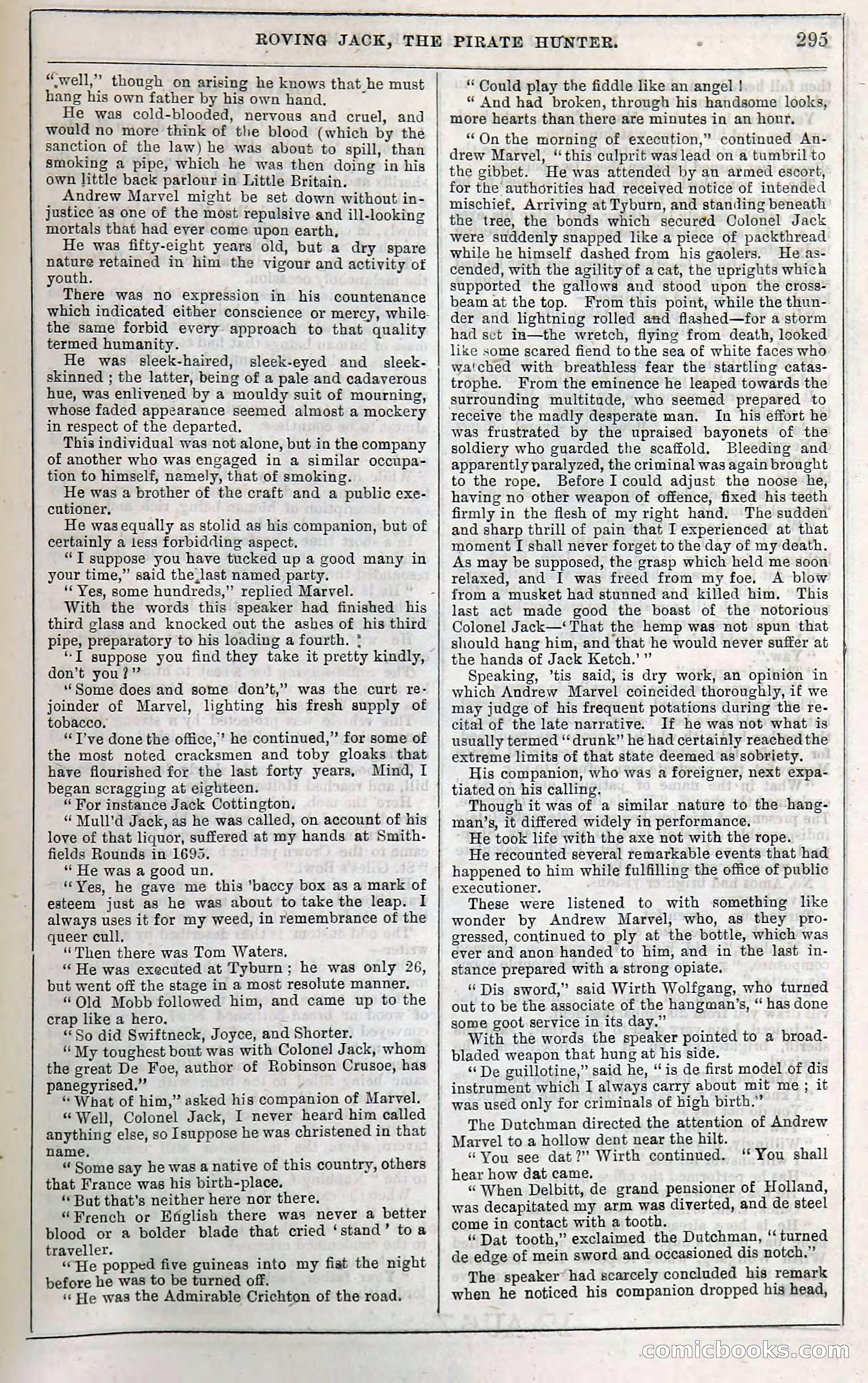
A restored page from Penny Dreadfuls, 1867. Page through the whole issue in the reader above.
📄 Transcribed text from this page (OCR, searchable)
Machine-transcribed from the original scan — historical spelling and the odd misread are preserved.
ROVING JACK, THE PIRATE HUNTER. “well,” though on arising he knows that he must hang his own father by his own hand. ’ He was cold-blooded, nervous and cruel, and would no more think of the blood (which by the sanction of the law) he was about to spill, than smoking a pipe, which he was then doing in his own little back parlour in Little Britain. _ Andrew Marvel might be set down without in- justice as one of the most repulsive and ill-looking mortals that had ever come upon earth, He was fifty-eight years old, but a dry spare nature retained in him the vigour and activity of youth. There was no expression in his countenance which indicated either conscience or mercy, while. the same forbid every approach to that quality termed humanity. He was sleek-haired, sleek-eyed and _ sleek- skinned ; the latter, being of a pale and cadaverous hue, was enlivened by a mouldy suit of mourning, whose faded appearance seemed almost a mockery in respect of the departed. This individual was not alone, but in the company of another who was engaged in a similar occupa- tion to himself, namely, that of smoking. He was a brother of the craft and a public exe- cutioner, He wasequally as stolid as his companion, but of certainly a tess forbidding aspect. “T suppose you have tucked up a good many in your time,”’ said the,last named party. ‘Yes, some hundreds,” replied Marvel. With the words this speaker had finished his third glass and knocked out the ashes of his third pipe, preparatory to his loading a fourth. ? “IT suppose you find they take it pretty kindly, don’t you?” ‘Some does and some don’t,” was the curt re- joinder of Marvel, lighting his fresh supply of tobacco. ‘““T’ve done the office,’ he continued,” for some of the most noted cracksmen and toby gloaks that have flourished for the last forty years, Mind, I began scragging at eighteen. “ For instance Jack Cottington. “ Mull’d Jack, as he was called, on account of his love of that liquor, suffered at my hands at Smith- fields Rounds in 1695. “He was a good un. “Yes, he gave me this ‘baccy box as a mark of esteem just as he was about to take the leap. I always uses it for my weed, in remembrance of the queer cull, ‘Then there was Tom Waters. “He was executed at Tyburn; he was only 26, but went off the stage in a most resolute manner, “Old Mobb followed him, and came up to the crap like a hero. “So did Swiftneck, Joyce, and Shorter. ‘“ My toughest bout was with Colonel Jack, whom the great De Foe, author of Robinson Crusoe, has panegyrised.” ; “ What of him,” asked his companion of Marvel. “Well, Colonel Jack, I never heard him called anything else, so Isuppose he was christened in that name, “ Some say he was a native of this country, others that France was his birth-place. ‘‘But that’s neither here nor there. “French or Efiglish there was never a better blood or a bolder blade that cried ‘stand’ toa traveller. é ‘He popped five guineas into my fiat the night before he was to be turned off. ‘«‘ He was the Admirable Crichton of the road. ‘ a a 295 Se a ee ee “Could play the fiddle like an angel ! * And had broken, through his handsome looks, more hearts than there are minutes in an hour, “On the morning of execution,” continued An- drew Marvel, ‘‘ this culprit was lead on a tumbril to the gibbet. He was attended by an armed escort, for the authorities had received notice of intended mischief, Arriving at Tyburn, and standing beneath the tree, the bonds which secured Colonel Jack were suddenly snapped like a piece of packthread while he himself dashed from his gaolers. He as- cended, with the agility of a cat, the uprights which supported the gallows and stood upon the cross- beam at the top. From this point, while the thun- der and lightning rolled and flashed—for a storm had set in—the wretch, flying from death, leoked like some scared fiend to the sea of white faces who wa'ched with breathless fear the startling catas- trophe. From the eminence he leaped towards the surrounding multitude, who seemed prepared to receive the madly desperate man. In his effort he was frustrated by the upraised bayonets of the soldiery who guarded the scaffold. Bleeding and apparently paralyzed, the criminal was again brought to the rope. Before I could adjust the noose he, having no other weapon of offence, fixed his teeth firmly in the flesh of my right hand. The sudden and sharp thrill of pain that I experienced at that moment I shall never forget to the day of my death. As may be supposed, the grasp which held me soon relaxed, and I was freed from my foe. A blow from a musket had stunned and killed him. This last act made good the boast of the notorious Colonel Jack—‘ That the hemp was not spun that should hang him, and that he would never suffer at the hands of Jack Ketch.’ ” Speaking, ’tis said, is dry work, an opinion in which Andrew Marvel coincided thoroughly, if we may judge of his frequent potations during the re- cital of the late narrative. If he was not what is usually termed ‘‘drunk” he had certainly reached the extreme limits of that state deemed as sobriety. His companion, who was a foreigner, next expa- tiated on his calling. Though it was of a similar nature to the hang- man’s, it differed widely in performance. He took life with the axe not with the rope. He recounted several remarkable events that had happened to him while fulfilling the office of public executioner. These were listened to with something like wonder by Andrew Marvel, who, as they pro- gressed, continued to ply at the bottle, which was ever and anon handed to him, and in the last in- stance prepared with a strong opiate. “Dis sword,” said Wirth Wolfgang, who turned out to be the associate of the hangman’s, “ has done some goot service in its day.” With the words the speaker pointed to a broad- bladed weapon that hung at his side. “De guillotine,” said he, “is de first model of dis instrument which I always carry about mit me; it was used only for criminals of high birth.” The Dutchman directed the attention of Andrew Marvel to a hollow dent near the hilt. “You see dat?” Wirth continued. ‘‘ You shall hear how dat came. “ When Delbitt, de grand pensioner of Holland, was decapitated my arm was diverted, and de steel come in contact with a tooth. “Dat tooth,” exclaimed the Dutchman, “turned de edge of mein sword and occasioned dis notch.” The speaker had scarcely concluded his remark when he noticed his companion dropped his head, EEE ne Ce mn CORN CoOMmicooo® S