
Penny Dreadfuls, 1867 · page 259 of 300
Roving Jack, The Pirate Hunter — page 259: what you’re looking at
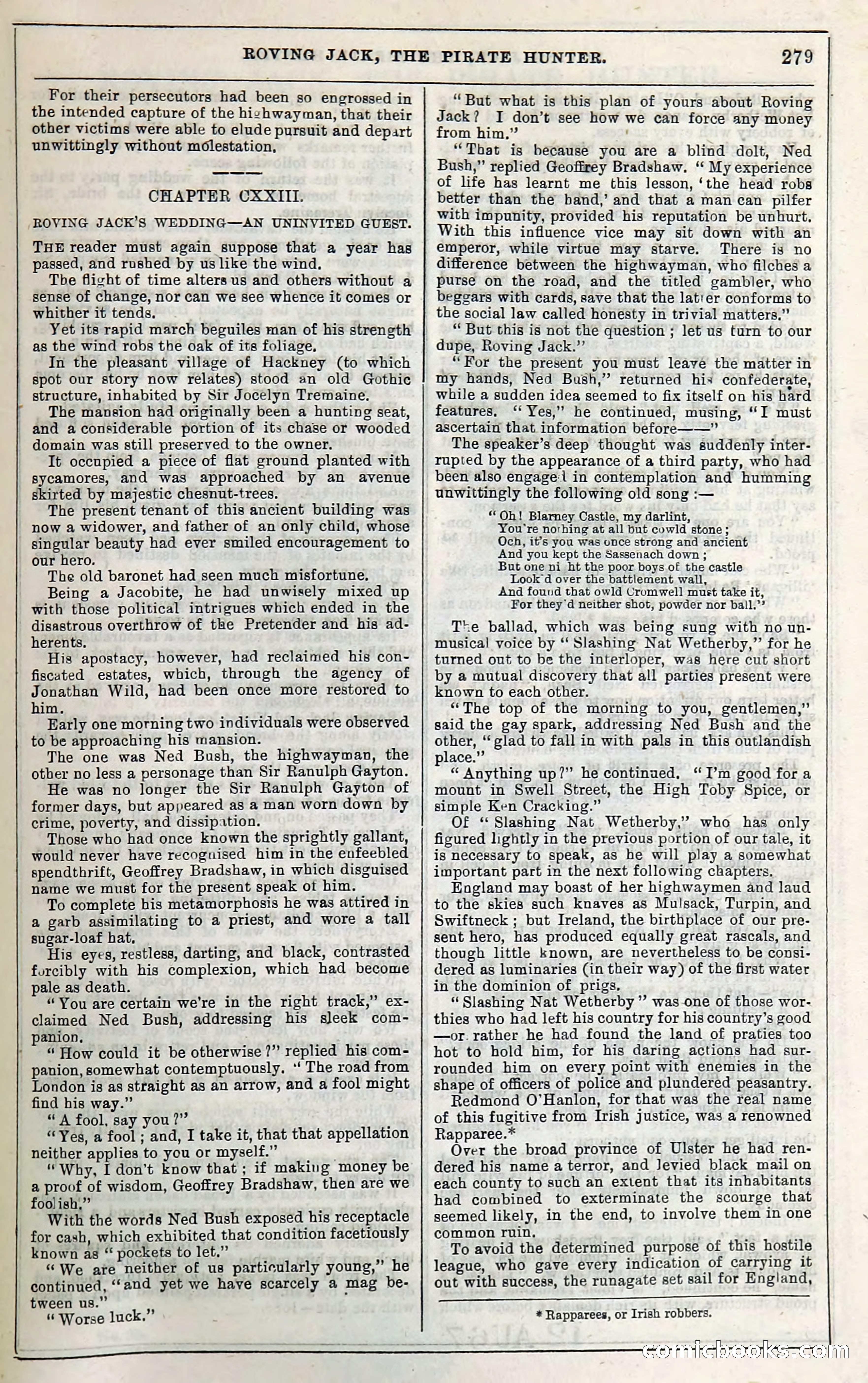
A restored page from Penny Dreadfuls, 1867. Page through the whole issue in the reader above.
📄 Transcribed text from this page (OCR, searchable)
Machine-transcribed from the original scan — historical spelling and the odd misread are preserved.
ROVING JACK, THE PIRATE HUNTER. 279 aa ee ee For their persecutors had been so engrossed in the intended capture of the hizhwayman, that their other victims were able to elude pursuit and depart unwittingly without molestation, CHAPTER CXXIII. ROVING JACK’S WEDDING—AN UNINVITED GUEST. THE reader must again suppose that a year has passed, and rushed by us like the wind. The flight of time alters us and others without a sense of change, nor can we see whence it comes or whither it tends. Yet its rapid march beguiles man of his strength as the wind robs the oak of its foliage, In the pleasant village of Hackney (to which spot our story now relates) stood an old Gothic structure, inhabited by Sir Jocelyn Tremaine. The mansion had originally been a hunting seat, and aconsiderable portion of its chase or wooded domain was still preserved to the owner. It occupied a piece of flat ground planted with sycamores, and was approached by an avenue skirted by majestic chesnut-trees. The present tenant of this ancient building was now a widower, and father of an only child, whose singular beauty had ever smiled encouragement to our hero. The old baronet had seen much misfortune, Being a Jacobite, he had unwisely mixed up with those political intrigues which ended in the disastrous overthrow of the Pretender and his ad- herents. His apostacy, however, had reclaimed his con- fiscated estates, which, through the agency of Jonathan Wild, had been once more restored to him. Early one morning two individuals were observed to be approaching his mansion. The one was Ned Bush, the highwayman, the other no less a personage than Sir Ranulph Gayton. He was no longer the Sir Ranulph Gayton of former days, but appeared as a man worn down by crime, poverty, and dissipation. Those who had once known the sprightly gallant, would never have recognised him in the enfeebled spendthrift, Geoffrey Bradshaw, in which disguised name we must for the present speak ot him. To complete his metamorphosis he was attired in a garb assimilating to a priest, and wore a tall sugar-loaf hat, His eyes, restless, darting, and black, contrasted forcibly with his complexion, which had become pale as death. “You are certain we're in the right track,” ex- claimed Ned Bush, addressing his sleek com- panion, “ How could it be otherwise?” replied his com- panion, somewhat contemptuously. ‘‘ The road from London is as straight as an arrow, and a fool might find his way.” “ A fool, say you?” “Yes, a fool ; and, I take it, that that appellation neither applies to you or myself.” “Why, I don’t know that ; if making money be a proof of wisdom, Geoffrey Bradshaw, then are we foo) ish,” With the words Ned Bush exposed his receptacle for cash, which exhibited that condition facetiously _ known as “ pockets to let.” “ We are neither of us particularly young,” he continued, “‘and yet we have scarcely a mag be- tween us.” “ Worse luck.” “But what is this plan of yours about Roving Jack? I don’t see how we can force any money from him,” “That is because you are a blind dolt, Ned Bush,” replied Geoffrey Bradshaw. ‘“ My experience of life has learnt me this lesson, ‘the head robs better than the hand,’ and that a man can pilfer with impunity, provided his reputation be unhurt. With this influence vice may sit down with an emperor, while virtue may starve. There is no difference between the highwayman, who filches a purse on the road, and the titled gambler, who beggars with cards, save that the latier conforms to the social law called honesty in trivial matters.” “ But this is not the question ; let us turn to our dupe, Roving Jack.” “For the present you must leave the matter in my hands, Ned Bush,” returned his confederate, while a sudden idea seemed to fix itself on his hard features. ‘Yes,’ he continued, musing, “I must ascertain that information before——” The speaker’s deep thought was suddenly inter- rupted by the appearance of a third party, who had been also engage:l in contemplation and humming unwittingly the following old song :— “Oh! Blarney Castle, my darlint, You're norhing at all but cowld stone; Och, it’s you was once strong and ancient And you kept the Sassenach down ; But one ni ht the poor boys of the castle Look d over the battlement wall, And found that owld Cromwell must take it, For they'd neither shot, powder nor ball.”? The ballad, which was being sung with no un- musical voice by “‘ Slashing Nat Wetherby,” for he turned out to be the interloper, was here cut short by a mutual discovery that all parties present were known to each other. “The top of the morning to you, gentlemen,” said the gay spark, addressing Ned Bush and the other, “‘glad to fall in with pals in this outlandish place.” “ Anything up?” he continued. “I’m good fora mount in Swell Street, the High Toby Spice, or simple Ken Cracking.” Of “Slashing Nat Wetherby,’ who has only figured lightly in the previous portion of our tale, it is necessary to speak, as he will play a somewhat important part in the next following chapters. England may boast of her highwaymen and laud to the skies such knaves as Mulsack, Turpin, and Swiftneck ; but Ireland, the birthplace of our pre- sent hero, has produced equally great rascals, and though little known, are nevertheless to be consi- dered as luminaries (in their way) of the first water in the dominion of prigs. “Slashing Nat Wetherby ” was one of those wor- thies who had left his country for his country’s good —or. rather he had found the land of praties too hot to hold him, for his daring actions had sur- rounded him on every point with enemies in the shape of officers of police and plundered peasantry. Redmond O’Hanlon, for that was the real name of this fugitive from Irish justice, was a renowned Rapparee.* Over the broad province of Ulster he had ren- dered his name a terror, and Jevied black mail on each county to such an extent that its inhabitants had combined to exterminate the scourge that seemed likely, in the end, to involve them in one common ruin. To avoid the determined purpose of this hostile league, who gave every indication of carrying it out with success, the runagate set sail for England, * Rapparees, or Irish robbers. E- —— Ss TIS OTT ECO)