
Penny Dreadfuls, 1867 · page 257 of 300
Roving Jack, The Pirate Hunter — page 257: what you’re looking at
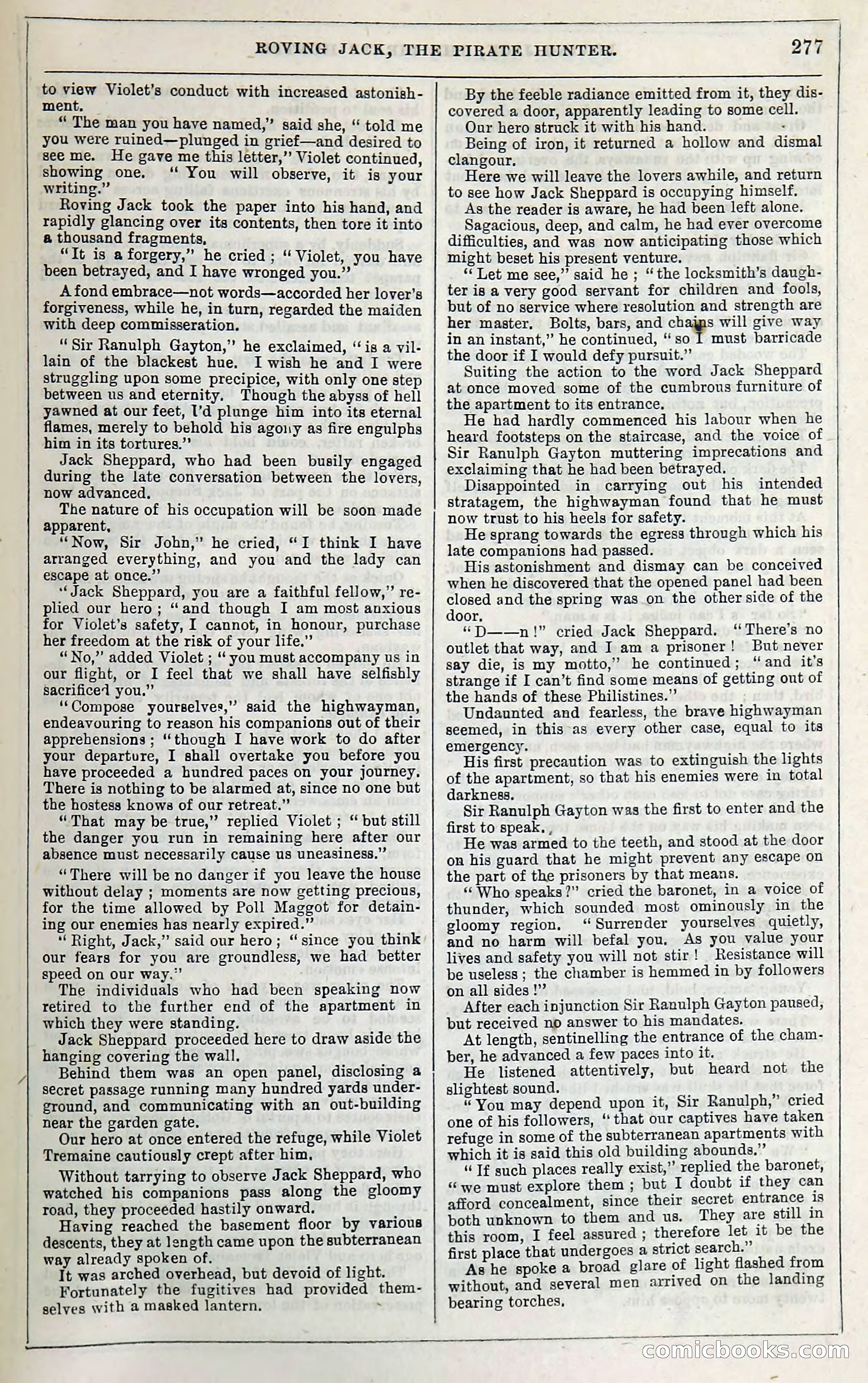
A restored page from Penny Dreadfuls, 1867. Page through the whole issue in the reader above.
📄 Transcribed text from this page (OCR, searchable)
Machine-transcribed from the original scan — historical spelling and the odd misread are preserved.
ROVING JACK, THE PIRATE HUNTER. eee nes eee ce 277 a wn Ee eg to pe Violet’s conduct with increased astonish- ment. | “ The man you have named,” said she, “ told me you were ruined—plunged in grief—and desired to seeme. He gave me this letter,” Violet continued, showing one, ‘‘ You will observe, it is your writing.” Roving Jack took the paper into his hand, and rapidly glancing over its contents, then tore it into a thousand fragments, “Tt is a forgery,” he cried ; ‘ Violet, you have been betrayed, and I have wronged you.” A fond embrace—not words—accorded her lover's forgiveness, while he, in turn, regarded the maiden with deep commisseration. “Sir Ranulph Gayton,” he exclaimed, “is a vil- lain of the blackest hue. I wish he and I were struggling upon some precipice, with only one step between us and eternity. Though the abyss of hell yawned at our feet, I'd plunge him into its eternal flames, merely to behold his agony as fire engulphs him in its tortures.”’ Jack Sheppard, who had been busily engaged during the late conversation between the lovers, now advanced. The nature of his occupation will be soon made apparent, “Now, Sir John,” he cried, “I think I have arranged everything, and you and the lady can escape at once.’’ “Jack Sheppard, you are a faithful fellow,” re- plied our hero; “and though I am most anxious for Violet’s safety, I cannot, in honour, purchase her freedom at the risk of your life.” “No,” added Violet ; ‘‘ you must accompany us in our flight, or I feel that we shall have selfishly Sacrificed you.” ‘‘Compose yourselves,” said the highwayman, endeavouring to reason his companions out of their apprehensions; “though I have work to do after your departure, I shall overtake you before you have proceeded a hundred paces on your journey, There is nothing to be alarmed at, since no one but the hostess knows of our retreat.”’ “That may be true,” replied Violet ; ‘ but still the danger you run in remaining here after our absence must necessarily cause us uneasiness.” “There will be no danger if you leave the house without delay ; moments are now getting precious, for the time allowed by Poll Maggot for detain- ing our enemies has nearly expired.” ‘Right, Jack,” said our hero; “since you think our fears for you are groundless, we had better speed on our way.” The individuals who had been speaking now retired to the further end of the apartment in which they were standing. Jack Sheppard proceeded here to draw aside the hanging covering the wall. Behind them was an open panel, disclosing a secret passage running many hundred yards under- ground, and communicating with an out-building near the garden gate. Our hero at once entered the refuge, while Violet Tremaine cautiously crept after him. Without tarrying to observe Jack Sheppard, who watched his companions pass along the gloomy road, they proceeded hastily onward. Having reached the basement floor by various descents, they at length came upon the subterranean way already spoken of. It was arched overhead, but devoid of light. Fortunately the fugitives had provided them- selves with a masked lantern. . ee By the feeble radiance emitted from it, they dis- covered a door, apparently leading to some cell. Our hero struck it with his hand. . Being of iron, it returned a hollow and dismal clangour. Here we will leave the lovers awhile, and return to see how Jack Sheppard is occupying himself. As the reader is aware, he had been left alone. Sagacious, deep, and calm, he had ever overcome difficulties, and was now anticipating those which might beset his present venture. ‘Tet me see,” said he ; “the locksmith’s daugh- ter is a very good servant for children and fools, but of no service where resolution and strength are her master, Bolts, bars, and chajps will give way in an instant,” he continued, “so I must barricade the door if I would defy pursuit.” Suiting the action to the word Jack Sheppard at once moved some of the cumbrous furniture of the apartment to its entrance, He had hardly commenced his labour when he heard footsteps on the staircase, and the voice of Sir Ranulph Gayton muttering imprecations and exclaiming that he had been betrayed. Disappointed in carrying out his intended stratagem, the highwayman found that he must now trust to his heels for safety. He sprang towards the egress through which his late companions had passed. His astonishment and dismay can be conceived when he discovered that the opened panel had been closed and the spring was on the other side of the door, “D——n!” cried Jack Sheppard. ‘“There’s no outlet that way, and I am a prisoner! But never say die, is my motto,” he continued; “and it’s strange if I can’t find some means of getting out of the hands of these Philistines.” Undaunted and fearless, the brave highwayman seemed, in this as every other case, equal to its emergency. His first precaution was to extinguish the lights of the apartment, so that his enemies were in total darkness. Sir Ranulph Gayton was the first to enter and the first to speak, , He was armed to the teeth, and stood at the door on his guard that he might prevent any escape on the part of the prisoners by that means. “Who speaks?” cried the baronet, in a voice of thunder, which sounded most ominously in the gloomy region. ‘Surrender yourselves quietly, and no harm will befal you. As you value your lives and safety you will not stir! Resistance will be useless ; the chamber is hemmed in by followers on all sides !” After each injunction Sir Ranulph Gayton paused, but received no answer to his mandates. At length, sentinelling the entrance of the cham- ber, he advanced a few paces into it. He listened attentively, but heard not the slightest sound. “You may depend upon it, Sir Ranulph,” cried one of his followers, ‘“ that our captives have taken refuge in some of the subterranean apartments with which it is said this old building abounds,” “Tf such places really exist,” replied the baronet, “we must explore them ; but I doubt if they can afford concealment, since their secret entrance 18 both unknown to them and us. They are still in this room, I feel assured ; therefore let it be the first place that undergoes a strict search.” As he spoke a broad glare of light flashed from without, and several men arrived on the landing bearing torches, Conmnicoooks.e©