
Penny Dreadfuls, 1867 · page 251 of 300
Roving Jack, The Pirate Hunter — page 251: what you’re looking at
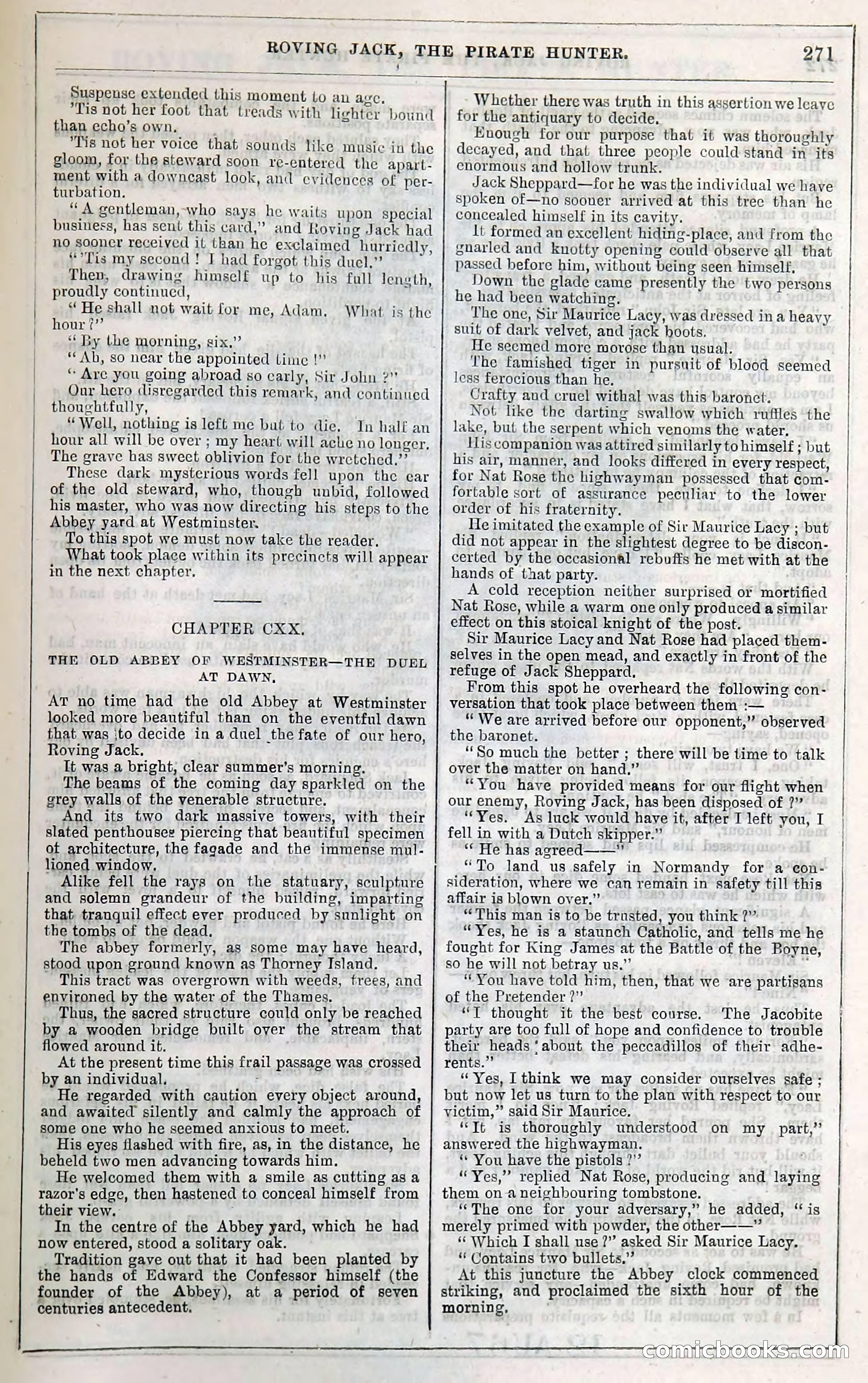
A restored page from Penny Dreadfuls, 1867. Page through the whole issue in the reader above.
📄 Transcribed text from this page (OCR, searchable)
Machine-transcribed from the original scan — historical spelling and the odd misread are preserved.
ete ROVING JACK, THE PIRATE HUNTER. ‘ cA. sR trae Suspense extended this moment to an age, Tis not her foot that treads with lighter bound than echo’s own. ‘Tis not her voice that sounds like music in the gloom, for the steward soon re-entered the apart- ment with a downecast look, and evidences of per- turbation. “A gentleman,-who says he waits upon special business, has sent this card,” and Roving Jack had no sooner received it than he exclaimed hurriedly, “Tis my second! J had forgot this duel.” Then, drawing himself up to his full Jensth, proudly continued, ee “ He shall not wait for me, Adam, hour ¢”’ “ By the morning, gix,”’ “Ah, so near the appointed Lime !” “ Are you going abroad so carly, Sir John 2” Our hero disregarded this remark, and continued thoughtfully, “Well, nothing is left me but to die, In half an hour all will be over ; my heart will ache no longer, The grave has sweet oblivion for the wretched.”’ These dark mysterious words fell upon the ear of the old steward, who, though unbid, followed his master, who was now directing his steps to the Abbey yard at Westminster. To this spot we must now take the reader. What took place within its precincts will appear in the next chapter. What is the CHAPTER CXX, THE OLD ABBEY OF WESTMINSTER—THE DUEL AT DAWN, AT no time had the old Abbey at Westminster looked more beautiful than on the eventful dawn that was jto decide in a duel the fate of our hero, Roving Jack. It was a bright, clear summer’s morning. The beams of the coming day sparkled on the grey walls of the venerable structure. And its two dark massive towers, with their slated penthouser piercing that beautiful specimen ot architecture, the fagade and the immense mul- lioned window. Alike fell the rays on the statuary, sculpture and solemn grandeur of the building, imparting that tranquil effect ever produced by sunlight on the tombs of the dead. The abbey formerly, as some may have heard, stood upon ground known as Thorney Island. This tract was overgrown with weeds, frees, and environed by the water of the Thames. Thus, the sacred structure could only be reached by a wooden bridge built oyer the stream that flowed around it. At the present time this frail passage was crossed by an individual. He regarded with caution every object around, and awaited silently and calmly the approach of some one who he seemed anxious to meet. _ His eyes flashed with fire, as, in the distance, he beheld two men advancing towards him. He welcomed them with a smile as cutting asa razor's edge, then hastened to conceal himself from their view. In the centre of the Abbey yard, which he had now entered, stood a solitary oak. _ Tradition gave out that it had been planted by the hands of Edward the Confessor himself (the founder of the Abbey), at a period of seven centuries antecedent. - ee re 271 Whether there was truth in this assertion we leaye for the antiquary to decide. Knough for our purpose that it was thoroughly decayed, and that three people could stand in its enormous and hollow trunk. Jack Sheppard—for he was the individual we have spoken of—no sooner arrived at this tree than he concealed himself in its cavity. lt formed an excellent hiding-place, and from the gnarled and knotty opening could observe all that passed before him, without being seen himself, Down the glade came presently the two persons he had been watching. The one, Sir Maurice Lacy, was dressed ina heavy suit of dark velvet, and jack boots. He seemed more morose than usual. The famished tiger in pursuit of blood seemed less ferocious than he. Crafty and cruel withal was this baronet. Not like the darting swallow which ruffles the lake, but the serpent which venoms the water, lis companion was attired similarly to himself ; but his air, manner, and looks differed in every respect, for Nat Rose the highwayman possessed that com- fortable sort of assurance pecnliar to the lower order of his fraternity. He imitated the example of Sir Maurice Lacy ; but did not appear in the slightest degree to be discon- certed by the occasional rebuffs he met with at the hands of that party. A cold reception neither surprised or mortified Nat Rose, while a warm one only produced a similar effect on this stoical knight of the post. Sir Maurice Lacy and Nat Rose had placed them- selves in the open mead, and exactly in front of the refuge of Jack Sheppard. From this spot he overheard the following con- versation that took place between them :— “We are arrived before our opponent,” observed the baronet. “So much the better ; there will be time to talk over the matter on hand.” “You have provided means for our flight when our enemy, Roving Jack, has been disposed of ?” ‘Yes. As luck would have it, after I left you, I fell in with a Dutch skipper.” ““ He has agreed——" “To land us safely in Normandy for a eon- sideration, where we can remain in safety till this affair is blown over.” “This man is to be trusted, you think ?” “Yes, he is a staunch Catholic, and tells me he fought for King James at the Battle of the Boyne, so he will not betray us.”’ “You have told him, then, that we are partisans of the Pretender ?” “T thought it the best course. The Jacobite party are too full of hope and confidence to trouble their heads ‘abont the peccadillos of their adhe- rents.”’ “Yes, [think we may consider ourselves safe ; but now let us turn to the plan with respect to our victim,” said Sir Maurice. “Tt is thoroughly understood on my _ part,’ answered the highwayman. ** You have the pistols ?” “Yes,” replied Nat Rose, producing and laying them on a neighbouring tombstone. ‘“The one for your adversary,” he added, “is merely primed with powder, the other——” ‘ Which I shall use?” asked Sir Maurice Lacy, “Contains two bullets.” At this juncture the Abbey clock commenced striking, and proclaimed the sixth hour of the morning, KL et