
Penny Dreadfuls, 1867 · page 247 of 300
Roving Jack, The Pirate Hunter — page 247: what you’re looking at
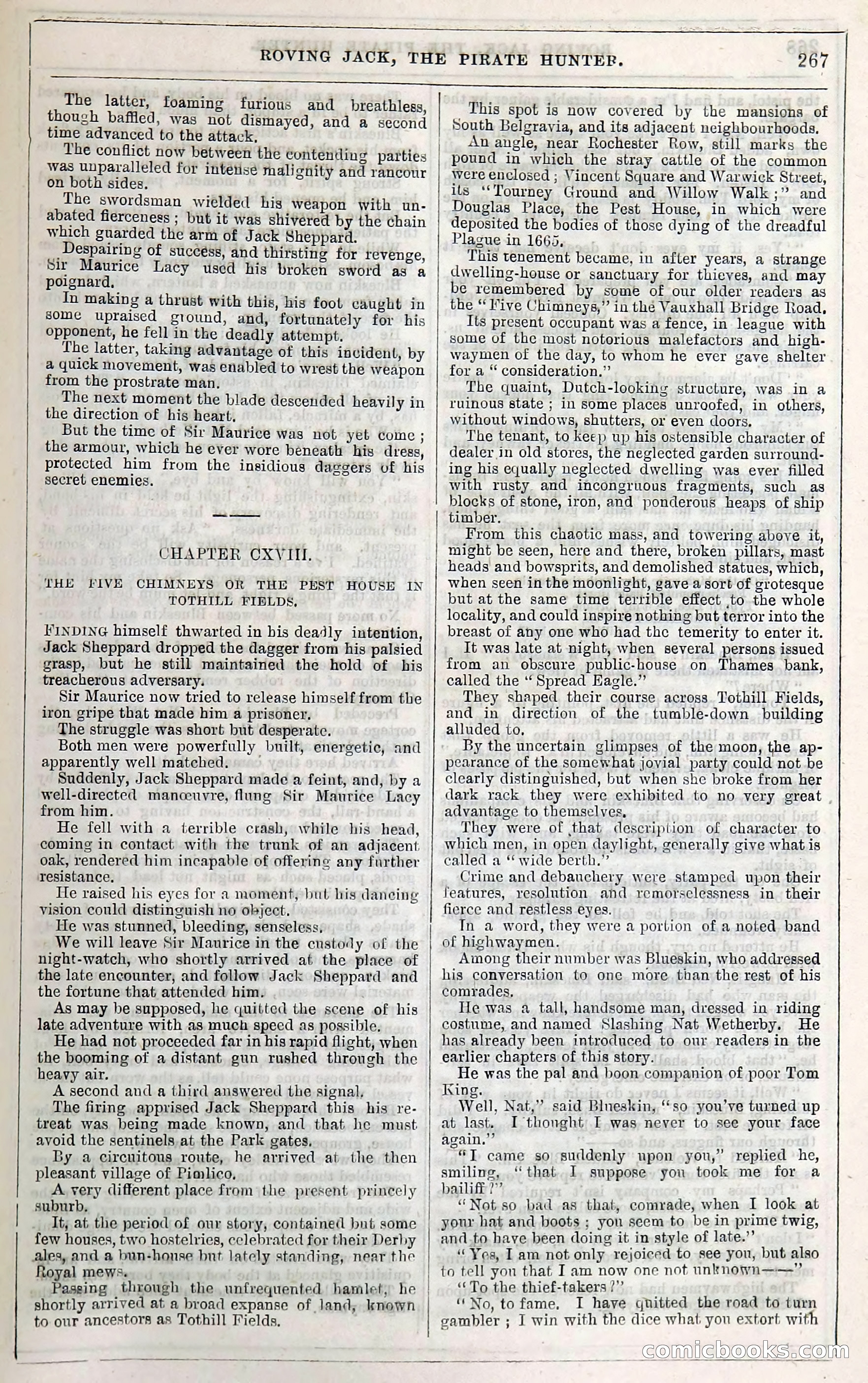
A restored page from Penny Dreadfuls, 1867. Page through the whole issue in the reader above.
📄 Transcribed text from this page (OCR, searchable)
Machine-transcribed from the original scan — historical spelling and the odd misread are preserved.
ROVING JACK, THE PIRATE HUNTER. 267 ts a a ll eee ae The latter, foaming furious and breathless, though baffled, was not dismayed, and a second time advanced to the attack, The conflict now between the contending was unparalleled for intetisé on both sides. The swordsman wielded his weapon with un- abated fierceness ; but it was shivered by the chain which guarded the arm of Jack Sheppard. _Despairing of succéss, and thirsting for revenge, Sir Maurice Lacy used his broken sword as a poignard, In making a thrust with this, his foot caught in some upraised ground, and, fortunately for his opponent, he fell in the deadly attempt. The latter, taking advantage of this invident, by a quick movement, was enabled to wrest the weapon from the prostrate man. The next moment the blade descended heavily in the direction of his heart, But the time of Sir Maurice was not yet come ; the armour, which he ever wore beneath his dress, protected him from the insidious daggers of his secret enemies. onte: parties malignity and rancour CHAPTER CXYVITI. THE FIVE CHIMNEYS OR THE PEST HOUSE IN TOTHILL FIBLDS, FINDING himself thwarted in bis deadly intention, Jack Sheppard dropped the dagger from his palsied grasp, but he still maintained the hold of his treacherous adversary. Sir Maurice now tried to release himself from the iron gripe that made him a prisoner. The struggle was short but desperate. Both men were powerfully built, energetic, and apparently well matched. Suddenly, Jack Sheppard made a feint, and, by a well-directed manceuvre, flung Sir Maurice Lacy from him. . He fell with a terrible crash, while his head, coming in contact with the trunk of an adjacent oak, rendered him incapable of offering any further resistance. He raised his eyes for a moment, but his dancing vision could distinguish no object. He was stunned, bleeding, senseless, We will leave Sir Maurice in the custody of the night-watch, who shortly arrived at the place of the late encounter, and follow Jack Sheppard and the fortune that attended him. As may be supposed, he quitted the scene of his late adventure with as much speed as possible, He had not proceeded far in his rapid flight, when the booming of a distant gun rushed through the heavy air. A second and a third answered the signal, The firing apprised Jack Sheppard this his re- treat was being made known, and that he must avoid the sentinels at the Park gates, By a circuitous route, he arrived at the then pleasant village of Pimlico, A. very (different place from the present. princely suburb, It, at. the period of our story, contained but some few houses, two hostelries, celebrated for their Derby ales, and a bun-honse but lately standing, near the Royal mews. Passing through the unfrequented hamlet, he shortly arrived at a broad expanse of land; known to our ancestors as Tothill Fields. This spot is now covered by the mansions of South Belgravia, and its adjacent neighbourhoods. An angle, near Rochester Row, still marks the pound in which the stray cattle of the common were enclosed ; Vincent Square and Warwick Street, ils ‘‘Tourney Ground and Willow Walk;” and Douglas Place, the Pest House, in which were deposited the bodies of those dying of the dreadful Plague in 1665, This tenement became, in after years, a strange dwelling-house or sanctuary for thieves, and may be remembered by some of our older readers as the “Five Chimneys,” in thé Vauxhall Bridge Road, Its present occupant was a fence, in league with some of the most notorious malefactors and high- waymen of the day, to whom he ever gave shelter for a “ consideration.” The quaint, Dutch-looking structure, was in a ruinous state ; in some places unroofed, in others, without windows, shutters, or even doors, The tenant, to keep up his ostensible character of dealer in old stores, the neglected garden surround- ing his equally neglected dwelling was ever filled with rusty and incongruous fragments, such as blocks of stone, iron, and ponderous heaps of ship timber. From this chaotic mass, and towering above it, might be seen, here and there, broken pillars, mast heads and bowsprits, and demolished statues, which, when seen in the moonlight, gave a sort of grotesque but at the same time terrible effect to the whole locality, and could inspire nothing but terror into the breast of any one who had the temerity to enter it. It was late at night, when several persons issued from an obscure public-house on Thames bank, called the ‘Spread Eagle.” They shaped their course across Tothill Fields, and in direction of the tumble-down building alluded to, By the uncertain glimpses of the moon, the ap- pearance of the somewhat jovial party could not be clearly distinguished, but when she broke from her dark rack they were exhibited to no very great advantage to themselves, They were of that description of character to which men, in open daylight, generally giye what is called a ‘wide berth.” Crime and debauchery were stamped upon their features, resolution and remorselessness in their fierce and restless eyes. In a word, they were a portion of a noted band of highwaymen. Among their number was Blueskin, who addressed his conversation to one more than the rest of his comrades, Ile was a tall, handsome man, dressed in riding costume, and named Slashing Nat Wetherby. He has already been introduced to our readers in the earlier chapters of this story. He was the pal and boon companion of poor Tom King. Well, Nat,” said Blneskin, ‘‘so you’ve turned up at last. I thonght I was never to see your face again.” *T came so suddenly upon you,’ replied he, smiling, ‘that I. suppose you took me for a bailiff?” “Not so bad as that, comrade, when I look at your hat and boots ; yon seem fo be in prime twig, and.to have been doing it in style of late.” ‘“Yos, Iam not only rejoiced to see you, but also to tell yon that I am now one not unknown——” “To the thief-takers ?”’ ‘No, tofame, I have qnitted the road to turn gambler ; I win with the dice what you extort with COMICMOOOKS:CO