
Penny Dreadfuls, 1867 · page 222 of 300
Roving Jack, The Pirate Hunter — page 222: what you’re looking at
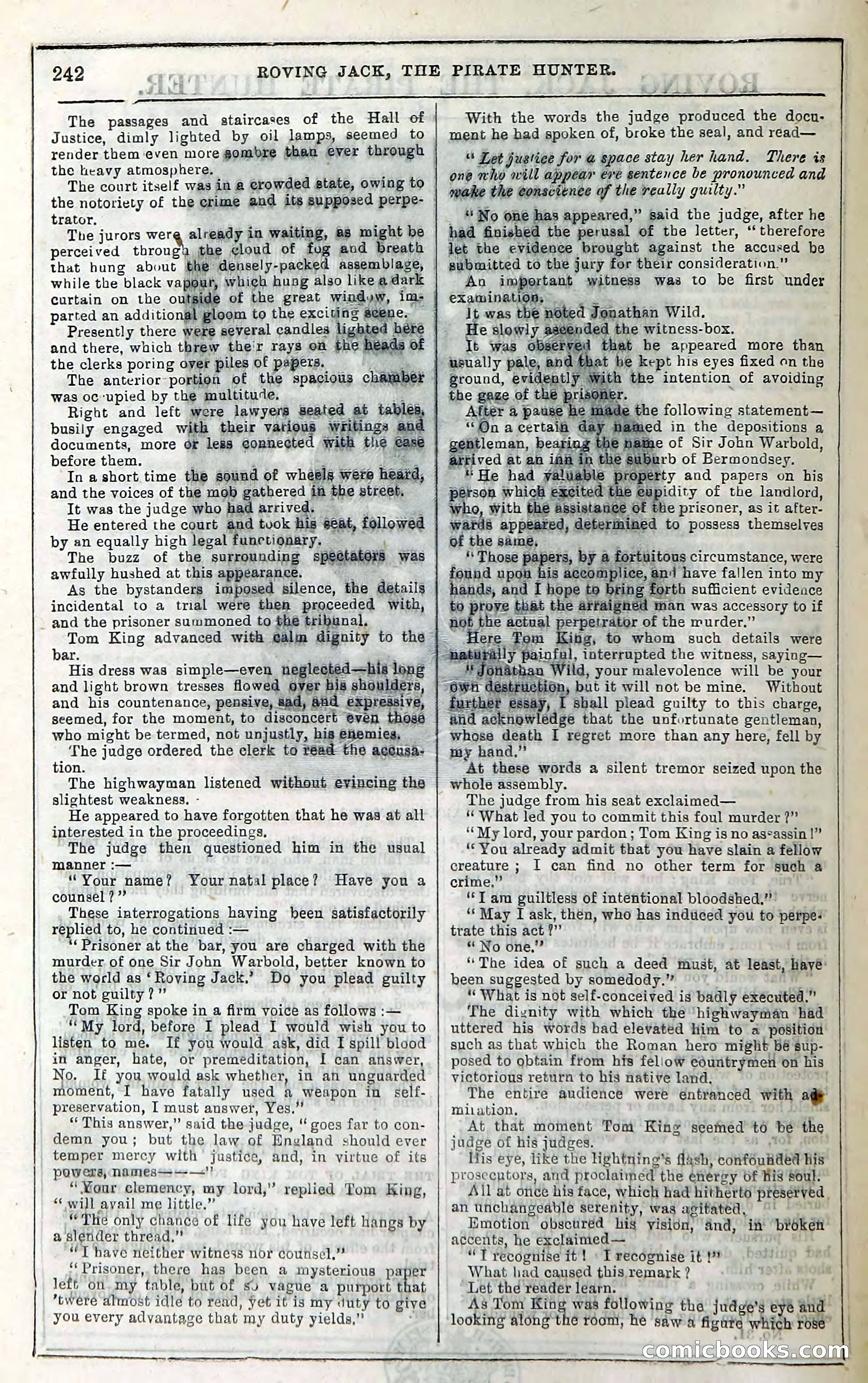
A restored page from Penny Dreadfuls, 1867. Page through the whole issue in the reader above.
📄 Transcribed text from this page (OCR, searchable)
Machine-transcribed from the original scan — historical spelling and the odd misread are preserved.
242 The passages and staircases of the Hall of Justice, dimly lighted by oil lamps, seemed to render them ‘even more gombre than ever through © the heavy atmosphere, , The court itself was in a crowded state, owing to the notoriety of the crime and its supposed perpe- trator, The jurors were already in waiting, as might be perceived through the cloud of fog aud breath that hung about the densely-packe assemblage, — while the black vapour, whieh hung also like a dark Curtain on the outs of the great windyw, im- parted an additional gloom to the exciting scene. Presently there were several candles li and there, which threw their rays on the he; the clerks poring oyer piles of ARCTS. ye The anterior-portion of the spacious chamber was ocupied by the multitude, Mii Right and left were lawyers seated at tablet busily engaged with their vatious Writings ap documents, more or less connected with the ease before them. " In a short time the sound of wheels were heard, and the voices of the mob gathered in the street. It was the judge who had arrived. 4 = He entered the court ape tuok his seat, followed by an equally high legalfunctionary. The buzz of the surrounding speetatoxys was awfully hushed at this appearance. ‘ As the bystanders imposed silence, the détails incidental to a trial were them proceeded with, and the prisoner summoned to $he tribunal, Tom King advanced with calm dignity to the {- bar. His dress was simple—even neglecte: his long and light brown tresses flowed Over iis g oulders, and his countenance, pensive, Sad, 84d expressive, seemed, for the moment, to disconcert @ven thos who might be termed, not unjustly, his €Hemies, The judge ordered the clerk to read the accusa- tion. The highwayman listened without eyincing the slightest weakness. - He appeared to have forgotten that he was at all interested in the proceedings, The judge then questioned him in the usual manner :— “Your name? Your natal place? Have you a counsel ?” These interrogations haying heen satisfactorily replied to, he continued :— ‘Prisoner at the bar, you are charged with the murder of one Sir John Warbold, better known to the world as ‘Roving Jack,’ Do you plead guilty or not guilty?” Tom King spoke in a firm voice as follows :— ‘My lord, before I plead I would wish you to listen to me. If you would ask, did I spill blood in anger, hate, or premeditation, I can answer, No. If you would ask whether, in an unguarded moment, I have fatally used 2 weapon in self- preservation, I must answer, Yes.”’ “ This answer,” said the judge, “ goes far to con- demn you; but the law of England should ever temper mercy with justice, and, in virtue of its powers, names——-—”’’ ‘Your clemency, my lord,” replied Tom King, “‘ will avail me little.” “The only chance of life you have left hangs by a slender thread,” “T have neither witness nor counsel,” ‘‘ Prisoner, there has been a mysterious paper left on my table, but of sv vague a purport that ’twere almost idle to read, yet it is my duty to give you every advantage that my duty yields,”’ : ie, ROVING JACK, THE PIRATE HUNTER. - — — * [ . ~ With the words the judge produced the docu- ment he had spoken of, broke the seal, and read— “ Let justice for @ space stay her hand. There is one rho will appear eve sentence be pronounced and wake the consctenee of the really guilty.” _ “No one has appeared,” said the judge, after he had finished the perusal of the letter, ‘‘ therefore let the evidence brought against the accused he submitted to the jury for their consideration.” An important witness was to be first under examination, — & It was the noted Jonathan Wild. e slowly aseended the witness-box. & was observed that he appeared more than usually pale, and that be kept his eyes fixed on the ground, evidently With the intention of avoiding the gaze of the prisoner. After a pause Be made atleman, bearin, e of Sir John Warbold, ; rived at an iff in the suburb of Bermondsey He had ya! 4 erty and papers on his person which excited the eupidity of the landlord, With pe Bpoistanee OF | the prisoner, as it after- wards appeared, determined to possess themselves \pers, by a fortuitous circumstance, were is BECO na ae fallen into my na I hope ti rir th sufficient evidence to P oye that the arraigned man was accessory to if no i ie actual ee of the murder.” bg, to whom such details were , lnterrupted the witness, saying— ld, your malevolence will be your w Without arther essay, Shall plead gnilty to this charge, nd acknowledge that the unfortunate gentleman, whose death I regret more than any here, fell by my hand,” 4 At these words a silent tremor seized upon the whole assembly. The judge from his seat exclaimed— What led you to commit this foul murder ?” ‘“My lord, your pardon ; Tom King is no assassin !” ‘“You already admit that you have slain a fellow creature ; I can find no other term for such a crime,” rf ‘Tam guiltless of intentional bloodshed.” | ‘May I ask, then, who has induced you to perpe! trate this act?” YS fi “ No one,” Ou “The idea of such a deed must, at least, Tiayé: been suggested by somedody.” |" any” ‘What is not self-conceived is badly executed.” The dignity with which the ‘highwayman had uttered his words bad elevated Him to a position’ such as that which the Roman hero might bé sup- posed to obtain from his feliow eduntrymen on his victorious return to his native land. Sager). The entire audience were éntranced with ade miation, TO) De asue At that moment Tom King seemed to be the judge of his judges. A OT 000) Iis eye, like the Hghtnine’s flash, confounded his prosecntors, and proclaimed the energy bf His Soul.” All at once his face, which had hitherto preserved an unchangeable serenity, wag agitated, motion obscured hig vision, and, in broken accents, he exclaimed— rig | “T recognise it! I recognise it? 9°) 79" What had caused this remark ? Ts ORS aust a pe a a ) tt s Tom King was following tha judge's e a he room, he saw 4 figite w ae SGOT pruebion, but it will not be mine. fs rth looking along t comicboo eee ee